

Element and Elementary Substance
If a substance is divided and no substance other than that substance is obtained, it is called an elementary substance or element.
Examples: Nitrogen (N₂), Hydrogen (H₂), Carbon (C), Sulfur (S), etc.
Compound and Compound Substance
Substances that, when broken down, produce two or more elements are called compounds or compound substances.
Examples: Water (H₂O), Carbon dioxide (CO₂), etc.
Remember:
i) Formation of HCl:
H₂ + Cl₂ → 2HCl
Molecule + Molecule → Compound
ii) Formation of H₂O:
2H₂ + O₂ → 2H₂O
Molecule + Molecule → Compound
iii) Formation of CuSO₄:
Cu²⁺ + SO₄²⁻ → CuSO₄
Atom + Radical → Compound
Atoms and Molecules
The term “atom” refers to the smallest possible part of an elemental substance. Generally, an atom cannot be broken down; that is, no physical or chemical change occurs within an atom.
\
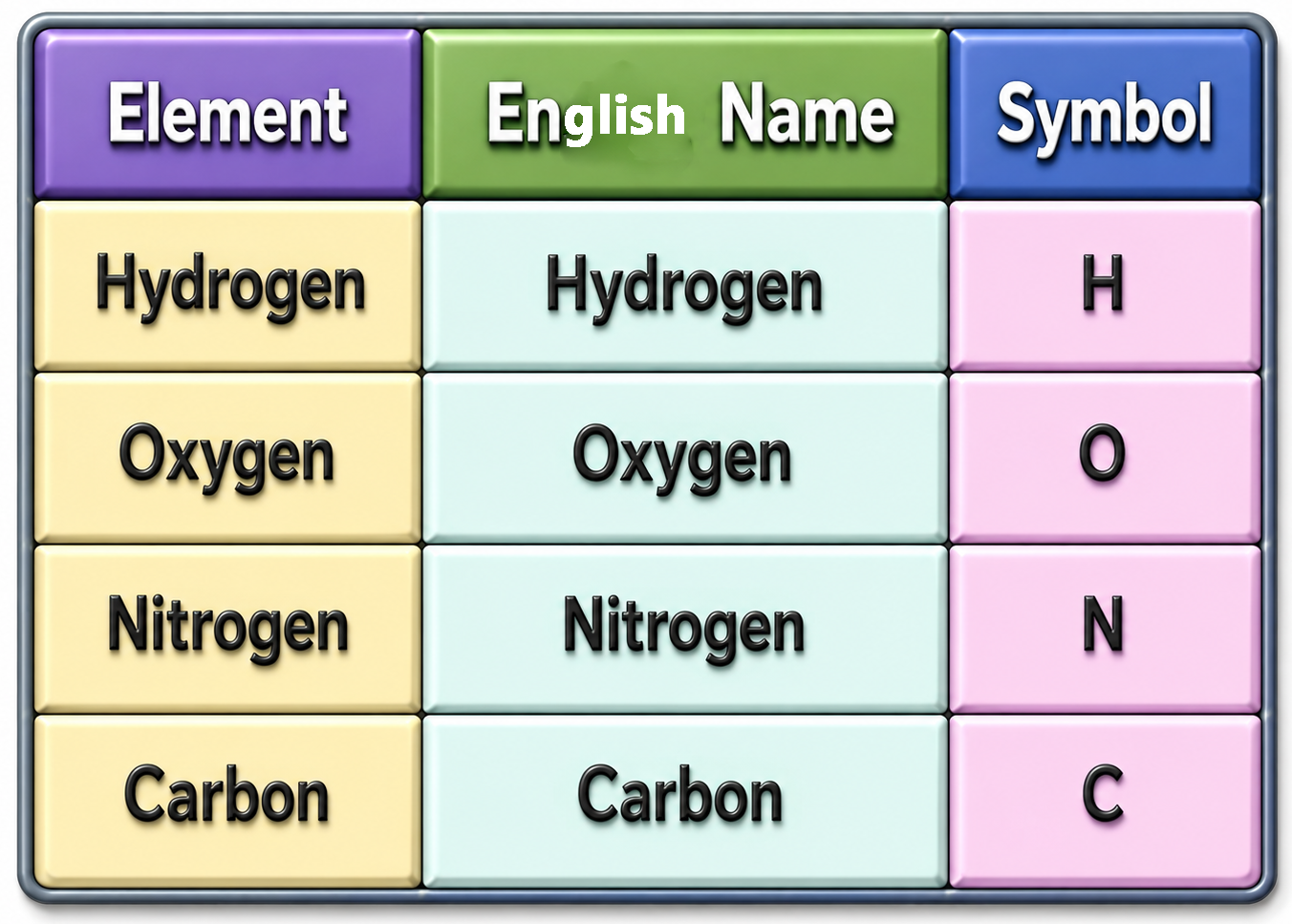
Examples: The symbol of Hydrogen is H, Oxygen is O, Carbon is C, etc.
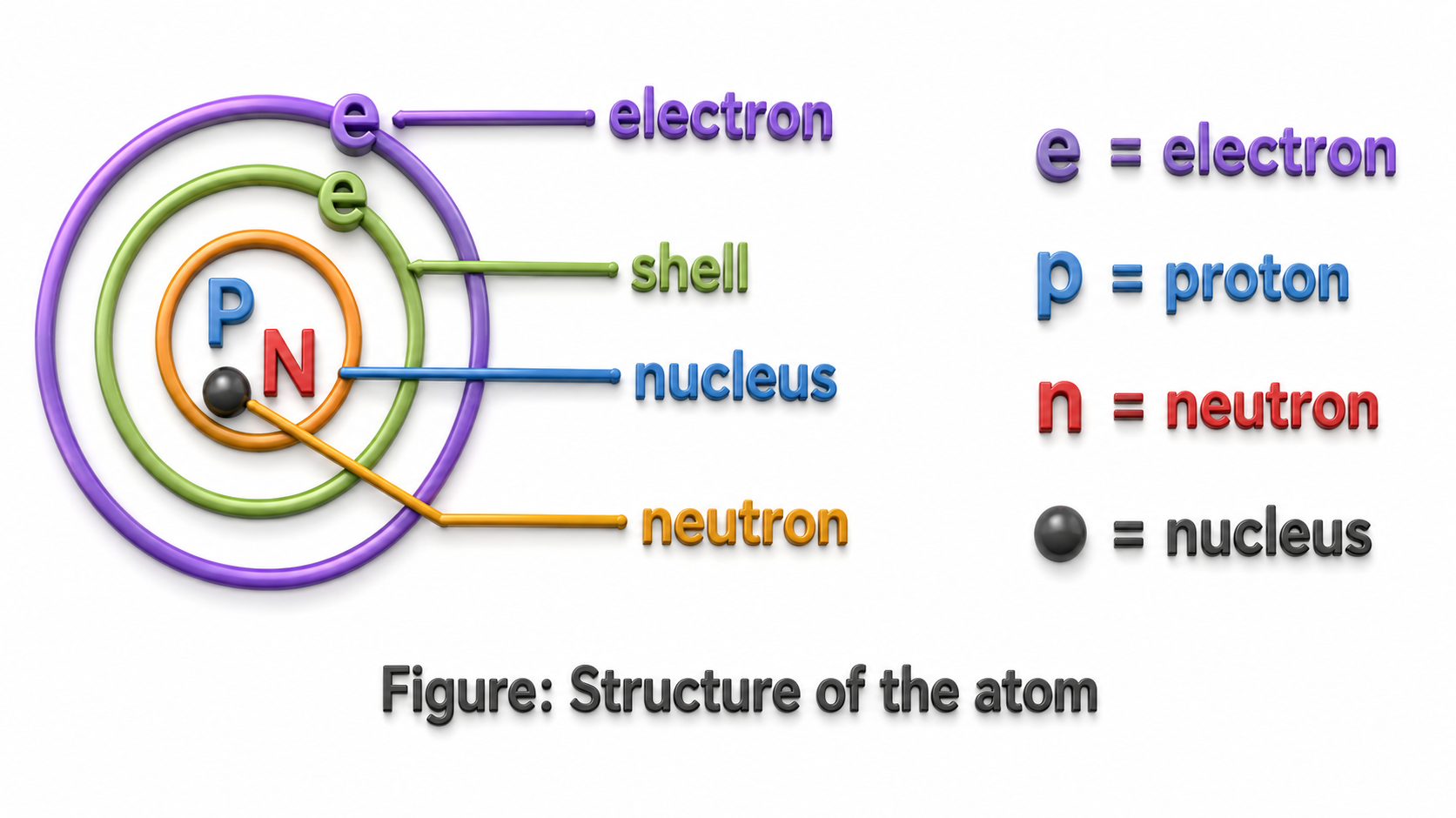
Remember: An atom contains three particles:
i) Electron (E)
ii) Proton (P)
iii) Neutron (N)
Structure of the Atom
Remember: The nucleus is located at the center of an atom.
➤ Charge of an electron = Negative
➤ Charge of a proton = Positive
➤ Neutron = Neutral (has no charge)
Molecule
A molecule is a larger unit of an elemental substance. A molecule is formed when two or more atoms combine together. Remember that a molecule is larger in size than an atom.
Examples: H₂, O₂, N₂, Cl₂, etc.
i) Formation of H₂:
H + H ⟶ H₂
Atom + Atom ⟶ Molecule
Remember:
i) One element = Atom
ii) Atom + Atom = Molecule
iii) Molecule + Molecule = Compound or Molecule
iv) Atom + Radical = Compound or Molecule
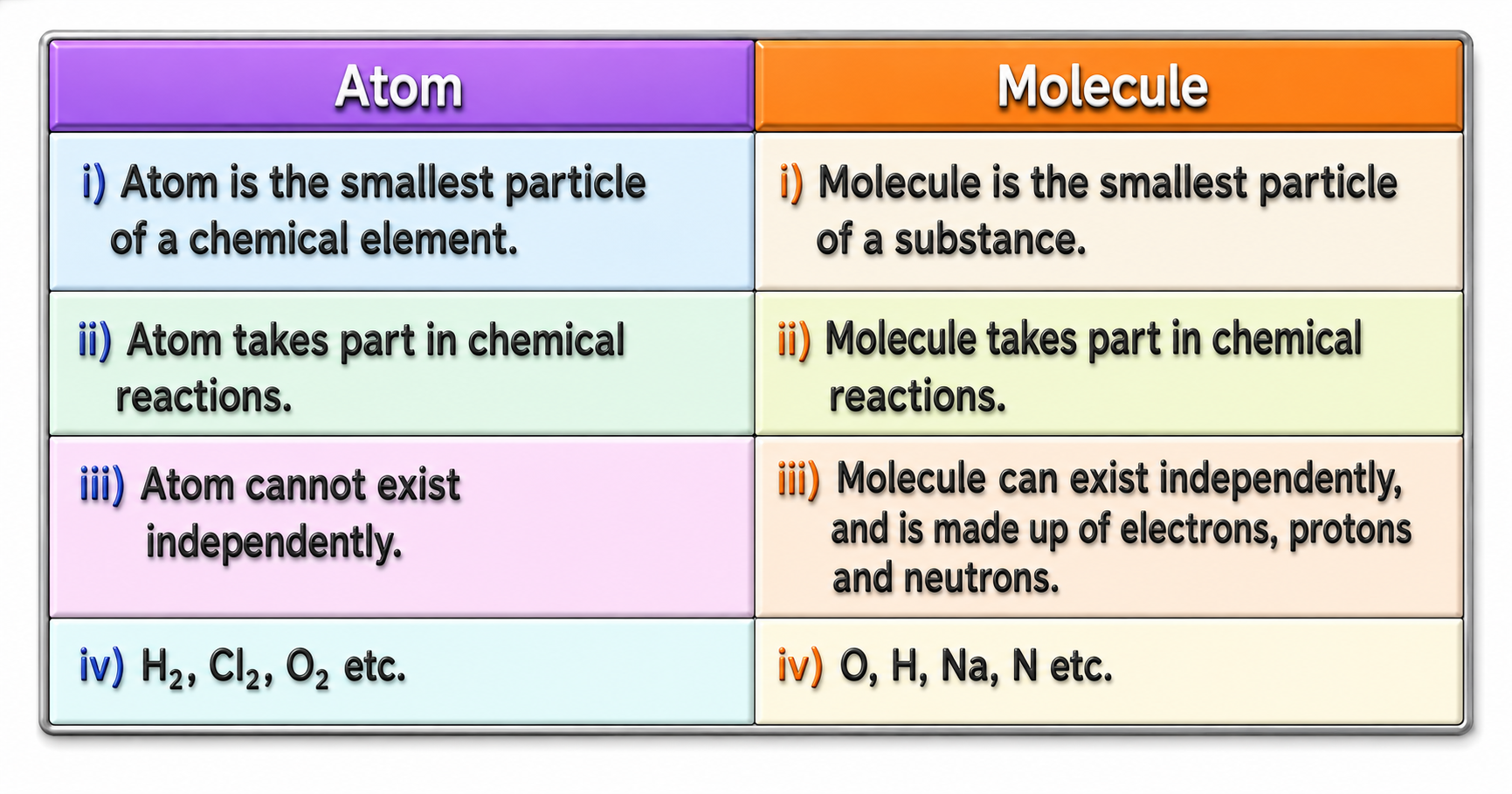
Differences Between Molecules and Atoms
Symbols of Elements
The abbreviated form of the English or Latin name of an element is called its symbol. A symbol is usually written using the first letter of the English name of the element.
Examples—
Formula
The abbreviated representation of an element or a compound substance is called a formula.
There are two types of information included in a formula:
i) Qualitative information
ii) Quantitative information
Examples: N₂, NH₃, H₂SO₄, HCl, etc.
Remember: The molecular mass of a substance can be determined from its formula.
Principal Quantum Number
The number that indicates the principal orbit or energy level of an atom is called the principal quantum number. Generally, English lowercase letters are used to represent orbitals.
Fundamental Particles (Elementary Particles)
Particles whose smallest constituent parts form atoms are called fundamental particles.
Based on their nature, fundamental particles are of three types:
i) Permanent particles
ii) Temporary particles
iii) Quantum particles
i) Permanent Particles
Particles that can be found freely in nature are called permanent particles.
Examples:
i) Electron
ii) Proton
iii) Neutron
ii) Temporary Particles
Particles that cannot be found freely in nature are called temporary particles.
Examples:
i) Neutrino
ii) Positron
iii) Meson
iv) Neutron
v) Photon
vi) Hyperantiproton
iii) Quantum Particles
Particles that possess characteristics intermediate between permanent and temporary particles are called quantum particles.
Examples:
i) Alpha particle
ii) Deuteron
Nucleus
At the center of an atom, there exists a heavy positively charged body. This heavy body is called the nucleus. Almost all of the mass of an atom is concentrated in the nucleus.
Structure of the Three Particles of an Atom
i) Electron
The electron is the smallest particle of matter. It was discovered by scientist J. J. Thomson in 1897. The charge of an electron is negative and is represented by −1 unit (e⁻). It is located outside the nucleus.
ii) Proton
The proton is the smallest particle of matter. It was discovered by scientist Ernest Rutherford in 1919. The charge of a proton is positive and is represented by +1 unit (p). It is located inside the nucleus.
iii) Neutron
The neutron is the smallest particle of matter. It was discovered by scientist James Chadwick in 1932. It is represented by N, has a neutral charge, and is located inside the nucleus
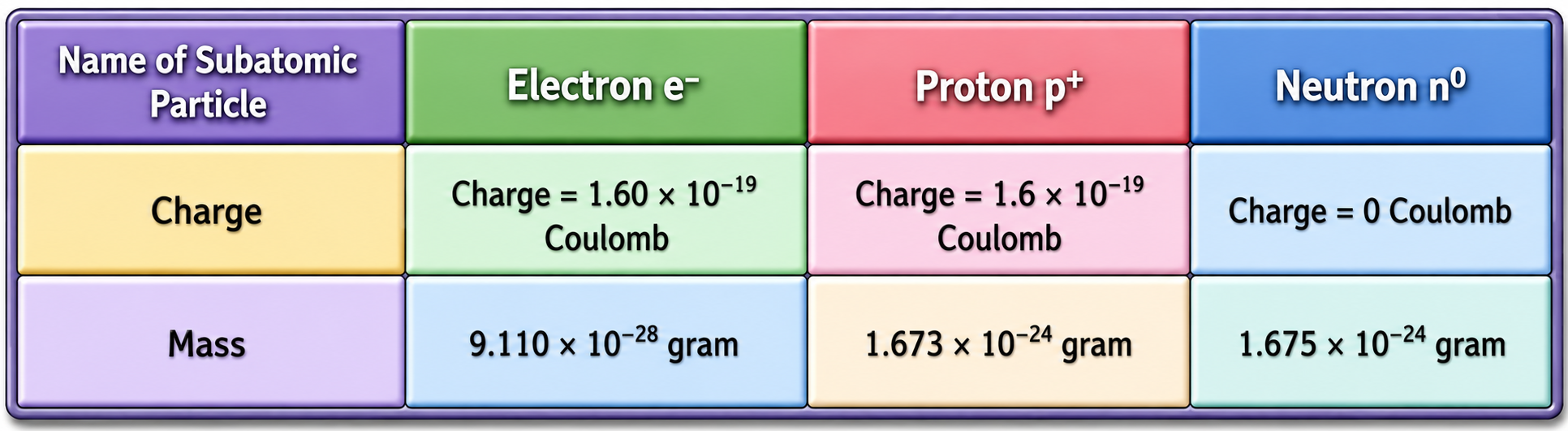
Names of Fundamental Particles
Atomic Number :
The number of protons present in the nucleus of an atom is called the atomic number. It is represented by Z.
Mass Number :
The total number of protons and neutrons present in the nucleus is called the mass number. It is represented by A.
Remember: If the number of protons is subtracted from the mass number, the number of neutrons is obtained. Neutron Number = Mass Number − Proton Number
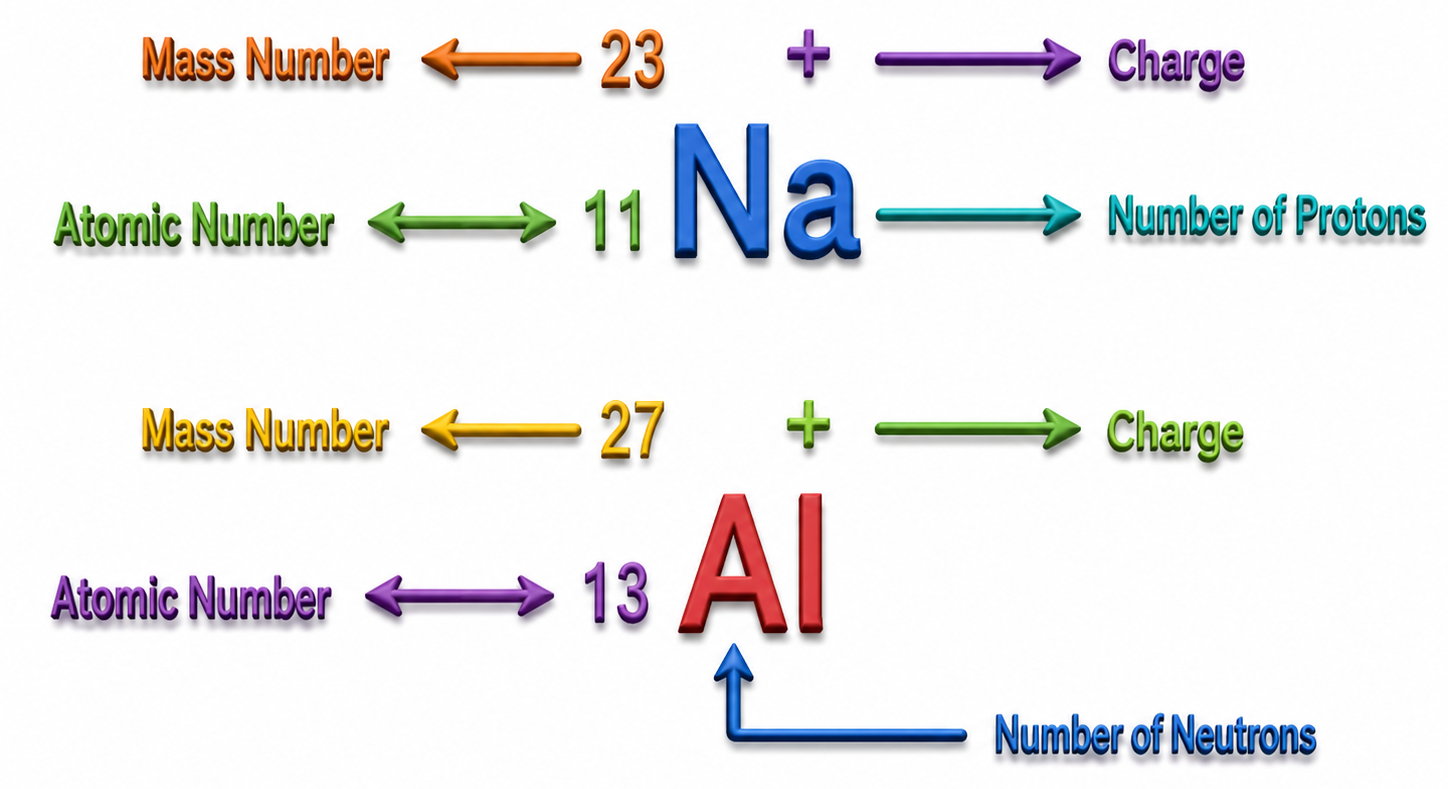
∴ Number of Neutrons = Mass Number − Atomic Number
= 27 − 13
= 14
Therefore, the number of neutrons in Aluminium = 14
Significance of the Symbol ¹⁶₈O²⁻
1. It is the symbol of an oxygen ion.
2. Its atomic number is 8, therefore the number of protons is 8.
3. Its mass number is 16, so the number of neutrons is: 16 − 8 = 8
4. It is a 2− charged anion, and its number of electrons is 10.
Method for Determining the Number of Electrons in the Ca²⁺ Ion
Calcium Atomic Number = 20
Calcium Proton Number = 20
Z = 20
n = +2
∴ Number of electrons in the Ca²⁺ ion = (Z ± n)
= (20 − 2)
= 18
Identification of an Atom
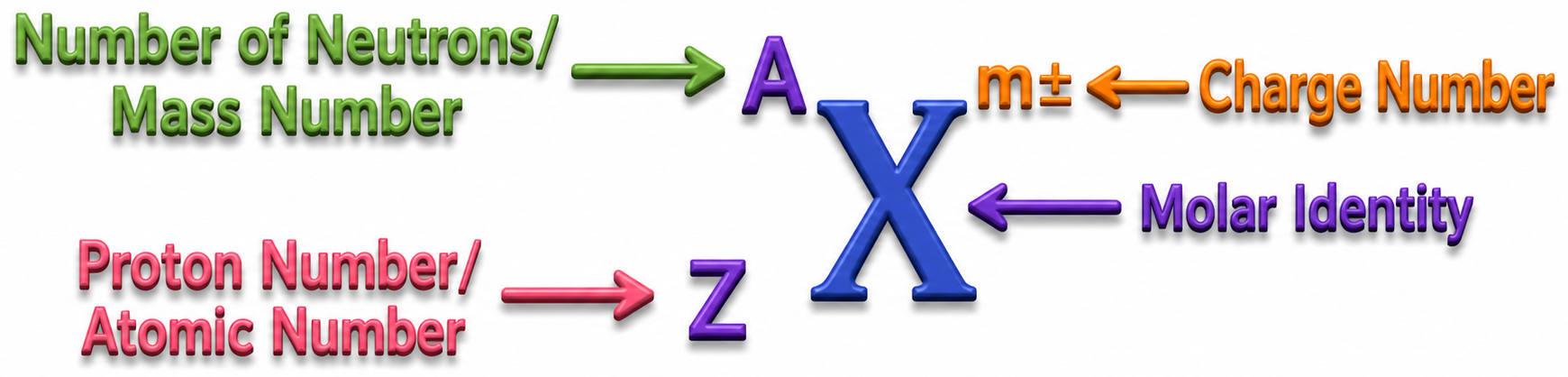
From the above element, the number of neutrons can be obtained by subtracting the proton number (Z) from the mass number (A).
Number of Neutrons = Mass Number − Proton Number = (A − Z)
Again, if the above element is electrically neutral, that is (m = 0), then the number of electrons of the element will be equal to the number of protons.
Number of Electrons = Number of Protons
If the element is charged, then the number of electrons of the element will be:
Number of Electrons = Number of Protons − Charge Number = Z − (±m).
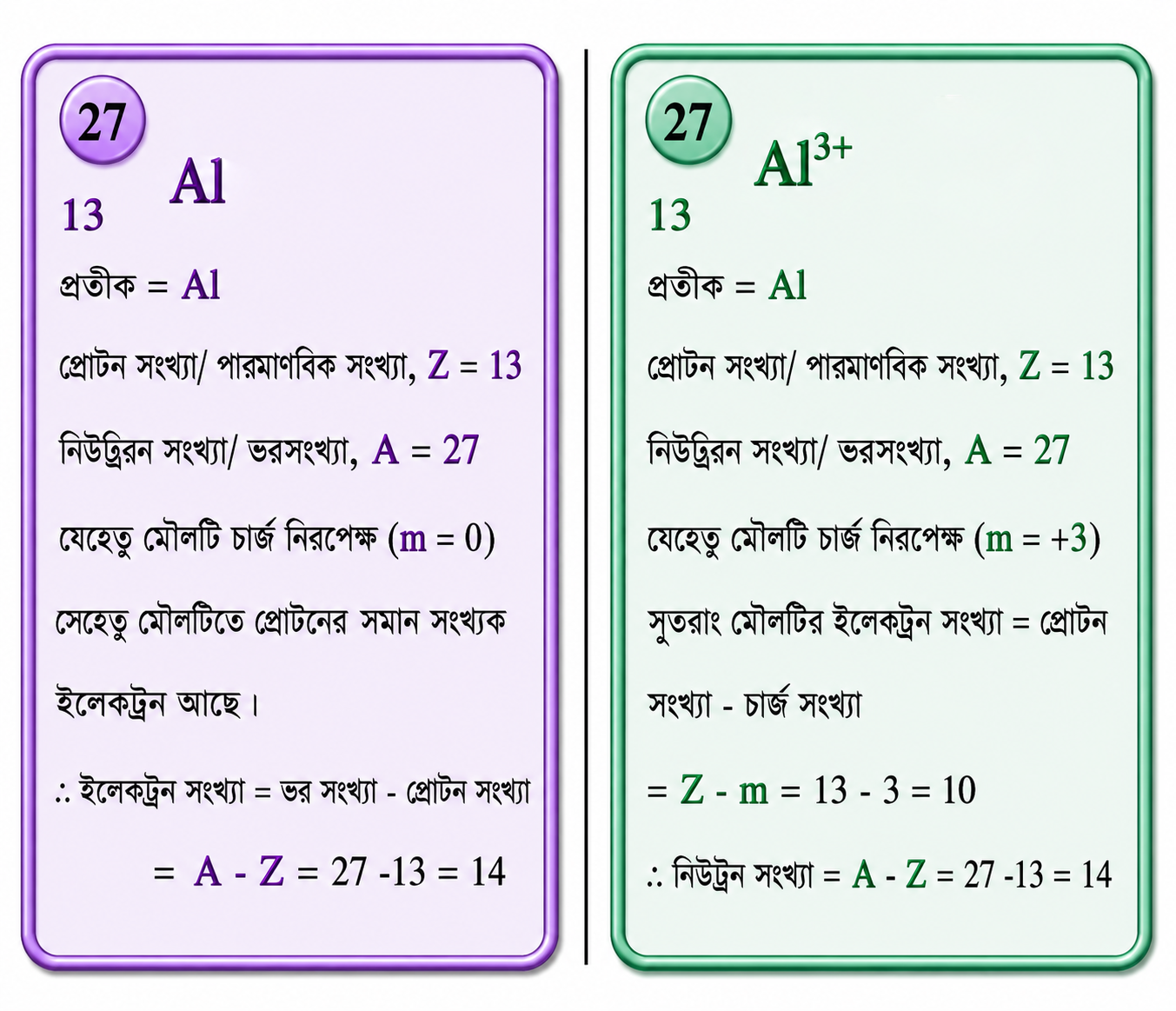
| ²⁷₁₃Al means : Symbol = Proton number / Atomic number, Z = 13 Nucleon number / Mass number, A = 27 Since the atom is electrically neutral (m = 0), the number of electrons is equal to the number of protons. ∴ Number of electrons = 13 Again, Number of neutrons = Mass number – Proton number = A − Z = 27 − 13 = 14 | ²⁷₁₃Al³⁺ means : Symbol = Proton number / Atomic number, Z = 13 Nucleon number / Mass number, A = 27 Since the atom has a positive charge (m = +3), therefore, Number of electrons = Proton number − Charge number = Z − m = 13 − 3 = 10 ∴ Number of neutrons = A − Z = 27 − 13 = 14 |
Electron, Proton, Neutron, and Nucleon Numbers for 
Here, X represents the symbol of the element.
m± indicates the magnitude and nature of the charge on the element.
Z represents the proton number (atomic number) of the element.
A represents the nucleon number (mass number) of the element.
Number of neutrons = Nucleon number − Proton number = A − Z
Number of electrons = Z − m
Formation of Atomic Spectrum
Electrons of a large number of atoms of an element absorb different amounts of energy from an energy source and move to various higher energy levels in the excited state
.
When the energy source is removed, these electrons can return to lower energy levels by emitting light energy.
If the emitted light rays are passed through a prism, an atomic spectrum is produced.
Why Do ₃Li and ₁₁Na Have the Same Valency?
Electron configuration of ₃Li:
1s² 2s¹
Electron configuration of ₁₁Na:
1s² 2s² 2p⁶ 3s¹
It can be seen that both ₃Li and ₁₁Na have one electron in their outermost shell.
Therefore, the valency of both elements is 1.
That is, ₃Li and ₁₁Na have the same valency.
Why Do ₁₂Mg and ₂₀Ca Have a Valency of 2?
Valency is the combining capacity of an atom of an element with an atom of another element during molecule formation.
Generally, for metals:
Valency = Number of electrons in the outermost energy level
Electron configuration of ₁₂Mg:
1s² 2s² 2p⁶ 3s²
Electron configuration of ₂₀Ca:
1s² 2s² 2p⁶ 3s² 3p⁶ 4s²
It can be seen that both ₁₂Mg and ₂₀Ca have two electrons in their outermost shell.
Therefore, the valency of both elements is 2.
Why Does Fe Have More Than One Valency?
⁵⁶₂₆Fe
Electron configuration of ₂₆Fe:
1s² 2s² 2p⁶ 3s² 3p⁶ 3d⁶ 4s²
(Since iron has 2 electrons in its outermost shell, the valency of Fe is 2. In this case, Fe loses 2 electrons and forms the positive ion Fe²⁺.)
Electron configuration of Fe²⁺:
1s² 2s² 2p⁶ 3s² 3p⁶ 3d⁶
Here, the 3d orbital contains 6 electrons. However, a 3d orbital with 5 electrons is relatively more stable.
Therefore, to attain a more stable state, Fe²⁺ can lose one more electron from the 3d orbital and form Fe³⁺.
Then the valency of Fe becomes 3.
Hence, Fe exhibits more than one valency (2 and 3).
Find the Number of Neutrons and Electrons in ²³₁₁Na
²³₁₁Na
Given:
Atomic number = Proton number, Z = 11
Mass number, A = 23
Number of neutrons
= Mass number − Atomic number
= 23 − 11
= 12
Again, since the atom is electrically neutral (m = 0), the number of electrons is equal to the number of protons.
∴ Number of electrons = Proton number = 11
Find the Number of Neutrons and Electrons in Al³⁺
²⁷₁₃Al³⁺
Solution:
For Al³⁺, the mass number A = 27 and the atomic number Z = 13.
∴ Number of neutrons = Mass number − Atomic number
= A − Z
= 27 − 13
= 14
Again, Al³⁺ is formed by removing 3 electrons from Al.
That is,
Al − 3e⁻ → Al³⁺
Atomic number = Proton number = 13
Charge number, m = +3
∴ Number of electrons in Al³⁺
= Proton number − Charge number
= Z − m
= 13 − 3
= 10
Find the Number of Neutrons, Protons, and Electrons in F⁻
¹⁹₉F⁻
Solution:
Mass number, A = 19
Atomic number, Z = 9
∴ Number of neutrons
= A − Z
= 19 − 9
= 10
Again, since the ion is negatively charged (m = −1), it contains (Z − m) electrons.
∴ Number of electrons
= Z − m
= 9 − (−1)
= 9 + 1
= 10
Also,
Number of protons = Atomic number = Z = 9
Find the Mass Number of A if the Electronic Configuration of A²⁺ is 2, 8, 18 and the Number of Neutrons is 35
Solution:
A²⁺ → 2, 8, 18
Therefore, the electronic configuration of A will be:
A → 2, 8, 18, 2
Hence, the atomic number/proton number of element A is:
2 + 8 + 18 + 2 = 30
Again, the number of neutrons in A is 35 (given).
∴ Mass Number of A = (Number of Protons + Number of Neutrons)
= (30 + 35)
= 65.
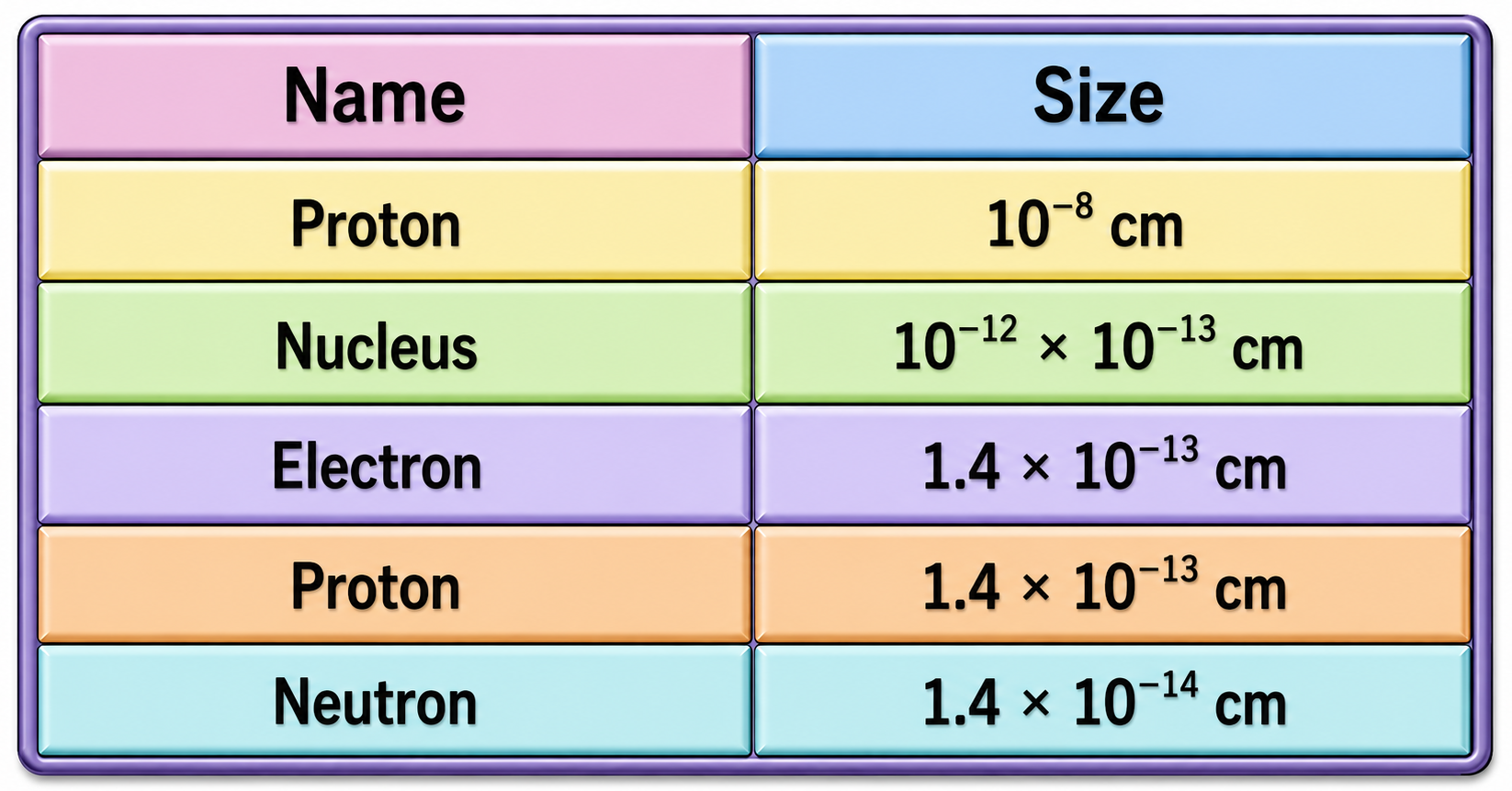
Information Related to the Size of an Atom
Rutherford’s Atomic Model
1. At the center of an atom, there exists a heavy positively charged body called the nucleus. Almost all of the mass of the atom is concentrated in the nucleus. Compared to the total volume of the atom, the volume of the nucleus is extremely small.
2. Because the nucleus possesses positive charge and mass, the center of mass of the atom is almost entirely located there.
3. Just as all the planets in the solar system revolve around the Sun, electrons continuously revolve around the nucleus. The number of negatively charged electrons outside the nucleus is equal to the number of positively charged protons in the nucleus. Therefore, the atom remains electrically neutral.
4. Due to their motion, two types of forces act on the electrons: the centripetal force acting between the nucleus and the electrons, and the centrifugal force produced by their rotation. These two forces are equal in magnitude and opposite in direction.
Limitations of Rutherford’s Atomic Model
1. The planets in the solar system are electrically neutral, whereas electrons carry a negative charge. In the solar system, gravitational force exists between bodies, but between the nucleus and electrons there is an electrostatic force of attraction. Therefore, the solar-system analogy is not fully applicable to the atom.
2. According to Maxwell’s electromagnetic theory, a charged particle moving in a circular path continuously radiates energy. As a result, electrons should lose energy and eventually collapse into the nucleus. Therefore, Rutherford’s atomic model cannot explain the stability of atoms.
3. This model provides no information about the shape, size, or arrangement of the electron orbits.
এখানে,
n = 2
h = 6.626 × 10⁻³⁴
π = 3.1416
Angular Momentum
According to Bohr’s atomic model, the angular momentum of an electron is given by: 
Where,
m = Mass of the electron
v = Velocity of the electron
r = Radius of the orbit in which the electron revolves
h = Planck’s constant
n = Principal energy level (principal quantum number)
Note:
h = Planck’s constant = 6.626 × 10⁻³⁴ m²kg/s
� What is the Angular Momentum of an Electron Revolving in the 2nd Energy Level?
Solution


here,
n = 2
h = 6.626 × 10⁻³⁴
π = 3.1416
Determination of Absorbed or Emitted Energy
Amount of Absorbed or Emitted Energy :
or, 

here,
C = 3 × 10⁸ ms⁻¹
h = Planck’s constant
λ = Wavelength of the absorbed or emitted radiation = Frequency of the absorbed or emitted radiation
1. An electron moves from the 2nd energy level to the 3rd energy level. If radiation of wavelength 450 nm is involved, how much energy is absorbed?
Amount of absorbed energy:

here,
C = 3 × 10⁸ ms⁻¹
h = 6.626 × 10⁻³⁴
λ = 450nm 
ν = Frequency of the absorbed or emitted radiation
2. An electron moves from the 2nd energy level to the 3rd energy level. If radiation with a frequency of 7.3 × 10¹⁴ Hz is involved, how much energy is absorbed?
We know,
Amount of absorbed energy is :


Here,
h = 6.626 × 10⁻³⁴ m²kg/s
ν = 7.3 × 10¹⁴ HZ
3. An electron moves from the 2nd energy level to the 5th energy level. If radiation of wavelength 500 nm is involved, how much energy is absorbed?
The amount of absorbed energy is:


Here,
C = 3 × 10⁸ ms⁻¹
h = 6.626 × 10⁻³⁴ m²kg/s
λ = 500nm 
E = ?
4. An electron moves from the 5th energy level to the 2nd energy level. If the energy involved is 3.976 × 10⁻¹⁹ J, find the wavelength of the light.
We know,
or, 


Here,
C = 3 × 10⁸ ms⁻¹
h = 6.626 × 10⁻³⁴ m²kg/s
E = 3.976 × 10⁻¹⁹ J
λ = ?
5. Determine the Angular Momentum of the Last Electron of F
Solution:
Therefore, the last electron is in the 2nd energy level (n = 2).
The angular momentum is given by:


Here,
h = 6.626 × 10⁻³⁴ m²kg/s।
6. Determine the Angular Momentum of the Last Electron of Mg²⁺
Solution:
Therefore, the last electron of Mg²⁺ is in the 2nd energy level (n = 2).
∴ The angular momentum is given by:
Here,

Practice Problem
1. When an electron moves from the 2nd energy level to the 1st energy level and produces radiation with a wavelength of 480 nm, how much energy will be emitted? [4.14 × 10⁻¹⁹ J]
2. When an electron moves from the 2nd energy level to the 3rd energy level and produces radiation with a frequency of 4.9 × 10¹⁴ Hz, how much energy will be emitted? [3.24 × 10⁻¹⁹ J]
3. Determine the velocity of an electron (e⁻) revolving in the 3rd energy level or M-shell of a hydrogen atom. The radius of the 3rd orbit is 4.85 × 10⁻¹⁰ m. [7.17 × 10⁷ cm⁻¹]
Isotopes
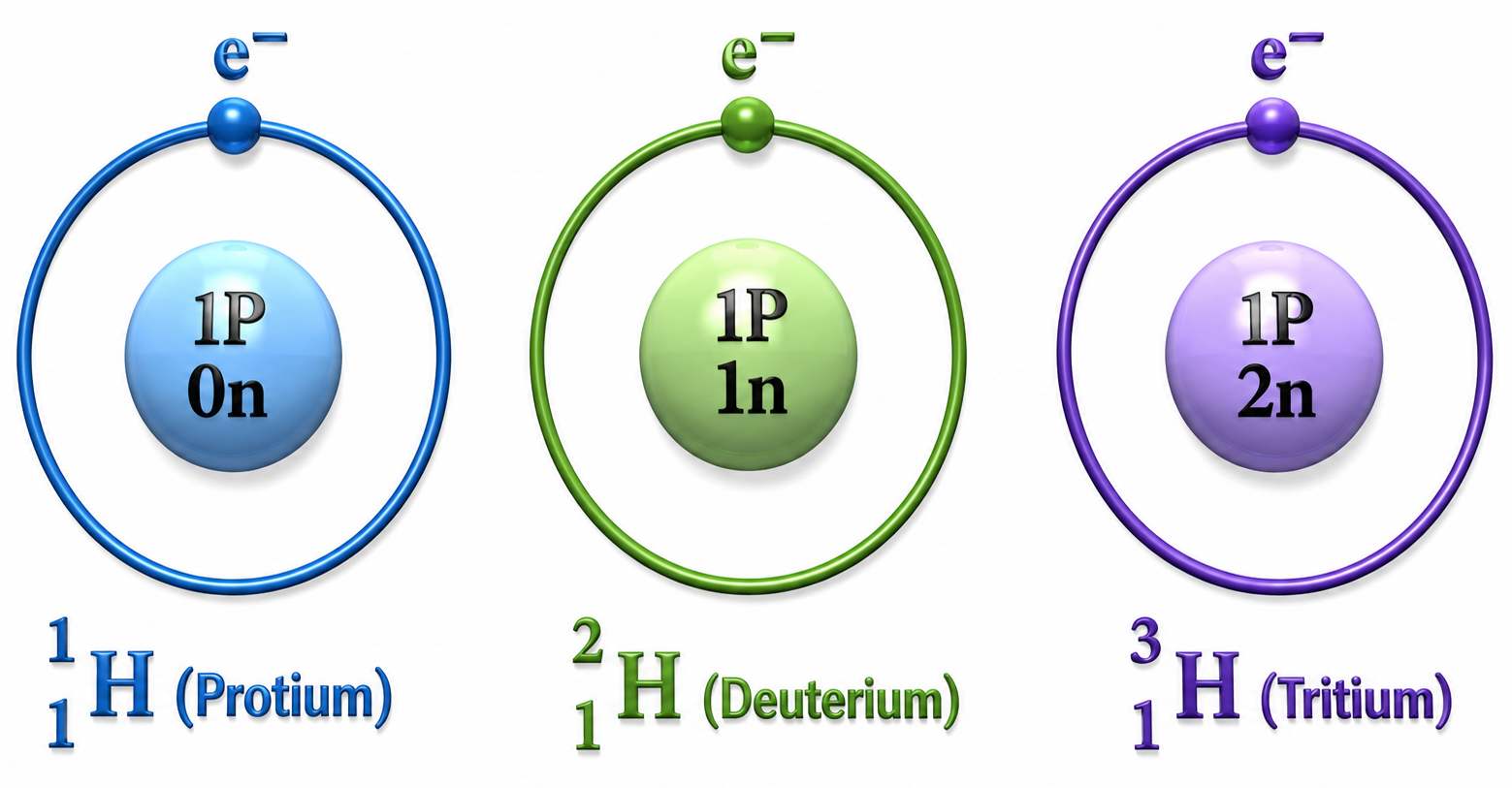
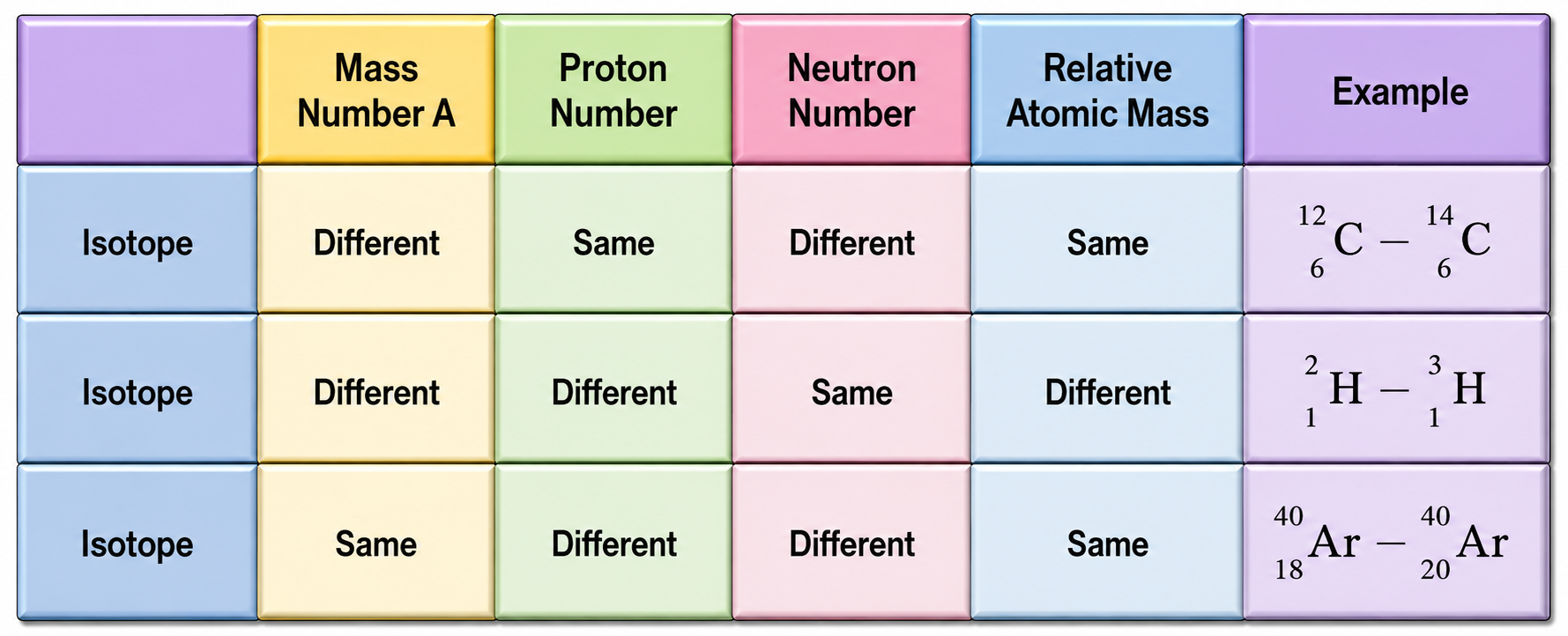
Isotopes: Atoms that have the same atomic number but different mass numbers due to having different numbers of neutrons in their nuclei are called isotopes of one another. In other words, atoms having the same number of protons but different mass numbers are called isotopes of each other.
Characteristics of Isotopes:
1. They are atoms of the same element.
2. They have the same atomic number but different mass numbers.
3. Since isotopes are atoms of the same element, they occupy the same position in the periodic table.
4. Iso means “same” and tope means “place.” The term is derived from Greek words.
5. Their chemical properties are the same, but differences are observed in their physical properties.
Example: Hydrogen has three isotopes. These are—
Uses of Isotopes
In the Medical Field:
i. Isotopes are used for disease diagnosis.
ii. ⁶⁰Co (Cobalt-60) is used to destroy cancer tumors.
iii. ³²P (Phosphorus-32) is used in the treatment of leukemia and polycythemia of the blood.
iv. ¹³¹I (Iodine-131) is used in the treatment of thyroid gland diseases and goiter.
v. ²³⁸Pu (Plutonium-238) is used in the manufacture of cardiac pacemakers.
vi. ⁹⁰Sr (Strontium-90) is used for bone growth-related conditions.
In the Industrial Field:
i. It is used to detect cracks in pipelines.
ii. It is used in counting tank capsules or cylinders.
iii. It is used in determining the age of the Earth.
In the Agricultural Field:
i. It is used for producing high-quality seeds and preserving food.
ii. It is used in the control of raw materials, food products, and insect pests.
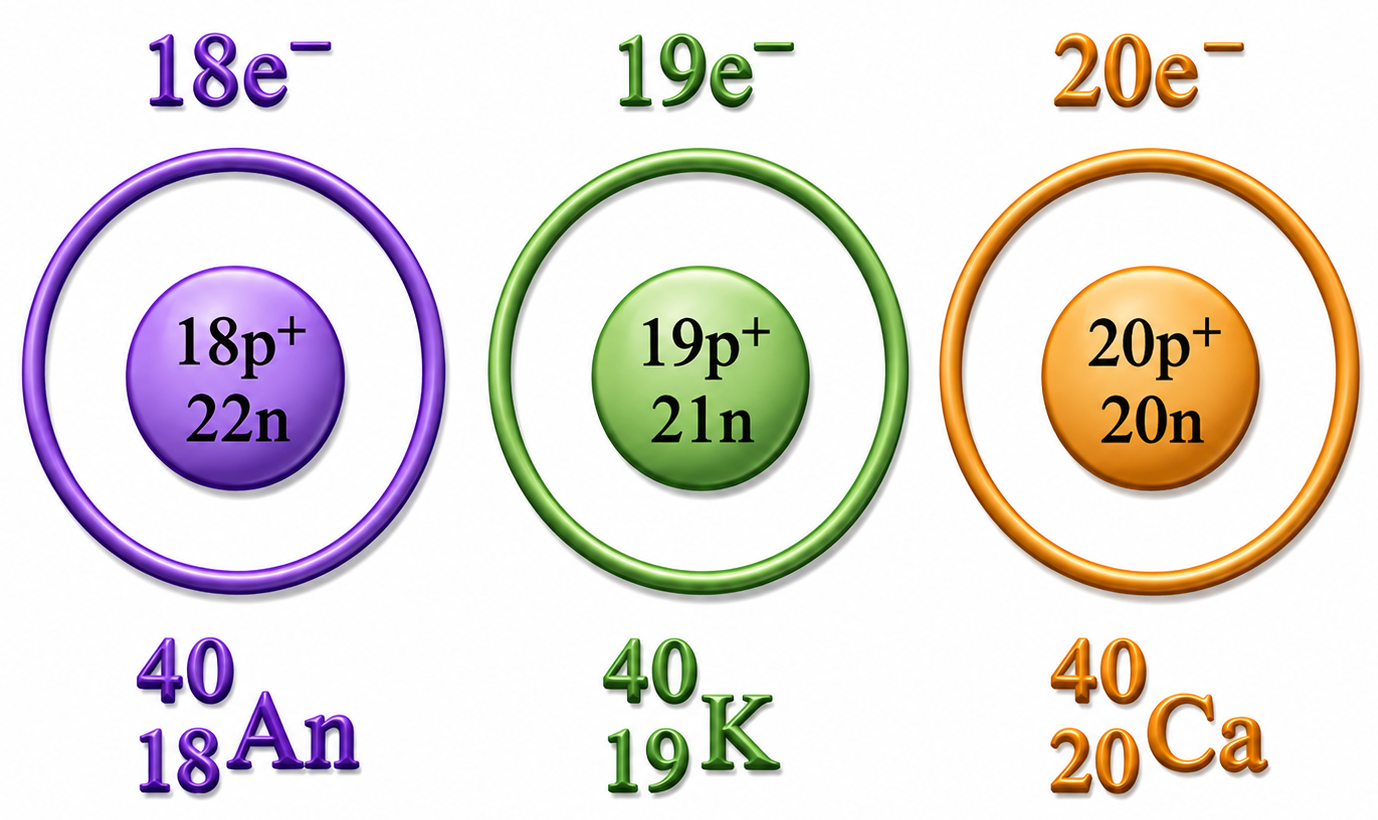
Isobars: Atoms that have the same mass number but different atomic numbers and different numbers of neutrons are called isobars of one another.
Characteristics of Isobars:
1. Isobars are atoms of different elements.
2. They have the same mass number but different atomic numbers. Therefore, their numbers of protons and neutrons are also different.
3. They occupy different positions in the periodic table.
4. Their physical and chemical properties are different.
Example:
⁴⁰₁₈Ar, ⁴⁰₁₉K, and ⁴⁰₂₀Ca are isobars of one another. This is because the atomic numbers of Ar, K, and Ca are different (18, 19, and 20 respectively), and their neutron numbers are also different (22, 21, and 20 respectively). However, their mass numbers are the same (40 in each case).
Isotones : Atoms whose nuclei contain the same number of neutrons but different numbers of protons and different mass numbers are called isotones of one another. Isotones are atoms of different elements. The chemical properties of isotones are also different.
Example: ³₁H and ⁴₂He are isotones of each other because both have the same number of neutrons (2), but their atomic numbers and mass numbers are different.
Similarly,
(i) ³⁷₁₇Cl, ⁴⁰₂₀Ca, and ³⁹₁₉K are isotones of one another.
(ii) ¹⁴₆C, ¹⁵₇N, and ¹⁶₈O are isotones of one another.
Determination of the Relative Atomic Mass of Isotopes
i) Percentage abundance of ¹²C = 99%
Percentage abundance of ¹³C = 0.75%
Percentage abundance of ¹⁴C = 0.25%
ii) Percentage abundance of ¹⁶O = 99.76%
Percentage abundance of ¹⁷O = 0.037%
Percentage abundance of ¹⁸O = 0.204%
Information Particles :
Three types of particles are emitted from a radioactive element:
i. Alpha → α rays
ii. Beta → β rays
iii. Gamma → γ rays
Formula for Solution: 
Determination of Relative Molecular Mass from Relative Atomic Mass
Examples: H₂O, H₂SO₄, FeSO₄, ZnSO₄, CO₂, MgCl₂, CaSO₄, CaCO₃, etc.
i) What is the relative molecular mass of H₂O?
= 1 × 2 + 16
= 18 g H₂O
ii) H₂SO₄
= 1 × 2 + 32 + 16 × 4
= 98
iii) CaCO₃
= 40 + 12 + 16 × 3
= 100
iv) Al₂(SO₄)₃
= 27 × 2 + (32 + 16 × 4) × 3
= 54 + (32 + 64) × 3
= 54 + 96 × 3
= 54 + 288
= 342
Atomic Mass or Relative Atomic Mass


i. If the mass of one chlorine atom is 3.16 × 10⁻²³ g, what is its relative atomic mass?
ii. If the mass of one aluminum atom is 4.481 × 10⁻²³ g, what is its relative atomic mass?
iii. If the mass of one lithium atom is 3.81 × 10⁻²³ g, what is its relative atomic mass?
iv. If the mass of one chromium atom is 3.154 × 10⁻²³ g, what is its relative atomic mass?
v. What is the relative atomic mass of manganese?
Solution – 1.
Here,
Mass of one chlorine atom = 3.16 × 10⁻²³ g
1/12 of the mass of a Carbon-12 isotope atom = 1.66 × 10⁻²⁴ g
Therefore,
Note:
The mass of a single atom can be determined in the reverse way.
For example, suppose:
Atomic mass of Na = 23

Solution – 2.
If the mass of one Al atom is 4.482 × 10⁻²³ g, what is its relative atomic mass?
Solution:
We know that,
Mass of one Al atom = 4.482 × 10⁻²³ g
Again, of the mass of a Carbon-12 isotope atom = 1.66 × 10⁻²⁴ g
We know that,
Therefore, 
Therefore, the relative atomic mass of Al is 27.
Solution – 3.
The proton number of Mg is 12 and the neutron number is 12. What is the relative atomic mass of M
Solution:
Given,
Proton number of Mg = 12
Neutron number of Mg = 12
Mass of one Mg atom = (Mg proton number × mass of 1 proton) + (Mg neutron number × mass of 1 neutron)


Again, of the mass of a Carbon-12 isotope atom = 1.66 × 10⁻²⁴ g
We know that,
Therefore,
 (approximately)
Solution – 4.
If the mass of one oxygen atom is 2.6565 × 10⁻²³ g, determine its relative atomic mass.
Solution:
We know that,
Now,

Answer: The relative atomic mass of oxygen is 16. (Ans.)
Solution – 5.
The relative atomic mass of Na is 22.98977. Determine the mass of one sodium atom.
Solution:
We know that,
And,
Therefore,


Answer: The mass of one sodium (Na) atom is 
Solution – 6.
If the relative atomic mass of Ca is 40, determine the mass of one calcium atom.
Solution:
Given,
Relative atomic mass of Ca = 40
We know that,
Now,
Therefore,


Answer: 
Solution – 7.
If the mass of one zinc atom is 1.08 × 10⁻²² g, determine the mass of one Carbon-12 isotope atom.
[Relative atomic mass of zinc = 65]
Solution:
Given,
Relative atomic mass of zinc = 65
Mass of one zinc atom = 1.08 × 10⁻²² g
We know that,
Therefore,
or, 

Therefore,

Answer: 
Solution – 8.
If the mass of one water molecule is 2.988 × 10⁻²³ g, determine the relative molecular mass of water.
Solution:
We know that,
The relative molecular mass of water is:

Therefore, the relative molecular mass of water is: 
Solution – 9.
B is an element whose molecular formula is B₈. The mass of one B₈ molecule is 4.25 × 10⁻²² g. Determine the relative atomic mass of element B.
Solution:
Mass of 8 B atoms in a B₈ molecule 
Therefore, the mass of 1 B atom is 

Now,


Therefore, the relative atomic mass of element B is 32.
Solution – 10.
Calculate the relative atomic mass of the element.
| Symbol | Mass of One Molecule |
| A₈ | 4.25 × 10⁻²² g |
Solution:
The symbol of the element is A₈, and the mass of one molecule is 4.25 × 10⁻²² g.
Since one molecule of A₈ contains 8 atoms, we can say that the mass of 8 atoms is 4.25 × 10⁻²² g.
Therefore,

Now,
Therefore, the relative atomic mass of A₈ is 32.
Determination of Isotopic Percentage and Relative Atomic Mass
The relative atomic mass of an element is the number of times an atom of that element is heavier than  of the mass of a Carbon-12 isotope atom.
 :
:
Here,
p = Mass number of the first isotope
m = Percentage abundance of the first isotope
q = Mass number of the second isotope
n = Percentage abundance of the second isotope
1. If the percentage abundances of the two isotopes of chlorine, Cl³⁵ and Cl³⁷, are 75% and 25% respectively, what is the relative atomic mass of chlorine?
Solution:
Here,
Percentage abundance of Cl³⁵ = 75%
Percentage abundance of Cl³⁷ = 25%
Therefore,


Therefore, the relative atomic mass of chlorine is 35.5.
2. Copper has two naturally occurring isotopes, Cu⁶³ and Cu⁶⁵. If their average relative atomic mass is 63.5, determine the percentage abundance of Cu⁶³ and Cu⁶⁵.
Solution:
Let,
Percentage abundance of Cu⁶³ = x%
Percentage abundance of Cu⁶⁵ = (100 − x)%
Average relative atomic mass of copper: 
Or, 
or, 
or, 

Therefore,
Percentage abundance of Cu⁶³ = 75%
Percentage abundance of Cu⁶⁵ = 25%
3. Chlorine has two naturally occurring isotopes, ³⁵Cl and ³⁷Cl. If the average relative atomic mass of chlorine is 35.5, determine the percentage abundance of ³⁵Cl and ³⁷Cl.
Solution:
Let,
Percentage abundance of ³⁵Cl = x%
Percentage abundance of ³⁷Cl = (100 − x)%
Average relative atomic mass of chlorine: 


4. ³⁵₁₇Cl and ³⁷₁₇Cl are two isotopes of chlorine. If the percentage abundance of the first isotope is 75%, calculate the relative atomic mass of chlorine.
Solution:
Two isotopes of chlorine are given. The first isotope is ³⁵₁₇Cl.
Percentage abundance of ³⁵₁₇Cl = 75%
Percentage abundance of ³⁷₁₇Cl = 
We know that,
Therefore,

5. Three isotopes of oxygen occur naturally: ¹⁶O, ¹⁷O, and ¹⁸O. Their percentage abundances are 99.76%, 0.037%, and 0.204% respectively. Determine the average relative atomic mass of oxygen.
Solution:
Given,
¹⁶O = 99.76%
¹⁷O = 0.037%
¹⁸O = 0.204%
We know that,
Therefore,


 ( aprox)
6. If the percentage abundances of the two isotopes of hydrogen, ¹H and ²H, are 99.2% and 0.8% respectively, determine the average relative atomic mass of hydrogen.
Solution:
Given,
¹H = 99.2%
²H = 0.8%
We know that,
Therefore,


Therefore, the average relative atomic mass of hydrogen is: 
7. Naturally occurring hydrogen has two isotopes, H1 and H2. If the average relative atomic mass of hydrogen is 1.008, determine the percentage abundance of the isotopes H1 and H2 .
Solution:
Let,
Percentage abundance of H1 in nature = x%
Percentage abundance of H2 in nature = (100 − x)%
Now,


Therefore,


8. Chlorine has two isotopes, ³⁵Cl and ³⁷Cl. If the average relative atomic mass of chlorine is 35.5, determine the percentage abundance of the isotopes.
Solution:
Let,
Percentage abundance of ³⁵Cl in nature = x%
Therefore,
Percentage abundance of ³⁷Cl in nature = (100 − x)%
Now, the average relative atomic mass of chlorine is: 


Therefore, the percentage abundance of the isotope ³⁵Cl in nature is 75%.

9. The average relative atomic mass of the isotopes ¹⁶A and ¹⁷A is 16.016. Determine the percentage abundance of the two isotopes of element A.
Solution:
Let,
Percentage abundance of ¹⁶A in nature = x%
Percentage abundance of ¹⁷A in nature = (100 − x)%
Therefore,


Therefore,

10. The average relative atomic mass of ³⁵A and ³⁷A is 35.5. Name the element A and determine the percentage abundance of its two isotopes in nature.
Solution:
The average relative atomic mass of A is 35.5. Therefore, the element is chlorine (Cl).
Let,
Percentage abundance of ³⁵Cl in nature = x%
Percentage abundance of ³⁷Cl in nature = (100 − x)%
Therefore,


Therefore, 
Hence,

Therefore, the percentage abundances of the isotopes ³⁵Cl and ³⁷Cl are 75% and 25%, respectively.
11. Three isotopes of oxygen occur naturally: ¹⁷O, ¹⁸O, and ¹⁹O. Their percentage abundances are 99.76%, 0.037%, and 0.204% respectively. Determine the relative atomic mass of the element.
Solution:
Given,
The three isotopes of O are: ¹⁷O ,¹⁸O ,¹⁹O
Their percentage abundances are:
¹⁷O = 99.76%
¹⁸O = 0.037%
¹⁹O = 0.204%
Therefore,


Answer: The average relative atomic mass of the element is approximately 17.
Why is an atom electrically neutral under normal conditions?
An atom is electrically neutral because it contains an equal number of electrons and protons.
At the center of an atom is the nucleus, which contains protons and neutrons. Protons carry a positive charge, while neutrons have no charge. Therefore, the nucleus of an atom is positively charged.
On the other hand, electrons, which carry a negative charge, move around the nucleus in specific paths. Under normal conditions, the number of protons in an atom is equal to the number of electrons. As a result, the positive charge of the nucleus and the negative charge of the electrons cancel each other out.
Therefore, the atom remains electrically neutral.
Orbit and Orbital
Orbit:
An orbit is a fixed circular path of a definite radius around the nucleus of an atom in which electrons revolve. These are the permitted stable paths around the nucleus.
The orbits are represented by K, L, M, N, etc.
Orbital:
Each energy level of an atom consists of one or more sub-energy levels. These sub-energy levels are called
orbitals.
Orbitals are represented by s, p, d, f.
Electron Distribution in Energy Levels of an Atom
Formula: 
Where,
n = 1, 2, 3, 4, …
For n = 1 then 
Therefore, the maximum number of electrons = 2
For n = 2 then 
Therefore, the maximum number of electrons = 8
For n = 3 then 
Therefore, the maximum number of electrons = 18
For n = 4 then 
Therefore, the maximum number of electrons = 32
Note:
The 1st energy level is called the K shell.
The 2nd energy level is called the L shell.
The 3rd energy level is called the M shell.
The 4th energy level is called the N shell.
The 5th energy level is called the O shell.
The 6th energy level is called the P shell.
The 7th energy level is called the Q shell.
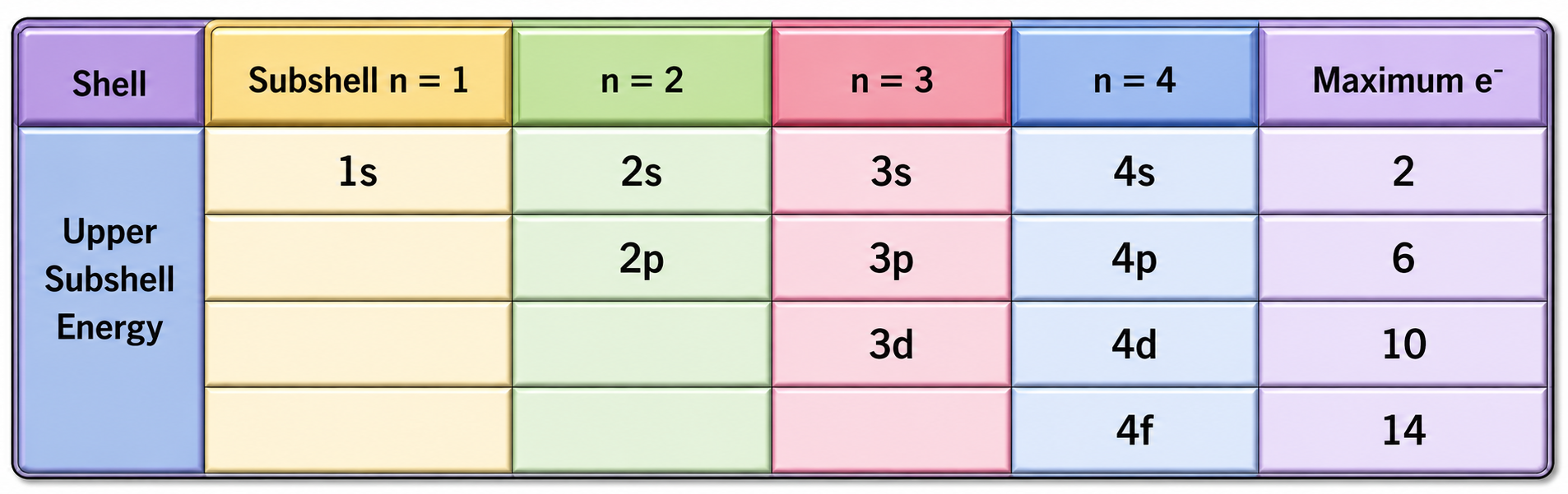
Concept of Energy Level and Sub-Energy Level
The Real Secret of Electron Configuration
Formulla : 
The maximum number of electrons in an S orbital
The maximum number of electrons in an P orbital = 
The maximum number of electrons in an d orbital = 
The maximum number of electrons in an f orbital = 
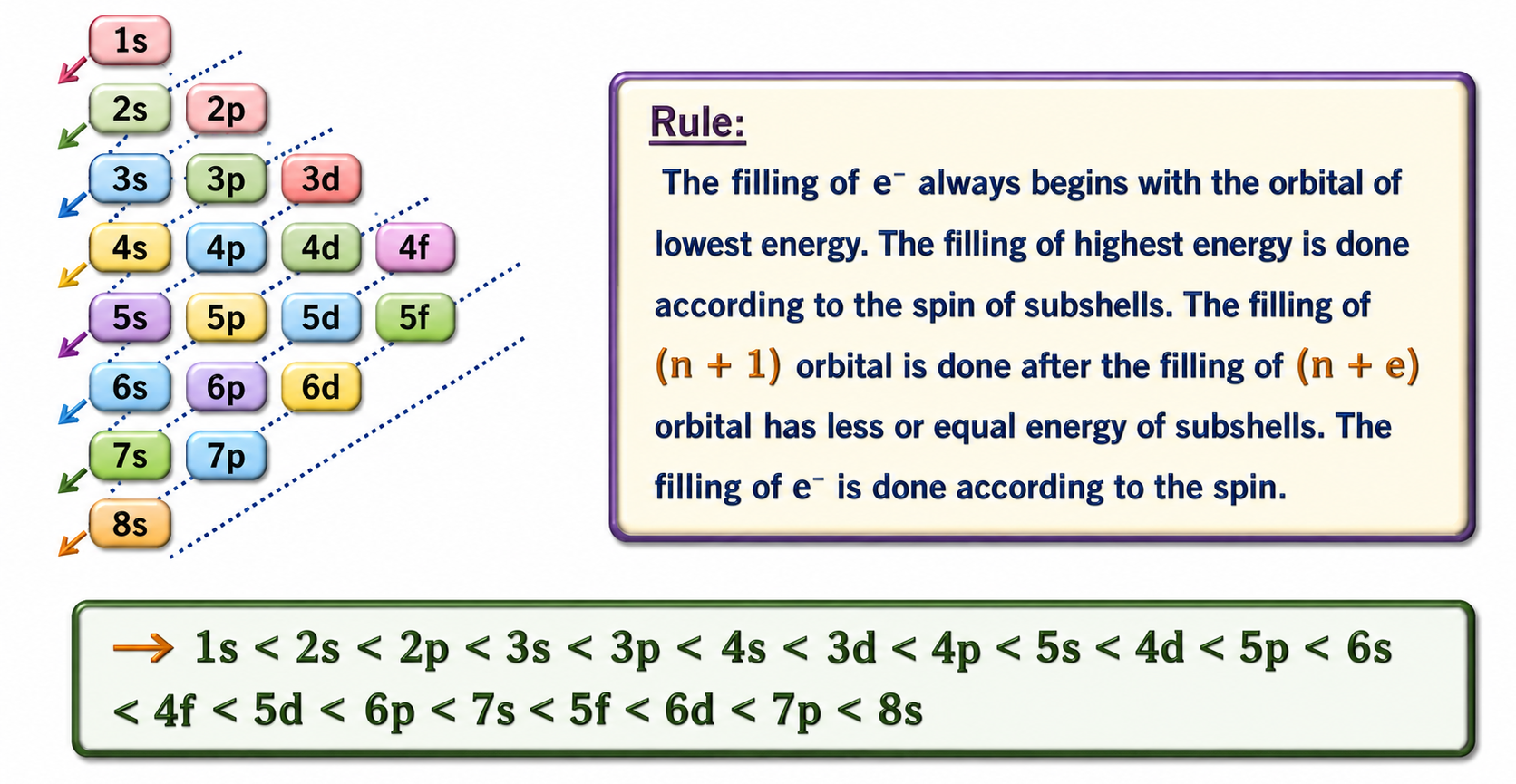
Technique for the Energy Order of Sub-Energy Levels
Electron Configuration:
Na (11) electron configuration = 1s² 2s² 2p⁶ 3s¹
Cl (17) electron configuration = 1s² 2s² 2p⁶ 3s² 2p⁵
Mg (12) electron configuration = 1s² 2s² 2p⁶ 3s²
Ca (20) electron configuration = 1s² 2s² 2p⁶ 3s¹ 4s²
Electron Configuration of Ions:
Fe₂₆ = 1s² 2s² 2p⁶ 3s² 3p⁶ 4d² 4d⁶
Fe₂₆²⁺ = 1s² 2s² 2p⁶ 3s² 3p⁶ 4d⁶
Rule: Electrons enter according to the order of energy levels, but they are removed from the outermost shell first.
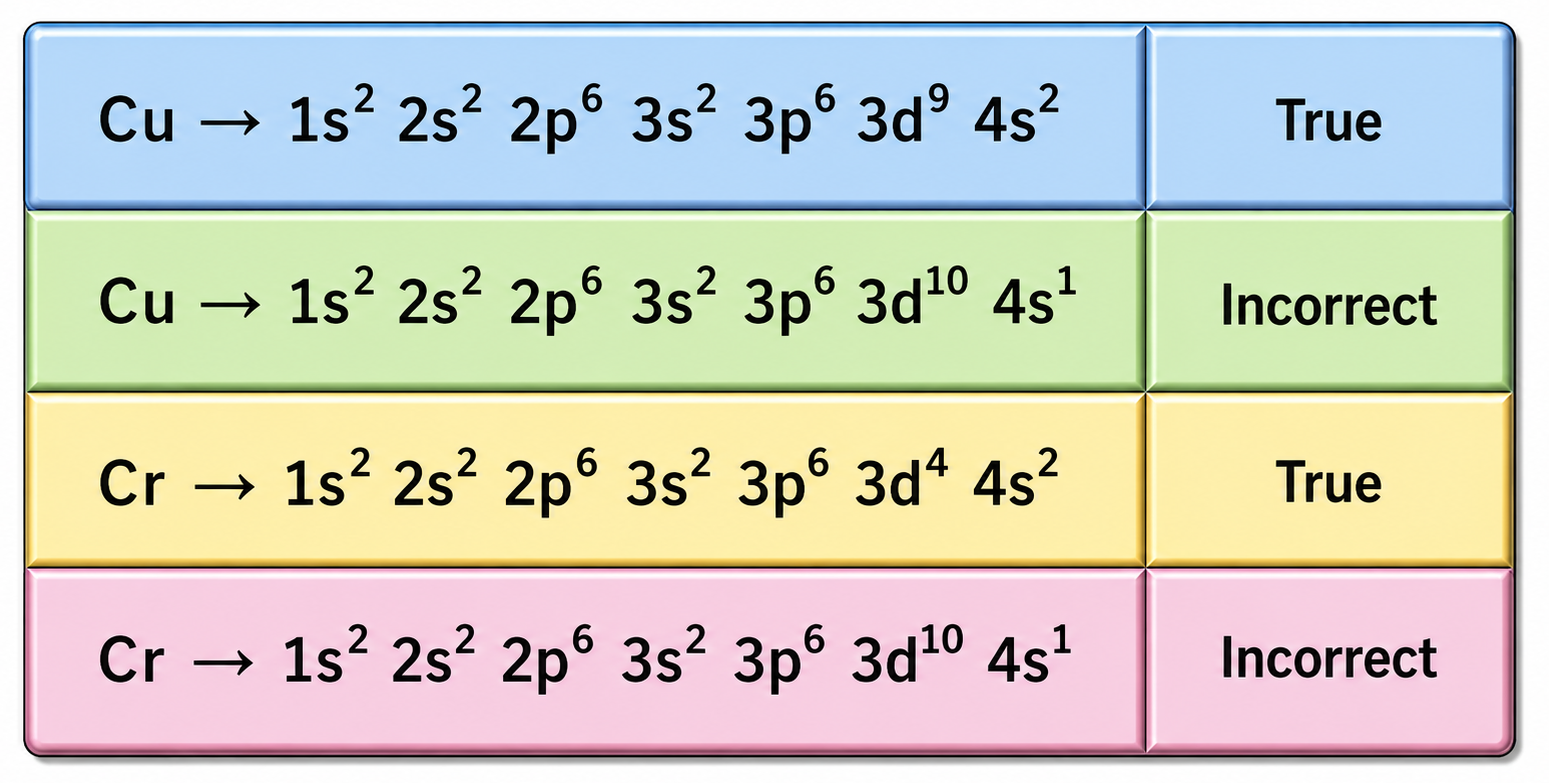
Exceptional Electron Configuration
Note:
Half-Filled and Fully Filled subshells are more stable.
The maximum electron holding capacity of the d-subshell is 10 electrons. Among these, d⁵ (half-filled) and d¹⁰ (fully filled) are two stable configurations.
Which of the ions Fe²⁺ and Fe³⁺ is more stable? Explain.
₂₆Fe²⁺ electron configuration = 1s² 2s² 2p⁶ 3s² 3p⁶ 3d⁶
₂₆Fe³⁺ electron configuration = 1s² 2s² 2p⁶ 3s² 3p⁶ 3d⁵
Between Fe²⁺ and Fe³⁺, the Fe³⁺ ion is more stable because its d-orbital is in a half-filled state (3d⁵). Therefore, Fe³⁺ is more stable than Fe²⁺.
Why does the 19th electron of potassium enter the 4s orbital instead of the 3d orbital?
Solution:
Potassium electron configuration: K₁₉ = 1s² 2s² 2p⁶ 3s² 3p⁶ 3d⁰ 4s¹
Here,
For the 3d subshell:
n = 3, L = 2
∴ n + L = 3 + 2 = 5
For the 4s subshell:
n = 4, L = 0
∴ n + L = 4 + 0 = 4
Here,
n = 3 L = 2
n = 4 L = 0
It is seen that,
For the 4s subshell, the value of n + L = 4
And for the 3d subshell, n + L = 5
Therefore, the 4s subshell has lower energy.
As a result, in the electron configuration of potassium (K), the last electron enters the 4s orbital instead of the 3d orbital.
| Higher energy subshell | Lower energy subshell |
Remember:
1. If the value of n + L is smaller, that orbital is filled first.
2. If the value of n + L is larger, that orbital is filled later.
3. If n + L values are equal, the orbital with the smaller value of n is filled first.
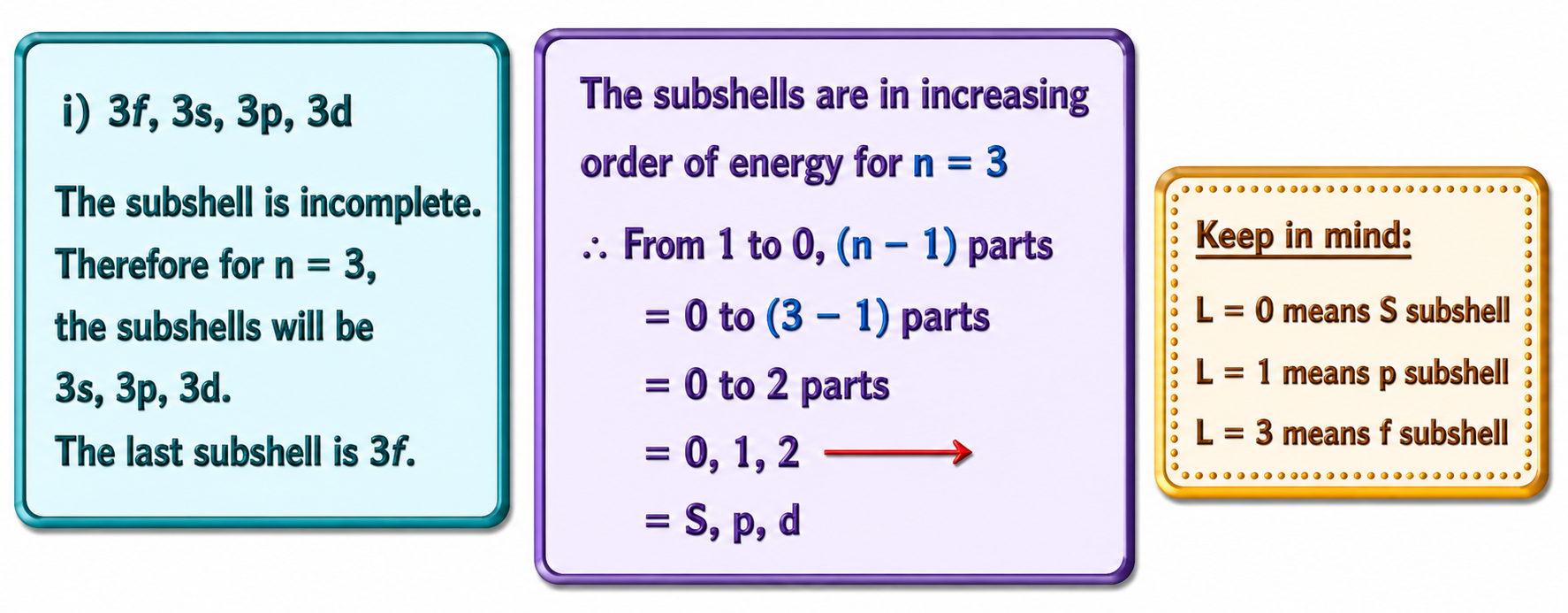
Which orbitals are possible/impossible in an atom?
Why do the last two electrons of calcium enter the 4s subshell instead of the 3d subshell?
Solution:
According to the Aufbau Principle, electrons first occupy the orbitals with lower energy. Between two orbitals, the lower-energy orbital can be determined from the values of the principal quantum number (n) and the azimuthal quantum number (l). The orbital for which the value of (n + l) is smaller has lower energy, and electrons enter that orbital first.
For example:
For the 3d orbital:
n = 3, l = 2
∴ (n + l) = 3 + 2 = 5
For the 4s orbital:
n = 4, l = 0
∴ (n + l) = 4 + 0 = 4
Therefore, the energy of the 4s orbital is lower than that of the 3d orbital (4s < 3d). As a result, the last two electrons of calcium enter the 4s subshell instead of the 3d subshell.
Hence, the electron configuration of calcium is: Ca = 1s² 2s² 2p⁶ 3s² 3p⁶ 4s²
Why does the last electron of Sc enter the 3d orbital only after the 4s orbital is filled?
According to the Aufbau Principle, during electron configuration, electrons first enter the lower-energy orbitals and then gradually occupy higher-energy orbitals. Since the energy of the 4s orbital is lower than that of the 3d orbital, the 4s orbital is filled first (4s²). After that, the last electron enters the 3d orbital.
The correct electron configuration of ₂₁Sc is: 1s² 2s² 2p⁶ 3s² 3p⁶ 4s² 3d¹
In the case of scandium, the 19th and 20th electrons complete the 4s orbital, and the 21st (last) electron enters the next higher-energy orbital, 3d.
Therefore, the last electron of Sc enters the 3d orbital only after the 4s orbital has been filled because the 4s orbital has lower energy than the 3d orbital.
Quantum Numbers
Definition: The numbers by which a complete and accurate description can be given of where and how electrons are positioned within an atom are called quantum numbers.
There are four quantum numbers, namely:
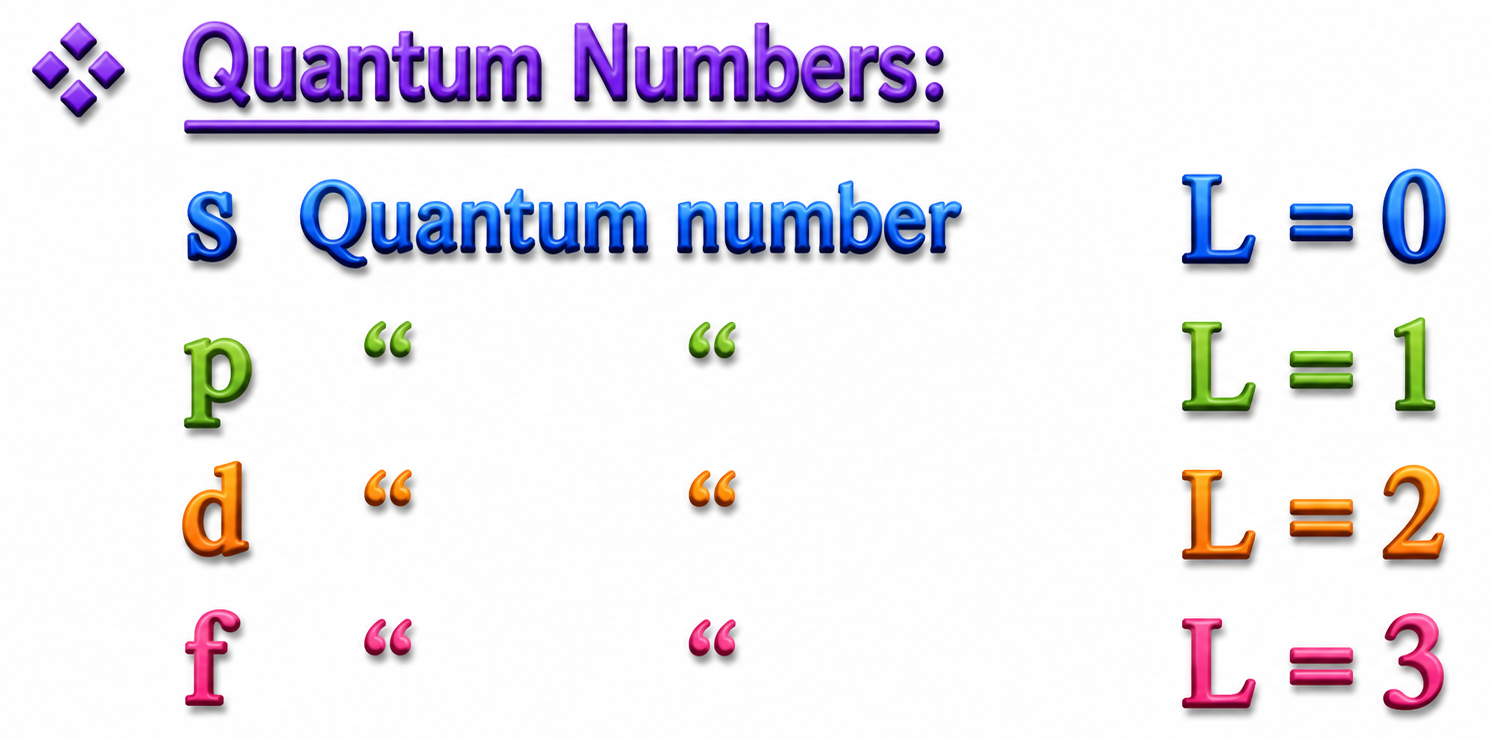
1. Principal Quantum Number (n) — Represents the principal energy levels (1, 2, 3, 4, ………)
2. Azimuthal (Subsidiary) Quantum Number (L) — Represents the sub-energy levels of a principal energy level (0, 1, 2, ……… n − 1)
3. Magnetic Quantum Number (m) — Represents the orientation of orbitals (+1, ………, 0, ………, −1)
4. Spin Quantum Number (S) — Represents the spin of electrons (±1/2)
1. Principal Quantum Number:
The number used to express in which principal energy level an electron revolves around the nucleus is called the
principal quantum number. It is denoted by n. The values of n are 1, 2, 3, 4, …………… and so on, which are whole numbers.
2. Azimuthal (Subsidiary) Quantum Number :
For the movement of electrons in an atom, each principal energy level is divided into a specific number of sub-energy levels. The quantum number used to indicate in which sub-level of a principal energy level an electron is located is called the azimuthal (subsidiary) quantum number. It is denoted by L. Its value depends on the principal quantum number n and ranges from 0 to (n − 1).
3. Spin Quantum Number :
An electron revolves around the nucleus while spinning like a top about its own axis, either in the clockwise direction or in the opposite direction. This property is expressed by the spin quantum number. It is denoted by s. The quantum number S has two possible values: +1/2 and −1/2.
4. Magnetic Quantum Number :
Due to the rotation of electrons, an electric field is first produced inside the atom, and under its influence a magnetic field is generated. Because of the magnetic field, different orbitals of electrons acquire different orientations. The quantum number introduced to express these various orientations is called the magnetic quantum number. It is denoted by m. The value of m depends on the value of L and can range from −L to +L, including zero. For each value of L, there are (2L + 1) possible values of m.
What is Hund’s Rule? Electron Configuration of N and O According to This Principle
Hund’s Rule:
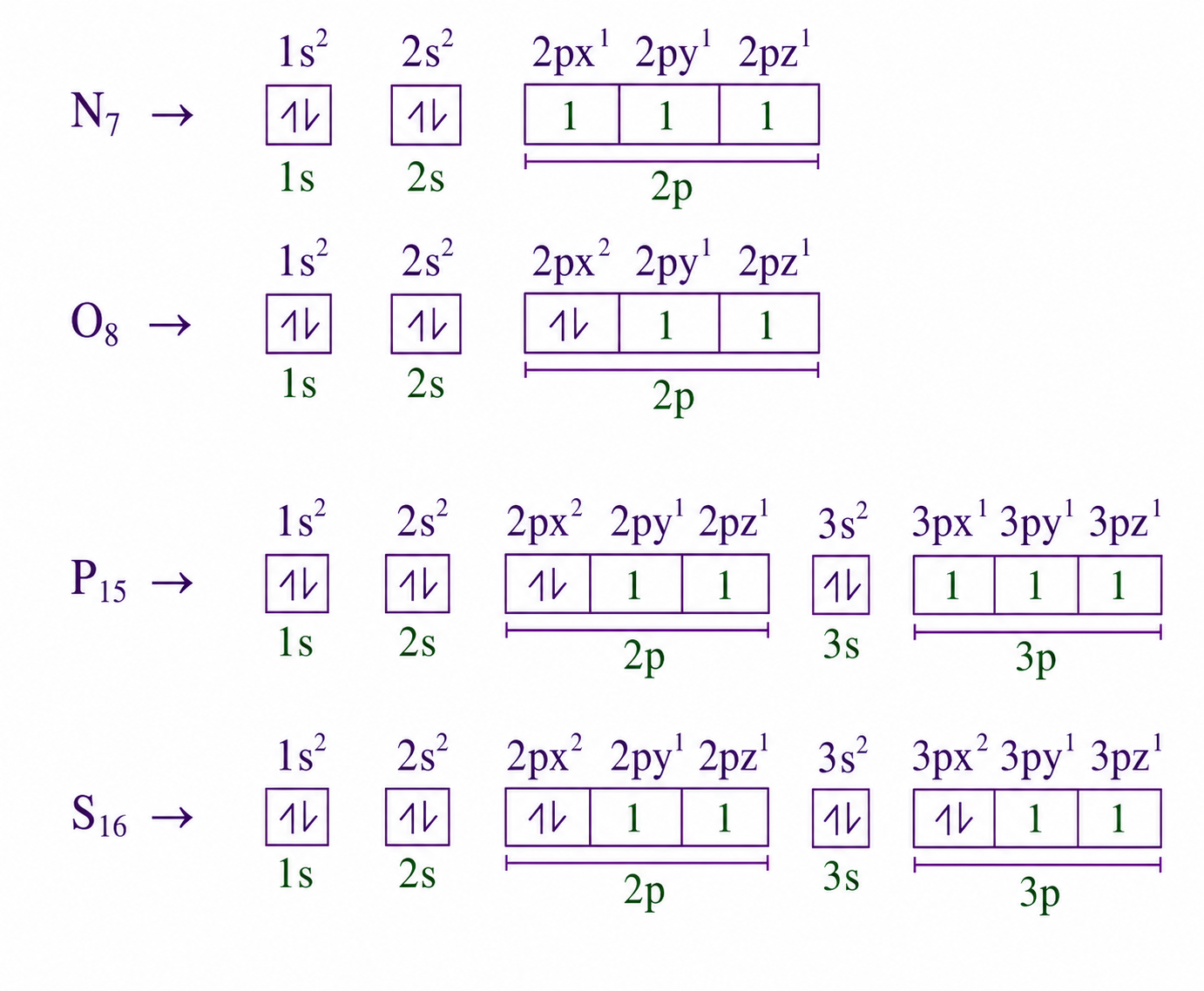
Electrons in different orbitals having the same energy are arranged in such a way that the maximum number of electrons remain unpaired, and all these electrons have parallel spins (same spin direction).
Electron Configuration of the N (Nitrogen) Atom According to Hund’s Rule:
According to this principle, in the 2p subshell of the nitrogen atom, the three orbitals 2px, 2py, and 2pz each receive one electron with the same spin. For example—
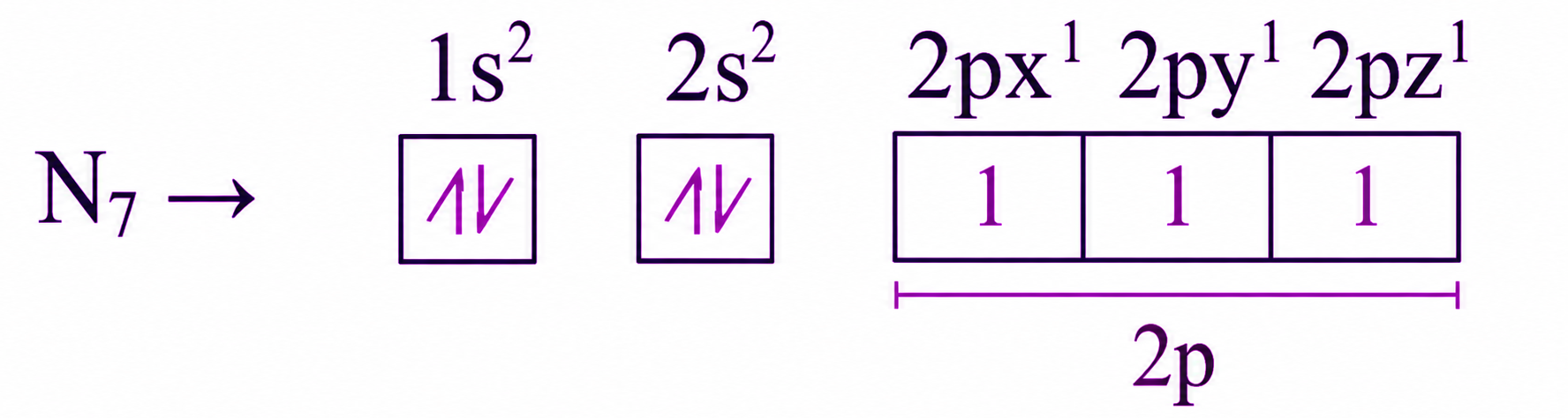
Therefore, according to Hund’s rule, one electron with the same spin first enters each orbital individually. Hund’s principle has been followed in the electron configuration of the nitrogen atom.
According to Hund’s rule, the electron configurations of N, P, O, and S are as follows—

Edutrack BD
শিক্ষার আলো ছড়িয়ে দিতে আমরা প্রতিশ্রুতিবদ্ধ। নির্ভরযোগ্য নোট, সাজেশন, গাইডলাইন ও সহজ ব্যাখ্যার মাধ্যমে শিক্ষার্থীদের সফলতার পথে এগিয়ে নিতে Edutrack BD সবসময় পাশে আছে। শেখা হোক সহজ, প্রস্তুতি হোক স্মার্ট।
Categories
- Chemistry (2)
- Class 8 (4)
- General Math ( Bangla Version ) (2)
- Higher Math (2)
- HSC (10)
- HSC Physics 2nd Paper Notes ( English Version ) (1)
- ICT (2)
- ICT ( English Version ) (1)
- Math (1)
- Math ( English Version ) (1)
- Physics ( Bangla Version ) (1)
- Physics ( Englisg Version ) (1)
- Science ( Bangla Version ) (1)
- Science ( English Version ) (1)
- SSC ( Bangla Version ) (1)
- SSC ( English Version ) (9)
- Uncategorized (1)