

Early History of the Periodic Table
Lavoisier:
(1789) Scientist Lavoisier first divided elements into metals and non-metals. Metals were those that could react with oxygen to form bases, and non-metals were those that could react with oxygen to form acids. Besides this, he also classified elements into three states: solid, liquid, and gaseous. He started his work using only 33 elements.

Dobereiner:
In 1829, scientist Döbereiner observed that certain elements could be grouped into sets of three based on their atomic masses. In these groups, the atomic mass of the middle element is approximately equal to half the sum of the atomic masses of the first and third elements. These groups are called triads. Döbereiner identified Cl, Br, and I as one such triad.

Newlands:
In 1864, Newlands proposed a law known as the Law of Octaves for elements. According to this law, when elements are arranged in order of increasing atomic mass, the properties of every eighth element are similar to those of the first element.
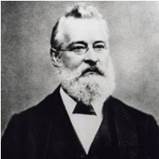
Mendeleev:
In 1869, the Russian scientist Mendeleev studied the properties of all known elements and proposed a law. According to him, the physical and chemical properties of elements recur periodically with the increase in their atomic masses.
However, there were some exceptions in this arrangement; for example, although the atomic mass of argon is 40 and that of potassium is 39, argon was placed before potassium in the periodic table.

Moseley:
In 1913, scientist Henry Moseley proposed arranging elements based on atomic number instead of atomic mass. This led to a corrected version of Mendeleev’s periodic table.

Modified Law:
“The physical and chemical properties of elements recur periodically according to their atomic numbers.”
Characteristics of the Periodic Table
(i) The horizontal rows extending from left to right in the periodic table are called periods. There are 7 periods in total.
(ii) The vertical columns extending from top to bottom in the periodic table are called groups or families. There are 18 groups in total.
(iii) Below the main periodic table, there are two separate rows called the lanthanides and actinides. They actually belong to the 6th and 7th periods and are included in group 3.
(iv) The 1st period contains 2 elements; the 2nd and 3rd periods contain 4 elements each; the 4th and 5th periods contain 18 elements each; and the 6th and 7th periods contain 32 elements each.
(v) In the same period, the properties of elements change gradually from left to right.
(vi) Elements within the same group have similar physical and chemical properties.
Determining the Position of an Element in the Periodic Table
Rules for Determining the Period:
1. The atomic number of the element must be known.
2. The electronic configuration must be written.
3. The highest principal energy level (shell number) indicates the period number.
Example:
For Lithium (Li), atomic number 3:
3Li → 1s² 2s¹ ⇒ 2nd period
For Sodium (Na), atomic number 11:
11Na → 1s² 2s² 2p⁶ 3s¹ ⇒ 3rd period
Rules for Determining the Group :
1. After writing the electronic configuration, if only the s orbital is present in the outermost shell, then the number of electrons in that orbital is the group number.
Example:
H → 1s¹ → Group 1
2. If the outermost shell contains both s and p orbitals, then the group number is obtained by adding 10 to the total number of electrons in these orbitals.
Example:
B → 1s² 2s² 2p¹ → Group → 2 + 1 + 10 = 13
3. If, just before the outermost energy level, there is a d orbital, then the group number is the sum of electrons in the s and d orbitals.
Example:
Mn → 1s² 2s² 2p⁶ 3s² 3p⁶ 3d⁵ 4s² → Group number → 5 + 2 = 7
Some Exceptions in the Periodic Table
Position of Hydrogen:
Hydrogen has one electron in its outermost shell, and many of its properties resemble those of alkali metals, so it is placed in Group 1 of the periodic table. However, hydrogen can also gain one electron to achieve a stable configuration, and many of its properties are similar to those of the halogens (Group 17 elements). Still, considering everything, hydrogen is placed in Group 1.
Position of Helium:
Helium has 2 electrons in its outermost shell, so it could be placed in Group 2 along with alkaline earth metals. However, helium is an inert (noble) gas, and the elements of Group 2 are highly reactive. Therefore, helium is placed with the noble gases in Group 18.
Position of Lanthanide and Actinide Series Elements:
The elements of the lanthanide and actinide series actually belong to Group 3. The lanthanides are part of Period 6, and the actinides are part of Period 7. However, if they were placed in their proper positions in the main periodic table, the table would become too wide and lose its structure. Therefore, to maintain the compactness and structure of the periodic table, these series are placed separately below it.
Periodic Properties of Elements
The physical and chemical properties of elements present in the periodic table—such as metallic character, non-metallic character, atomic size, melting point, boiling point, ionization energy, electronegativity, electron affinity, etc.—are called periodic properties.
A brief discussion of the periodic properties of elements is given below—
Metallic Character
Elements that are shiny, can be beaten into thin sheets (malleable), produce sound when struck, and can conduct heat and electricity are called metals. Also, elements that can lose one or more electrons to form positive ions are called metals. The ease with which an atom loses electrons determines its metallic character.
In the periodic table, metallic character decreases from left to right across a period, and increases from top to bottom within a group.
Non-Metallic Character
Elements that are not shiny, are not malleable, do not produce sound when struck, and cannot conduct heat and electricity are called non-metals. Also, elements that can gain one or more electrons to form negative ions are called non-metals. The tendency to gain electrons is called non-metallic character.
The more easily an atom can gain electrons, the greater its non-metallic character. In the periodic table, moving from left to right across a period, non-metallic character increases, and moving from top to bottom within a group, non-metallic character decreases.
The element that shows both metallic and non-metallic properties is called a metalloid (for example, silicon (Si) is a metalloid). In general, elements on the left side of the periodic table are metals, those in the middle are metalloids, and those on the right side are non-metals.
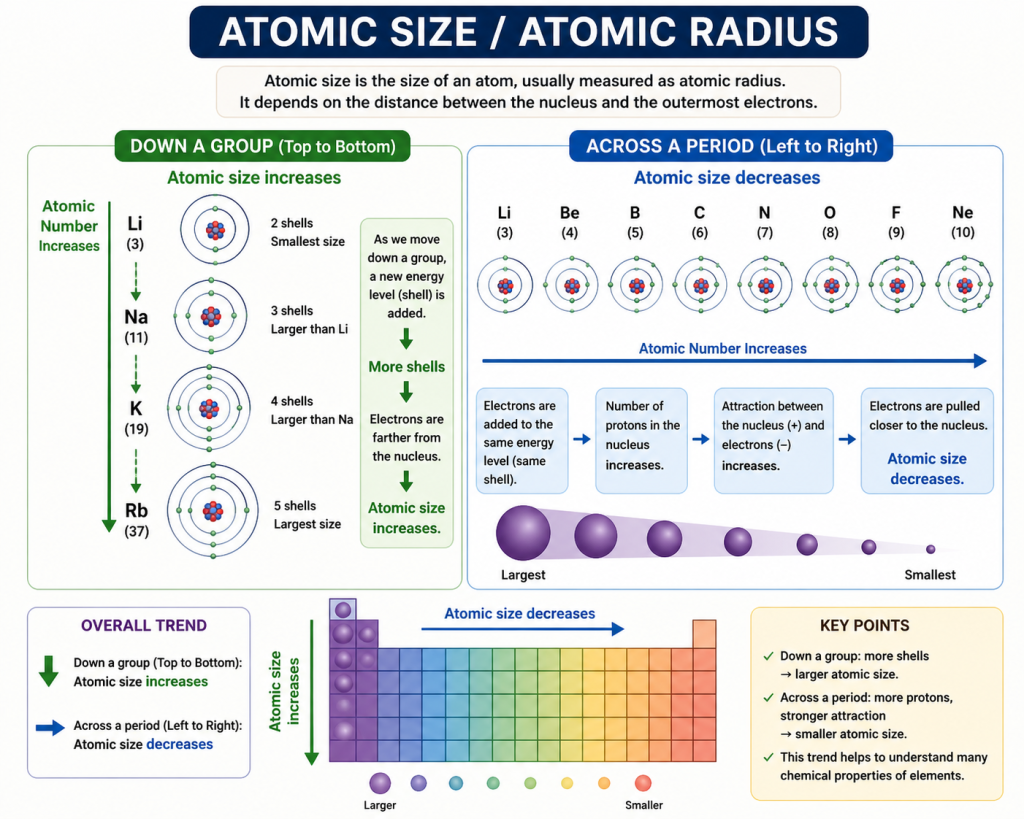
Atomic Size / Atomic Radius
Within a group, as we move from top to bottom, the atomic number increases. As a result, the number of electron shells increases, leading to an increase in atomic size. That is, moving down a group, a new energy level is added, so the atomic size increases.
On the other hand, across a period from left to right, although the atomic number increases, electrons are added to the same energy level. Therefore, atomic size generally decreases from left to right across a period.
But the number of electrons increases. As a result, the attraction between the greater number of protons in the nucleus and the greater number of electrons outside the nucleus increases. Therefore, the electrons are pulled closer to the nucleus, and the atomic size decreases.
Ionization Energy:
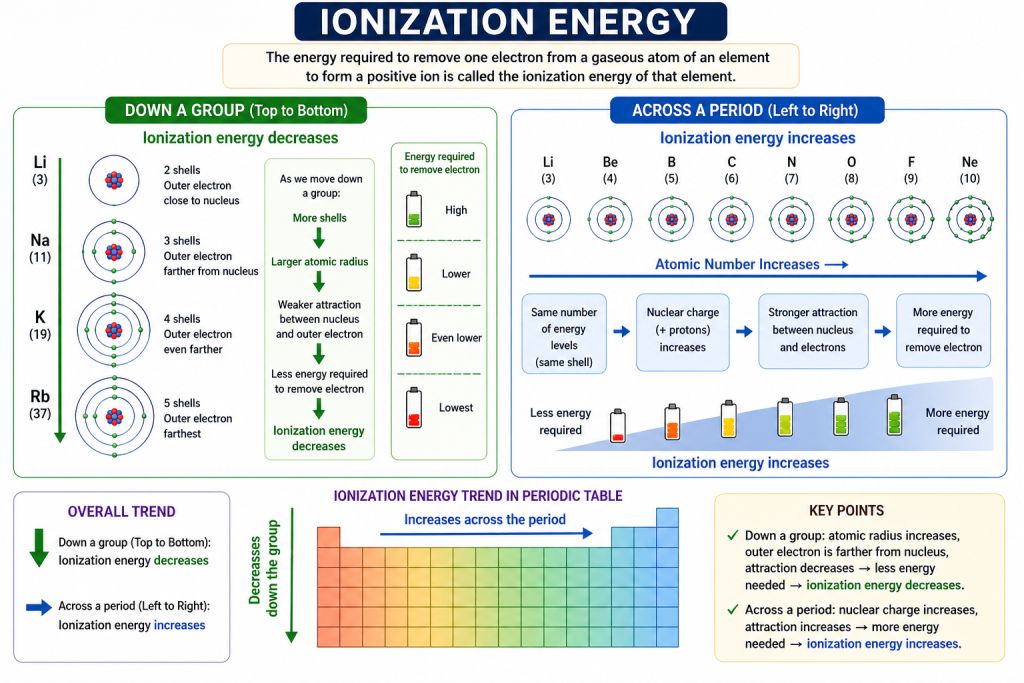
The energy required to remove one electron from a gaseous atom of an element to form a positive ion is called the ionization energy of that element.
Within a group, as we move from top to bottom, the atomic radius increases and the outermost electrons move farther away from the nucleus. As a result, the attraction of the nucleus for these electrons decreases, so less energy is required to remove an electron. Therefore, ionization energy decreases down a group.
Across a period from left to right, although the number of energy levels remains the same, the nuclear charge increases with increasing atomic number. This increases the attraction between the nucleus and electrons, making it harder to remove an electron. Therefore, ionization energy increases across a period.
Electron Affinity :
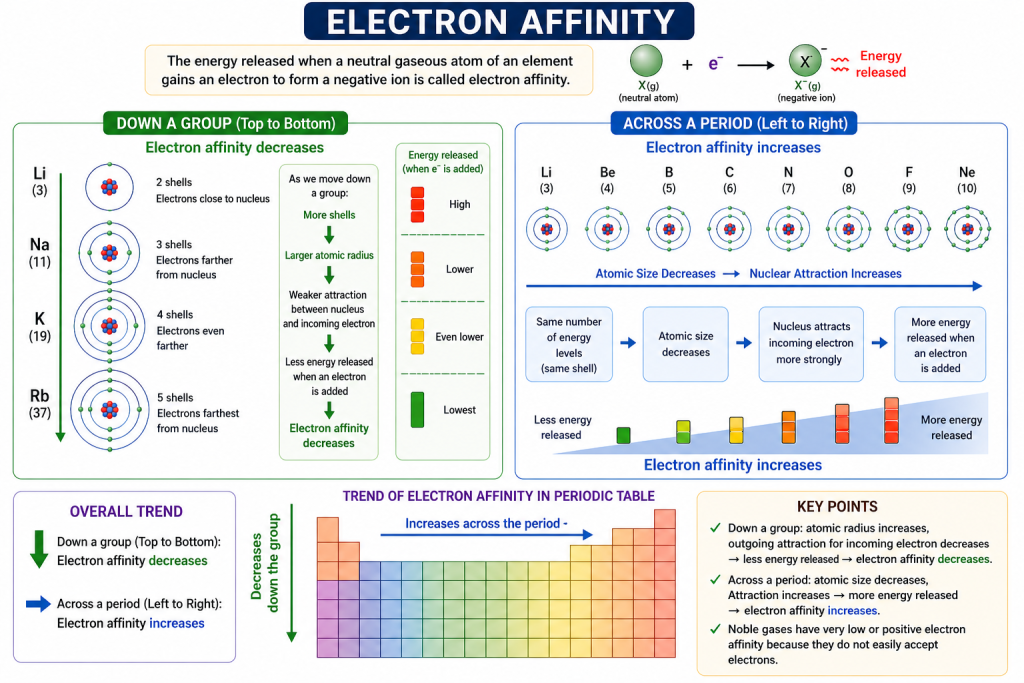
The energy released when a neutral gaseous atom of an element gains an electron to form a negative ion is called electron affinity.
Within a group, as we move from top to bottom, the atomic radius increases, and electrons are farther from the nucleus. As a result, the attraction between the nucleus and incoming electrons decreases, so less energy is released when an electron is added. Therefore, electron affinity decreases down a group.
Across a period from left to right, atomic size decreases, and the attraction of the nucleus for incoming electrons increases. As a result, more energy is released when an electron is added. Therefore, electron affinity increases across a period.
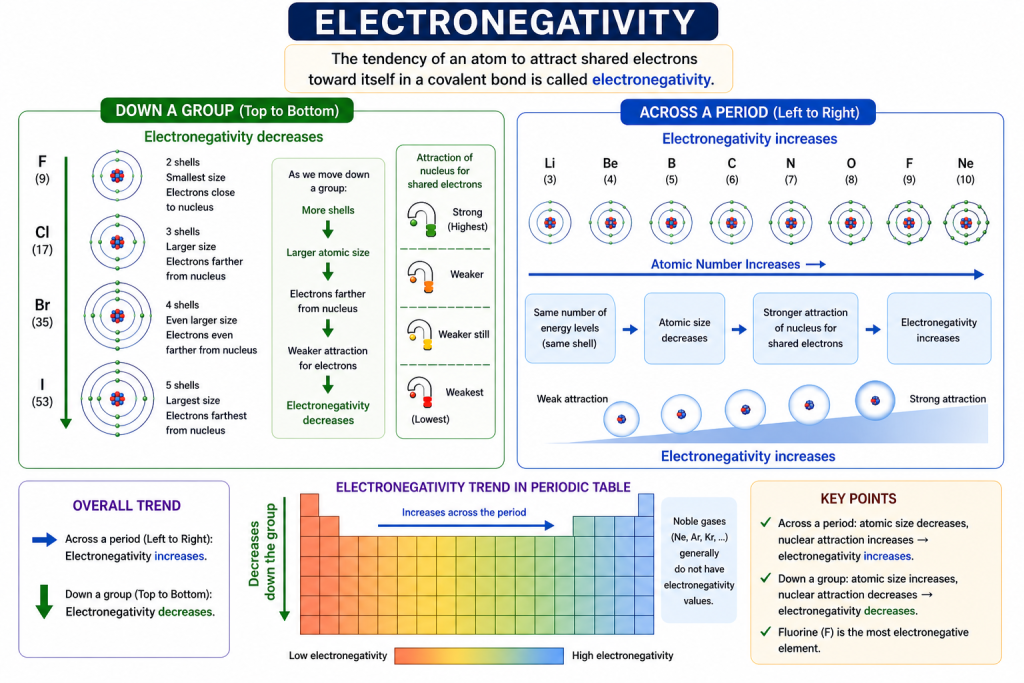
Electronegativity :
The tendency of an atom to attract shared electrons toward itself in a covalent bond is called electronegativity.
As we move from left to right across a period, the atomic size decreases. This means the attraction of the nucleus for electrons increases, and therefore the value of electronegativity increases.
Again, as we move from top to bottom within a group, the atomic size increases. This means electrons move farther from the nucleus, so the attraction of the nucleus for electrons decreases, and therefore the value of electronegativity decreases.
Relationship between periodic properties of elements with periods and groups
| Periodic Property | Trend Across a Period (Left → Right) | Trend Down a Group (Top → Bottom) |
| Atomic size / radius | Decreases | Increases |
| Metallic character | Decreases | Increases |
| Non-metallic character | Increases | Decreases |
| Ionization energy | Increases | Decreases |
| Electron affinity | Increases | Decreases |
| Electronegativity | Increases | Decreases |

Edutrack BD
শিক্ষার আলো ছড়িয়ে দিতে আমরা প্রতিশ্রুতিবদ্ধ। নির্ভরযোগ্য নোট, সাজেশন, গাইডলাইন ও সহজ ব্যাখ্যার মাধ্যমে শিক্ষার্থীদের সফলতার পথে এগিয়ে নিতে Edutrack BD সবসময় পাশে আছে। শেখা হোক সহজ, প্রস্তুতি হোক স্মার্ট।
Categories
- Chemistry (2)
- Class 8 (4)
- General Math ( Bangla Version ) (2)
- Higher Math (2)
- HSC (10)
- HSC Physics 2nd Paper Notes ( English Version ) (1)
- ICT (2)
- ICT ( English Version ) (1)
- Math (1)
- Math ( English Version ) (1)
- Physics ( Bangla Version ) (1)
- Physics ( Englisg Version ) (1)
- Science ( Bangla Version ) (1)
- Science ( English Version ) (1)
- SSC ( Bangla Version ) (1)
- SSC ( English Version ) (9)
- Uncategorized (1)