Concept of Inertia and Force
Inertia: The tendency of an object to remain in the state in which it exists forever, or the property by which it wants to maintain that state, is called inertia.
Important Note: The greater the mass of an object, the greater its inertia. If the inertia is less, then the mass of the object will also be less.
Force: If no external force is applied, a stationary object will remain stationary, and a moving object will continue to move in a straight line with uniform velocity.
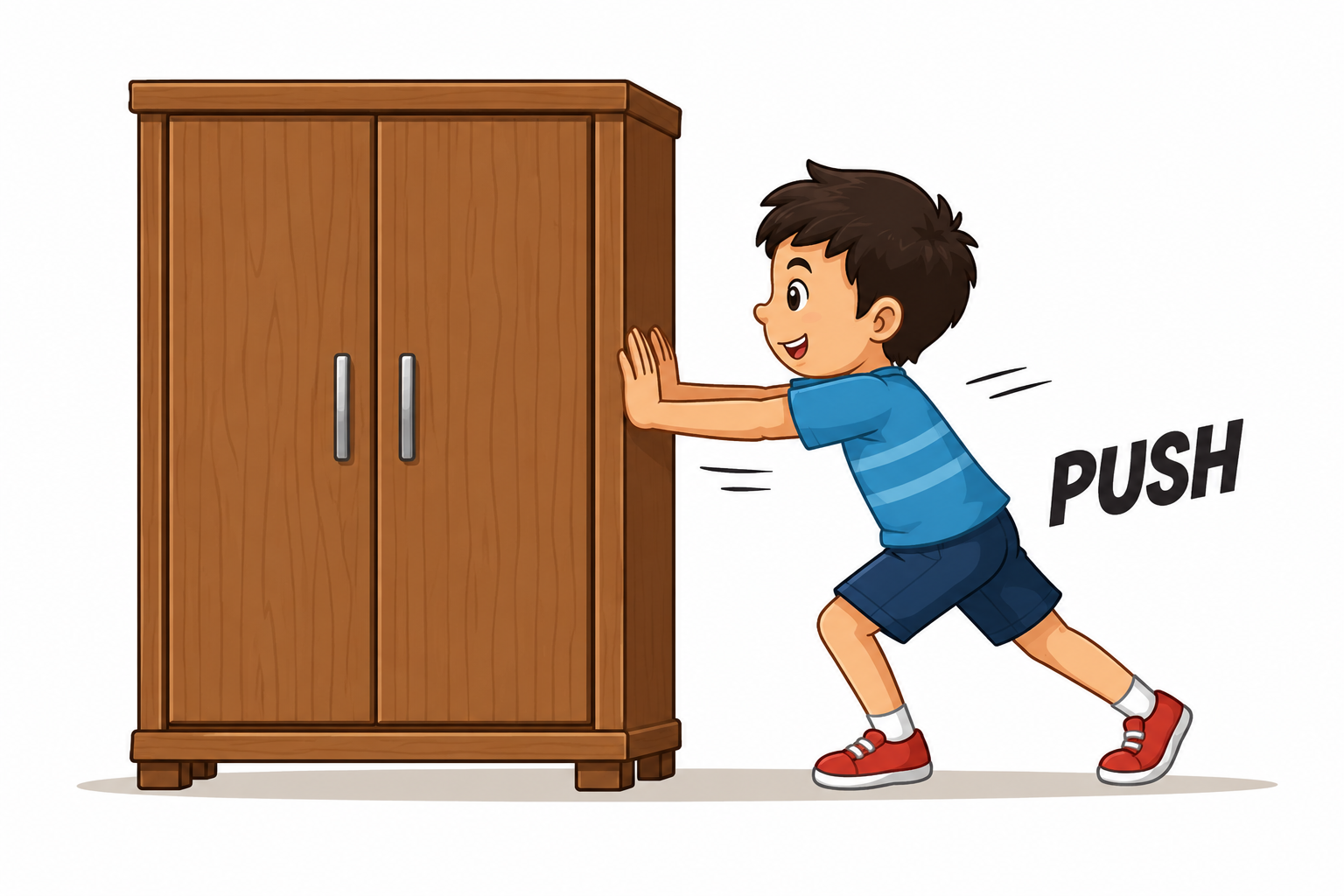
An object will not move on its own unless it is pushed. After applying a push on the object, acceleration is produced and the object moves forward. Again, if no force were applied to a moving object, it would continue moving with constant velocity.
Fundamental Force: The forces which are basic or natural in origin, meaning they are not produced from any other force but rather other forces arise from the manifestation of these forces, are called fundamental forces.
There are 4 types of fundamental forces—
⇒ Gravitational Force
⇒ Electromagnetic Force
⇒ Strong Nuclear Force
⇒ Weak Nuclear Force
Gravitational Force: The attractive force that exists between any two objects in the universe is called gravitational force.
Electromagnetic Force: The attractive or repulsive force exerted between two charged particles due to their charges is called electromagnetic force.
Strong Nuclear Force: The strong force that holds the nuclear particles together inside the nucleus of an atom is called strong nuclear force.
Weak Nuclear Force: The short-range and weak force that acts among the fundamental particles inside the nucleus and causes instability in many nuclei is called weak nuclear force.
Contact Force and Non-Contact Force
Contact Force:
The force that requires direct physical contact between two objects for its creation is called a contact force.
Examples: Frictional force, pulling force, force produced during collision.
Non-Contact Force:
The force that acts between two objects without direct physical contact is called a non-contact force.
Examples: Gravitational force, electromagnetic force.
Balanced Force and Unbalanced Force
Balanced Force:
When multiple forces act on an object and the resultant force becomes zero, those forces are called balanced forces.
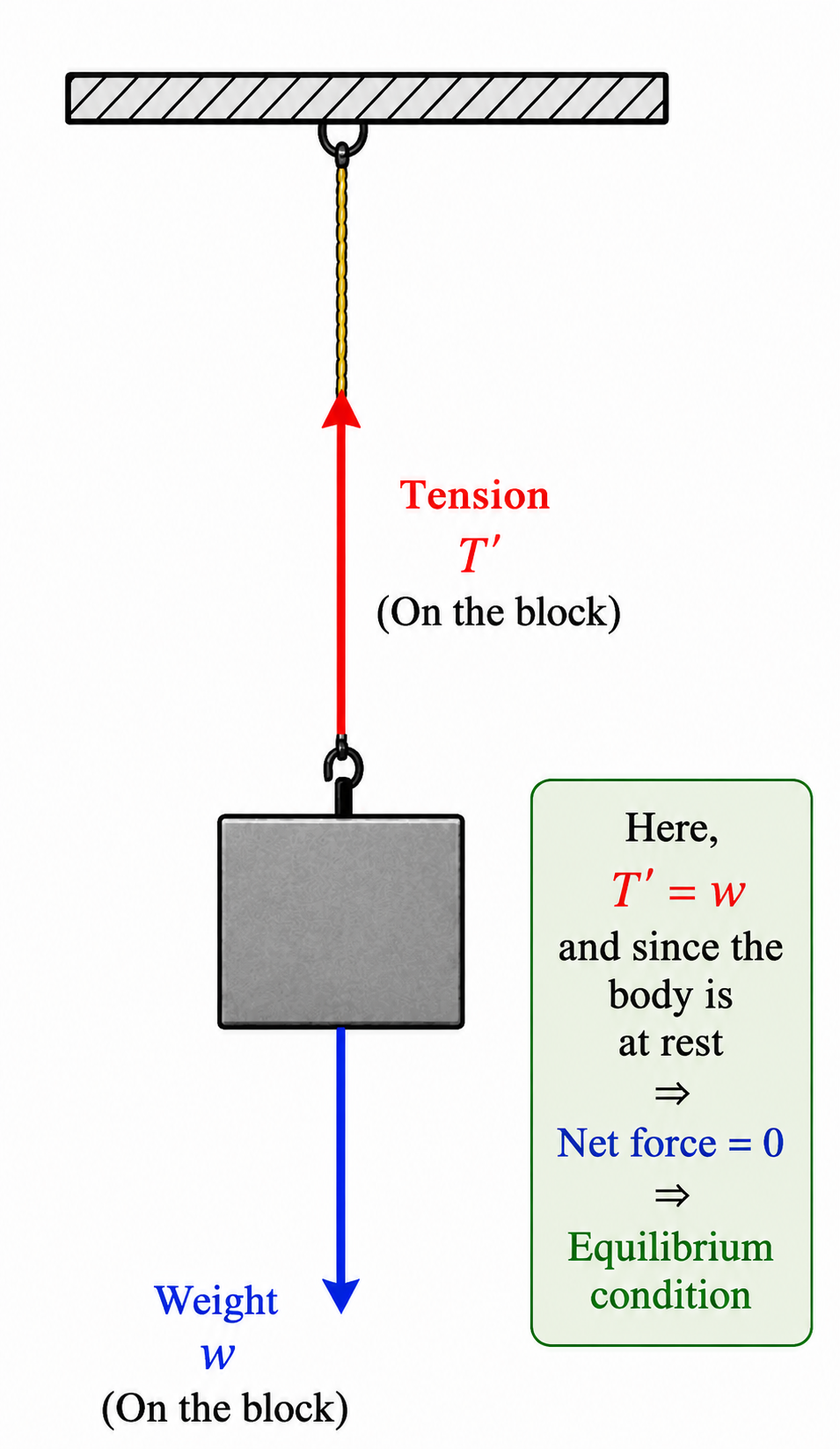
If an object is suspended by a string, the gravitational force of the Earth on the object, i.e., the weight of the object (W), acts vertically downward. At the same time, the tension of the string (T) acts vertically upward. Since the two forces are equal in magnitude and opposite in direction, they cancel each other’s effect and create a state of equilibrium.
Unbalanced Force :
When multiple forces act on an object and the resultant force has both magnitude and direction, such forces are called unbalanced forces.
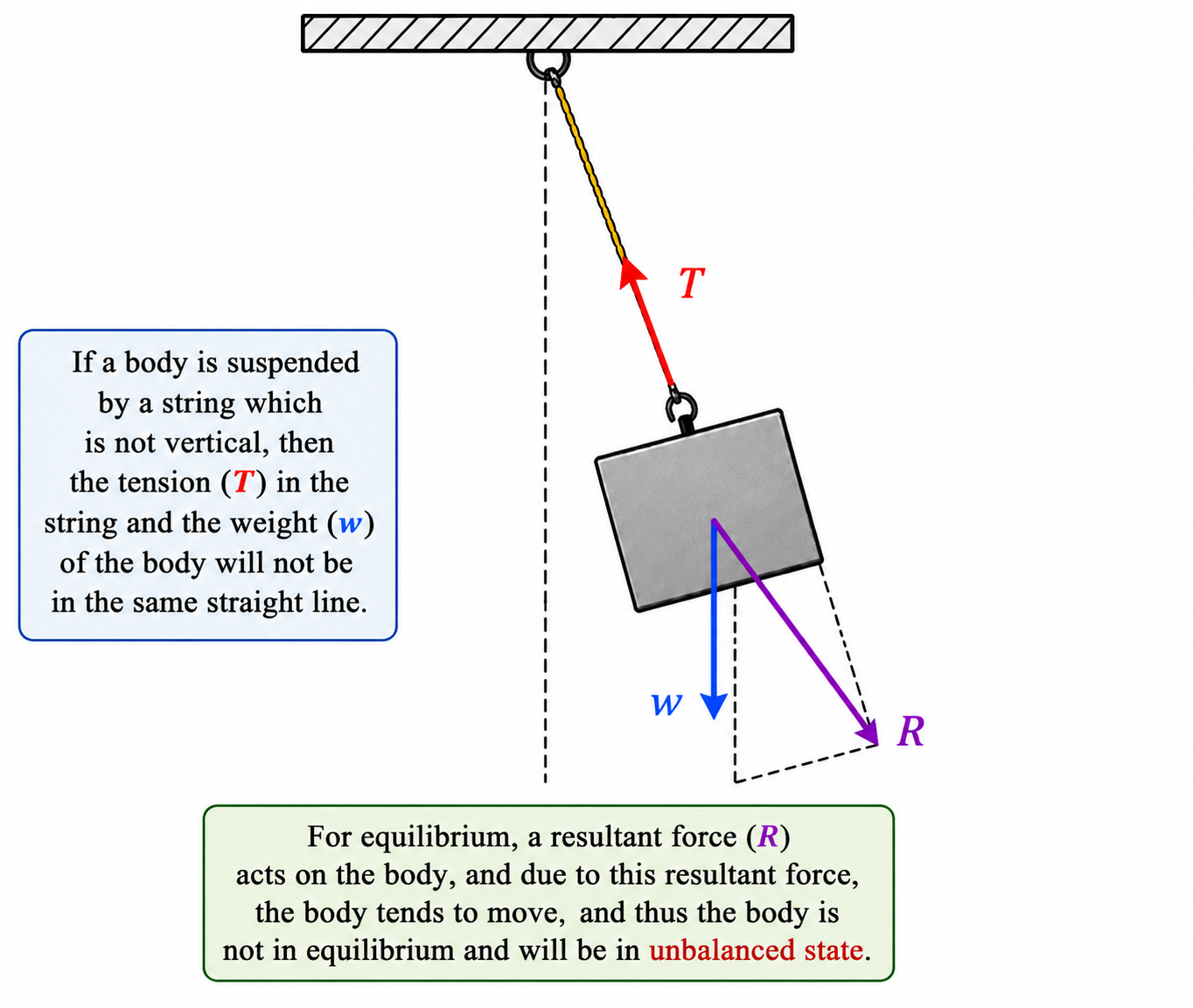
If the object is pulled slightly to one side, then the tension of the string (T) and the weight of the object (W) will no longer remain along the same straight line. As a result, equilibrium will not exist; instead, a resultant force will act on the object. Consequently, the object will continue to oscillate, creating a state of imbalance.
Difference Between Balanced Force and Unbalanced Force
| Balanced Force | Unbalanced Force |
|---|---|
| 1. When multiple forces act on an object and the resultant force becomes zero, those forces are called balanced forces. | 1.When multiple forces act on an object and the resultant force has both magnitude and direction, such forces are called unbalanced forces. |
| 2. If two forces act, they will be equal in magnitude and opposite in direction. | 2. If two forces act, they will be unequal in magnitude and may act in the same direction or in opposite directions. |
| 3. A stationary object remains stationary, and a moving object continues to move with the same velocity in the same manner. | 3.A stationary object starts moving toward the greater force, and the speed and direction of a moving object change. |
| 4. The resultant force is zero. | 4. The resultant force is non-zero. |
| 5. There is no acceleration. | 5. The object has acceleration. |
Newton’s Laws of Motion and Their Explanation
In 1686, Sir Isaac Newton published three laws in his immortal book Philosophiae Naturalis Principia Mathematica. These three laws are known as Newton’s Laws of Motion.
First Law:
If no external force is applied, a stationary object will remain at rest, and a moving object will continue to move in a straight line with uniform velocity.
Second Law:
The rate of change of momentum of an object is proportional to the applied force, and the change in momentum occurs in the direction in which the force acts.
Third Law:
For every action, there is an equal and opposite reaction.
Derivation of Newton’s Second Law or the Relation
Suppose an object of mass is moving with an initial velocity . Now, if a constant force acts on the object in the direction of motion for a time , then as long as the force acts, the velocity of the object will continue to increase uniformly. Let the velocity of the object after time be v.
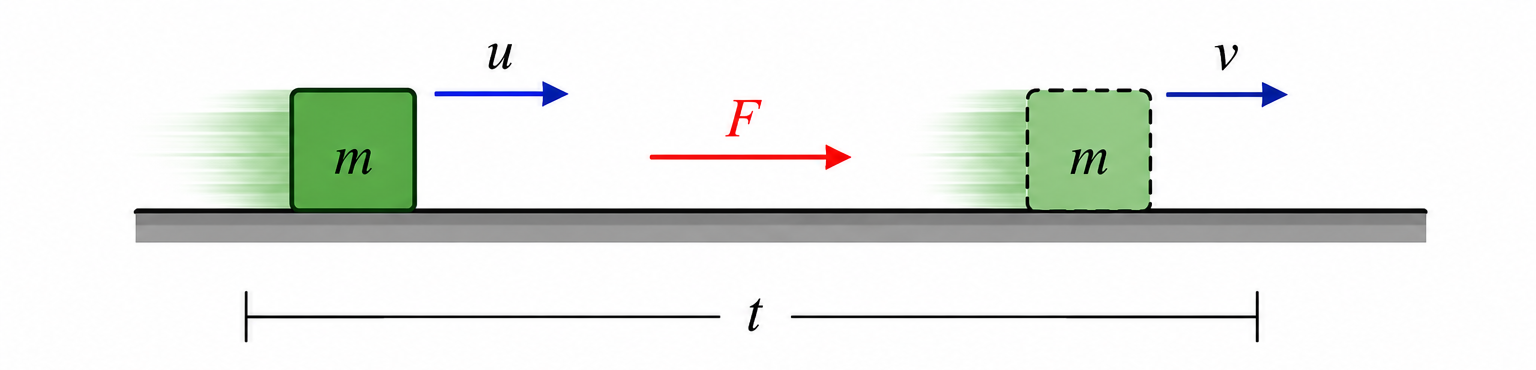
Initial momentum of the object 
Final momentum of the object 
Change in momentum of the object in time 


Rate of change of momentum 

But, 
Therefore, 
According to Newton’s Second Law of Motion,

Where,  is a proportionality constant.
In SI unit, 
Therefore, 
( Proved )
Derivation of Newton’s First Law from the Second Law
From Newton’s Second Law, we know that, 
Now, if no external force is applied, that is, if 
then from equation (i), 
Since the mass  of an object cannot be zero,

That means the velocity of the object remains unchanged
Therefore, a stationary object remains stationary, and a moving object continues to move with uniform velocity in a straight line unless an external force acts on it.
Hence, Newton’s First Law is proved from the Second Law.
Explanation of Newton’s Third Law
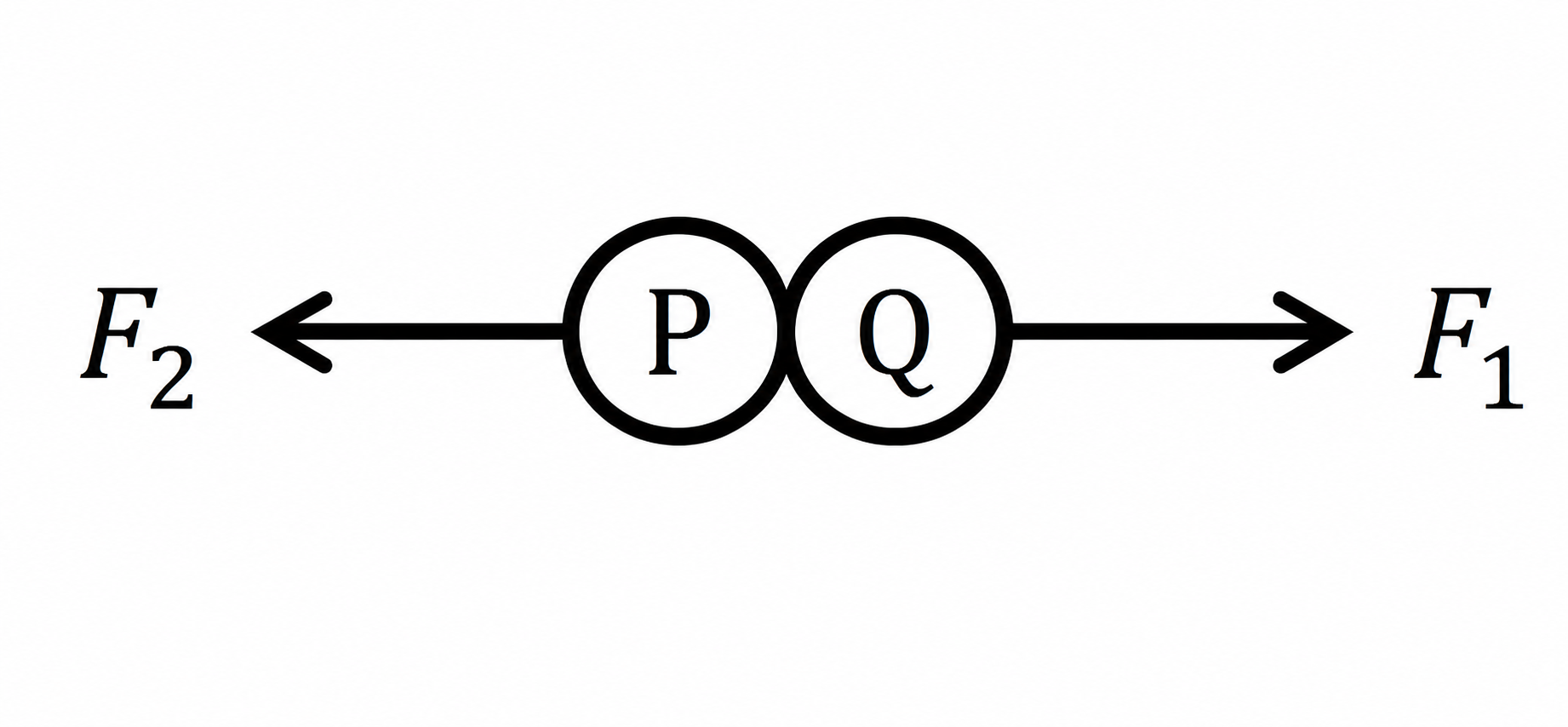
According to Newton’s Third Law, for every action there is an equal and opposite reaction. That is, action and reaction are equal in magnitude and opposite in direction.
According to the figure, if object P exerts a force  on object Q, then according to the law, object Q will also exert an equal and opposite force
  on object P.

Momentum: The product of mass and velocity is called momentum.
Formula: 
Here,
Mass 
Velocity 
Law of Conservation of Momentum
Statement of the Law :
If no external force acts on a system of two or more objects except action and reaction forces, then the total momentum of the objects in a particular direction remains unchanged.
Suppose,  and
and  are two objects moving along the same straight line in the same direction with velocities
  and
and  respectively. Their masses are
  and
and  . If the velocity of is greater than that of , that is,
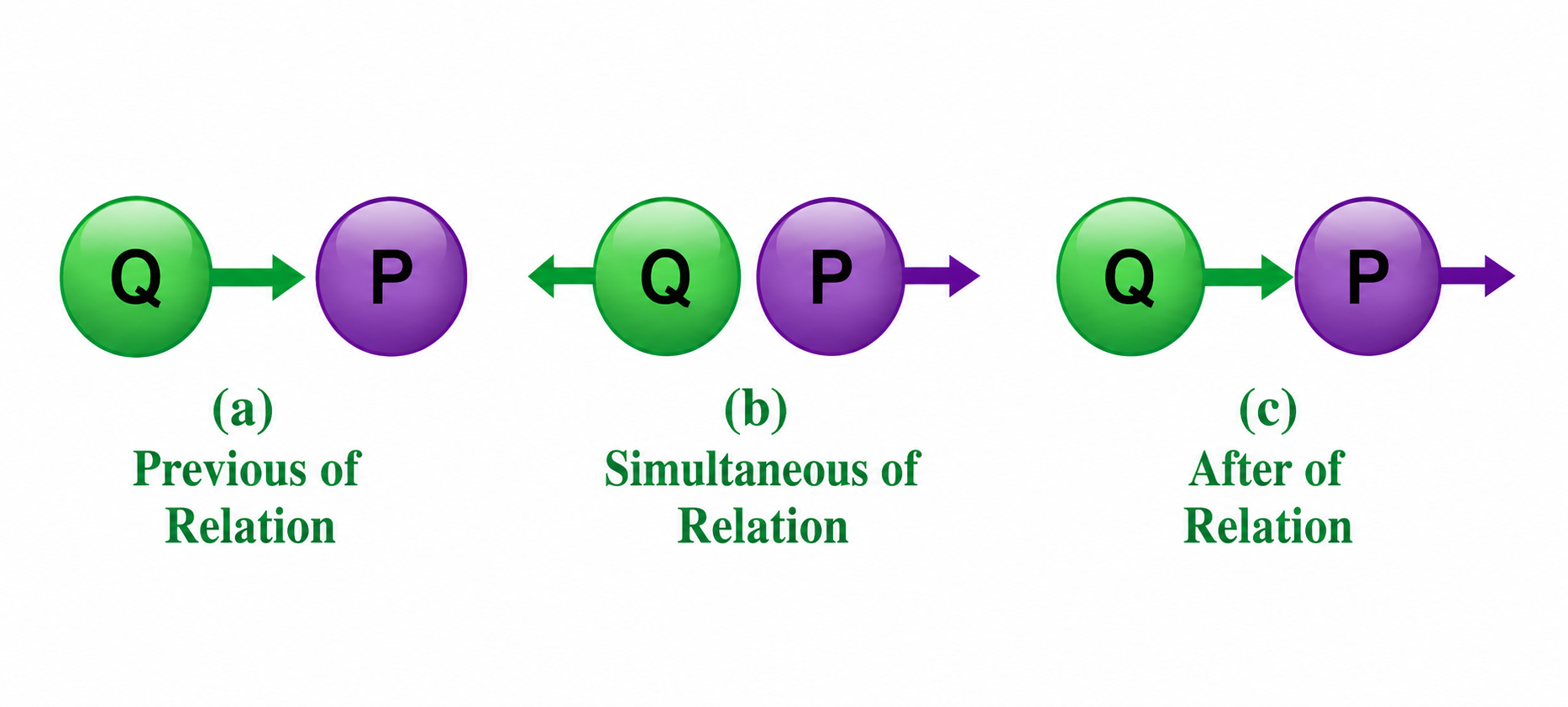
Object exerts a force on object . Now, object will also exert a force on object . The force exerted by object on object is .
According to Newton’s Third Law,
or, 
or,
or, 
or, 
Therefore, the total momentum of objects and before and after the interaction always remains equal.
Now, suppose that after collision, objects and stick together. That is, after collision both objects move with the same velocity.
Then, 
This formula will be applicable.
Again, during the collision, no force acts between the two objects except the action and reaction forces. From Newton’s Second Law, we get,
From this equation, we can express the change in momentum as follows:
That is, 
But the product of force and time is called the impulse of force.
Therefore, 
Gravitational Force
In this universe, any two objects or particles attract each other. The magnitude of this attractive force depends only on the masses of the two objects and the distance between them. It does not depend on their shape, nature, or the nature of the medium between them. This attraction is called gravitation.
Newton’s Law of Gravitation :
Every particle in the universe attracts every other particle toward itself, and the magnitude of this attractive force is directly proportional to the product of the masses of the two particles and inversely proportional to the square of the distance between them. This force acts along the straight line joining the two particles.
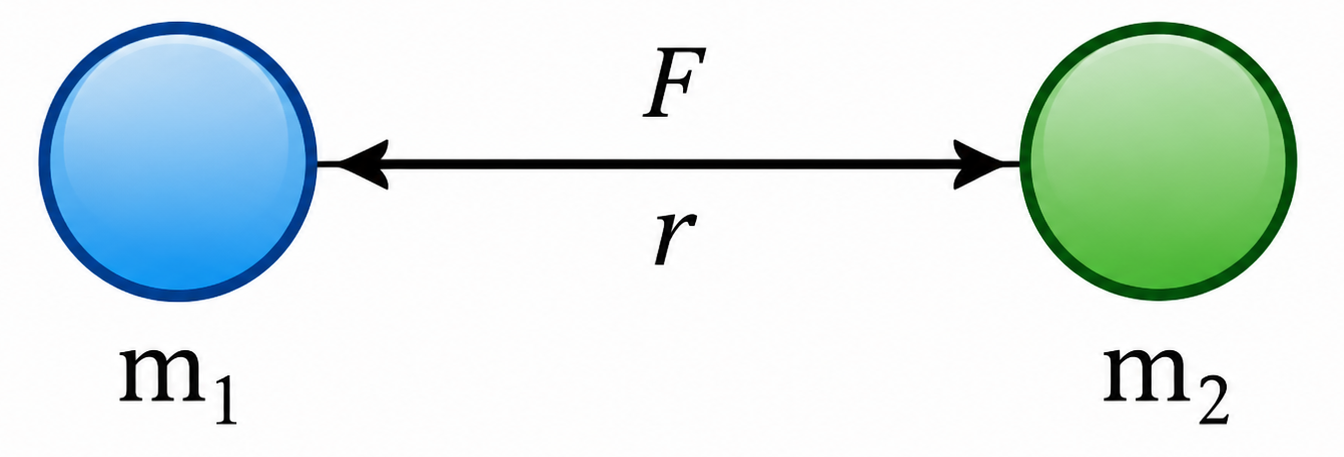
Suppose two objects of masses and are separated by a distance  .
.
First object mass 
Second object mass 
Distance between them 
 = Gravitational constant
Law of Gravitation Formula: 
Example
Suppose an object of mass is dropped from above. We know that due to the gravitational force of the Earth, the object will experience a force toward the Earth.
Formula: 
Where,= Gravitational constant = Mass of the Earth
 = Radius of the Earth= Mass of the object
Frictional Force
When one object tries to move or continues to move over another object while remaining in contact with it, a resistance is produced at the contact surface against the motion. This resistance is called friction, and the force causing this resistance is called frictional force.
Note: Frictional force always acts opposite to the direction of motion. Friction always opposes motion.
Friction can be divided into four types. They are:
1. Static Friction
2. Sliding Friction
3. Rolling Friction
4. Fluid Friction
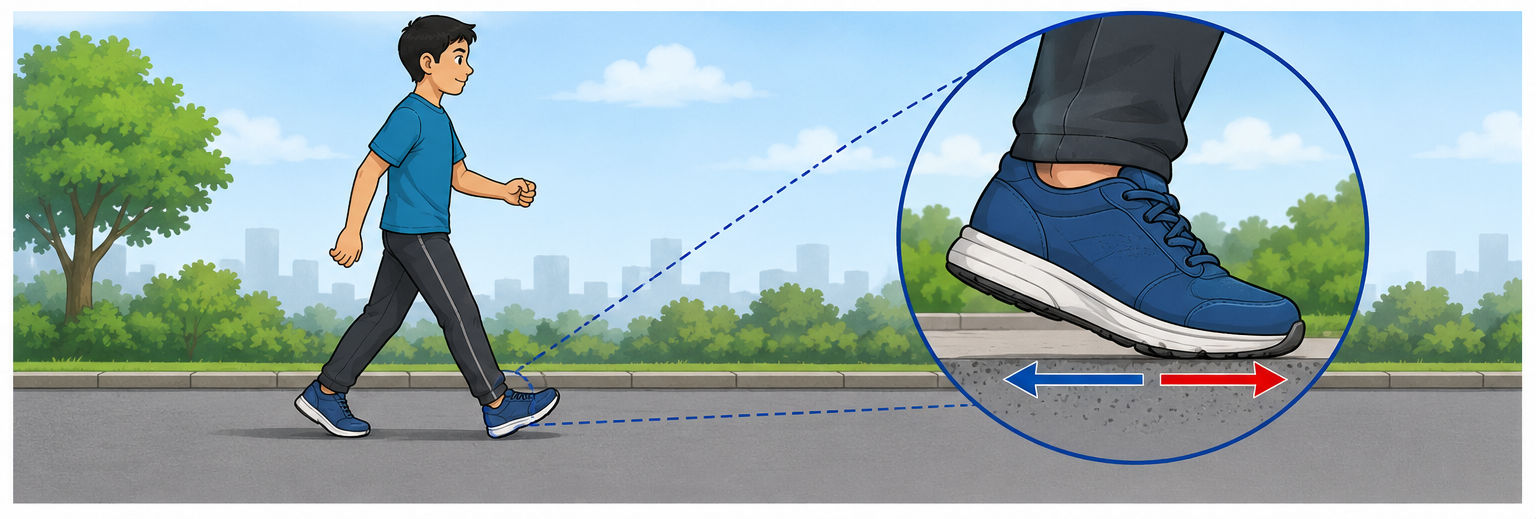
Static Friction:
When one of two surfaces is not moving relative to the other, the friction produced between them is called static friction.
Example: We are able to walk because of static friction.
kinetic Friction:
When one object moves relative to another object, the frictional force produced is called kinetic Friction .
If the mass of an object is , then its weight is a force whose magnitude is:  ,kinetic Friction
  ,Coefficient of friction
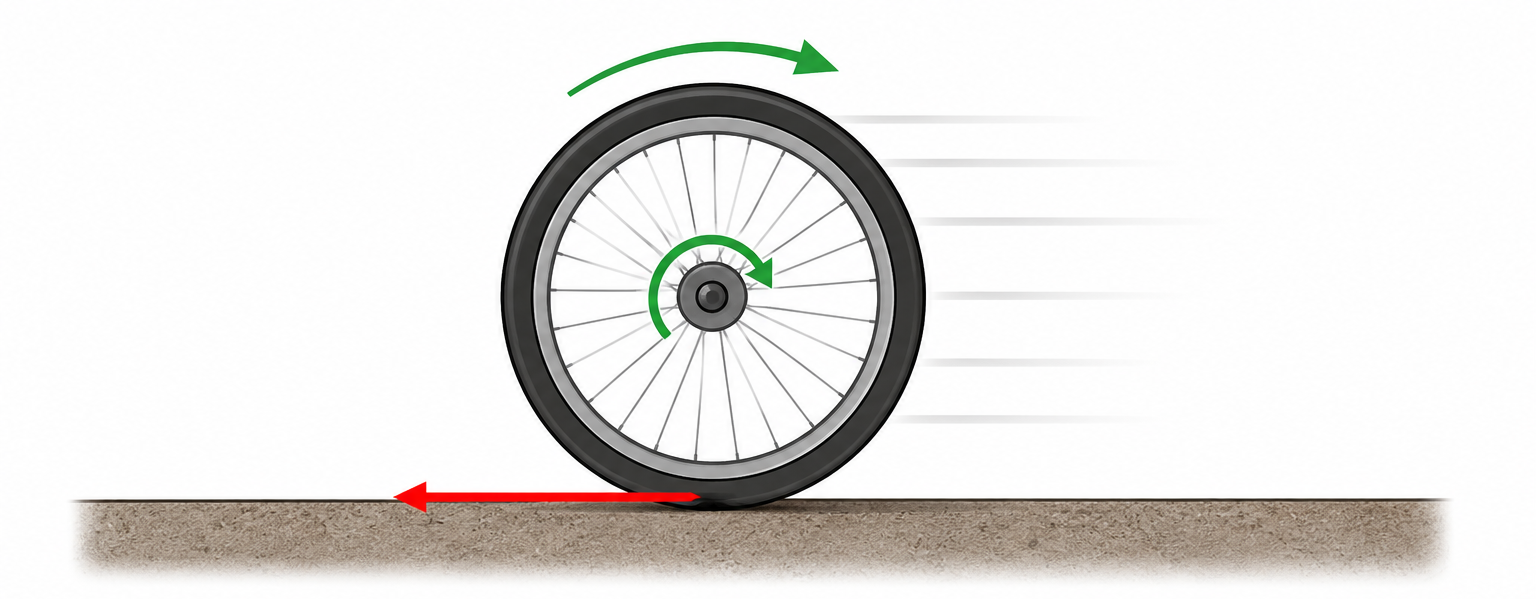
Rolling Friction:
When an object rolls over another surface, the friction acting against the motion is called rolling friction.
Example: Motion of bicycle wheels, motion of marbles.
Fluid Friction:
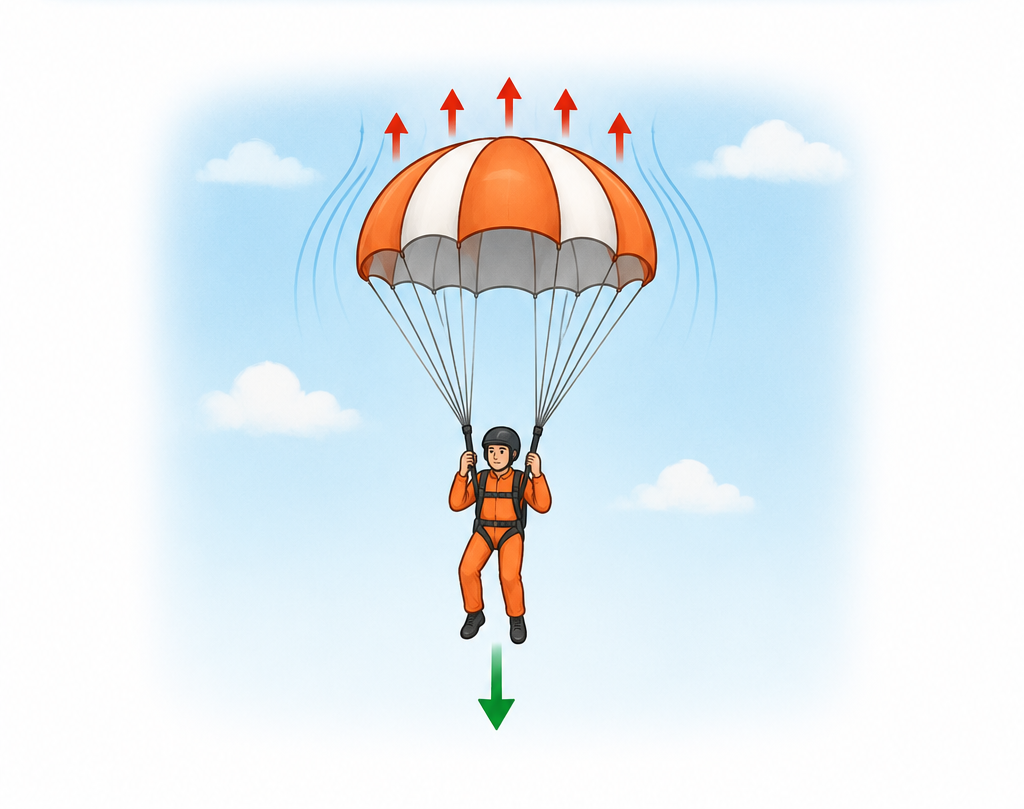
When an object moves through any fluid substance such as liquid or gas, the friction acting on it is called fluid friction.
Example: A person with a parachute can slowly descend due to the fluid friction of air.
Effect of Friction on Motion
Surface of the Tire:
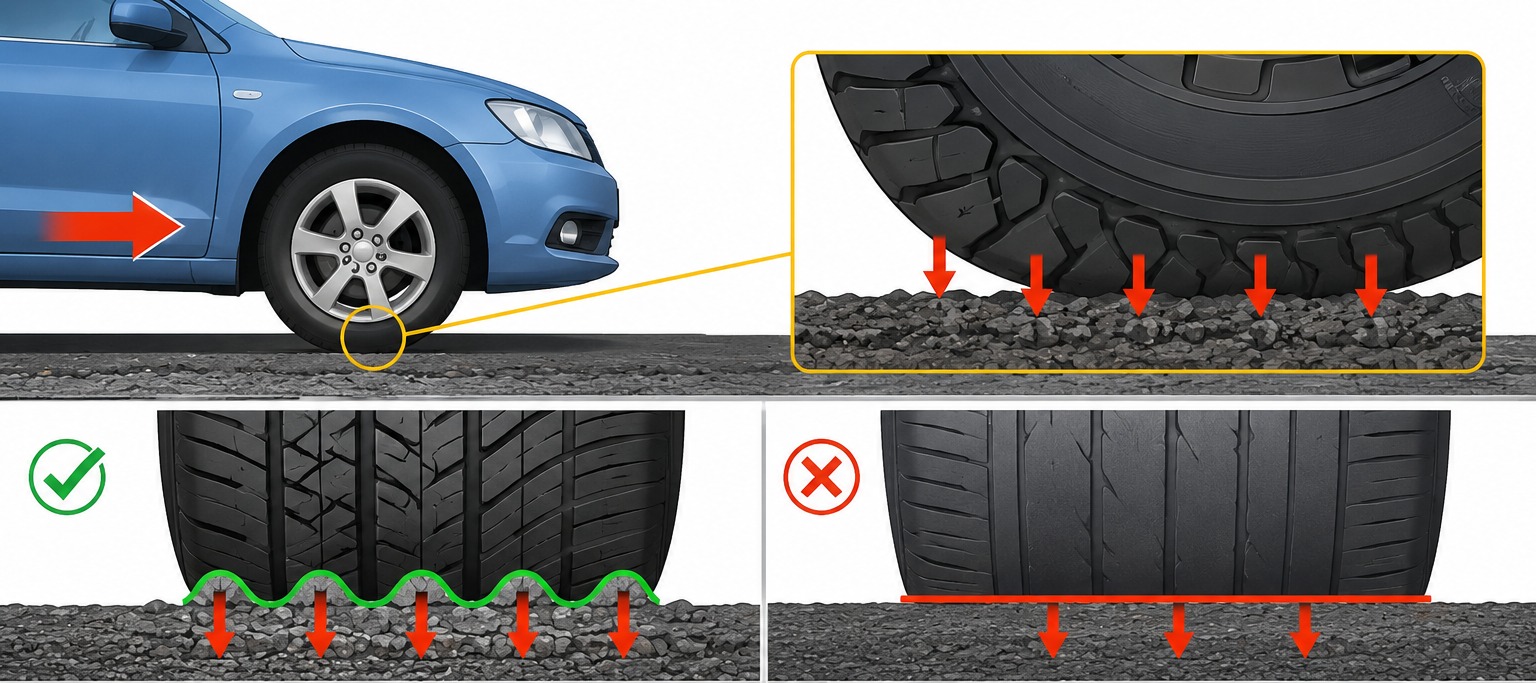
Driving a vehicle is possible because of the friction between the vehicle’s tire and the road. The magnitude of this frictional force depends on the external condition of the tire surface and the road surface. It also depends on the weight of the vehicle.
Different patterned teeth or grooves are made on the rubber surface of vehicle tires. As a result of these grooves, the tire surface becomes uneven. When the tire is new, these grooves are clearly visible, so the frictional force between the road and the tire is maximum. On the other hand, when the tire becomes old, the grooves wear away and the tire surface becomes smooth. As a result, the frictional force between the road and the tire decreases significantly.
Smoothness of the Road:
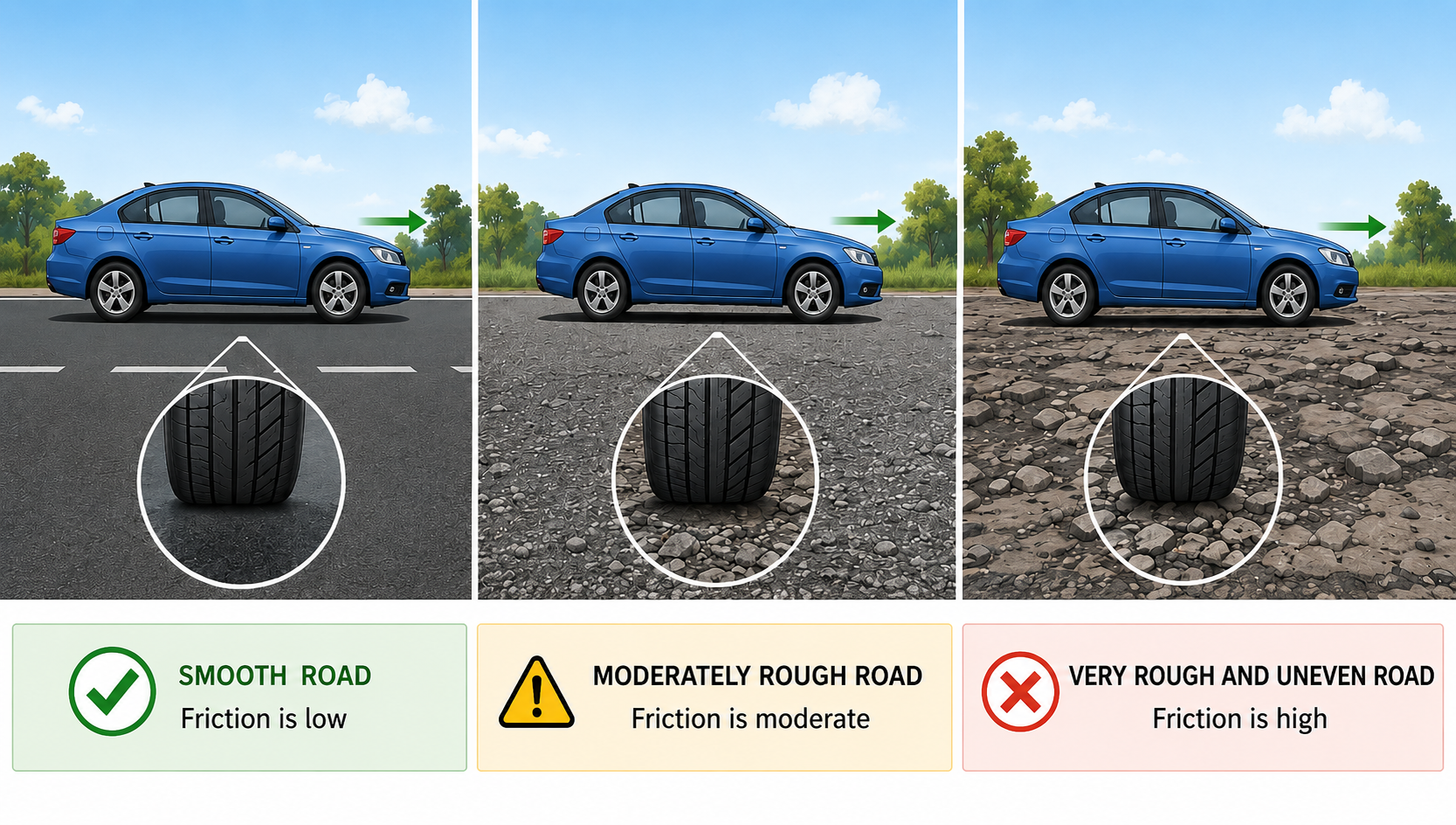
The smoothness of the road has a great effect on the motion of objects. If the road is smooth, the movement of vehicles becomes easier and traveling becomes comfortable. The smoother the road, the smaller the magnitude of the opposing frictional force.
The magnitude of the frictional force between the vehicle tire and the road depends on both the tire surface and the smoothness of the road. If the amount of friction decreases too much, various problems may arise. Therefore, making the road excessively smooth is not suitable. If the road becomes too smooth, it may not be possible to stop the vehicle at a specific place even after applying the brakes.
Speed Control and Braking Force:
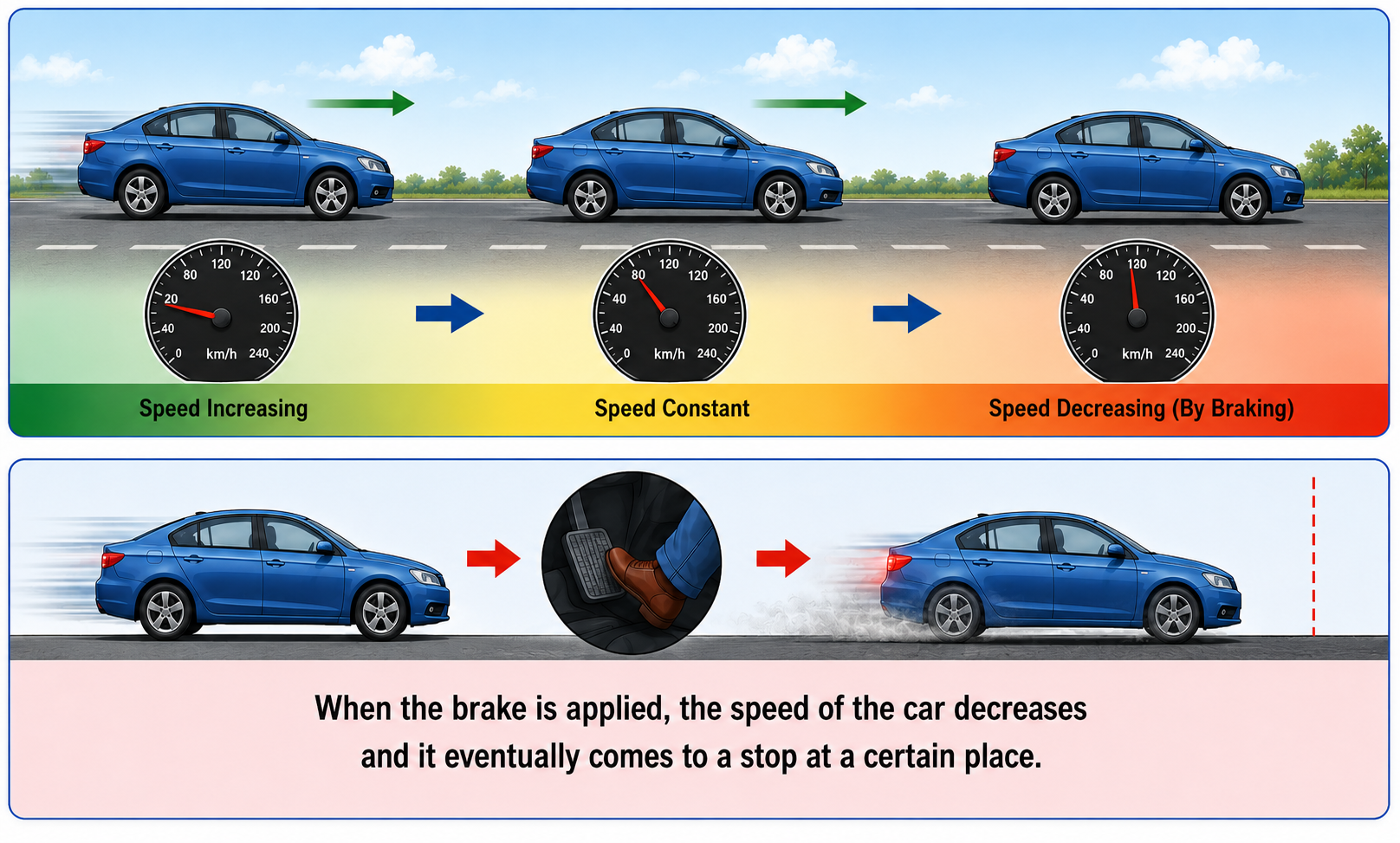
During the movement of vehicles, it is necessary to increase or decrease the speed of the vehicle as required. That is, the speed of the vehicle needs to be controlled.
A brake is a system that increases friction and controls the speed of the vehicle, that is, the rotation of the wheels as required. Through this system, a vehicle can be stopped at a specific place.
When the driver applies the brake, brake shoes or pads made of asbestos press against the metallic disc attached to the wheel. The friction between the pad and the disc reduces the speed of the wheel. As a result, the velocity of the vehicle decreases.
Pulley (Pulley) Complete Note & Shortcut Technique
Type–1 (For a Frictionless Surface)
Suppose,
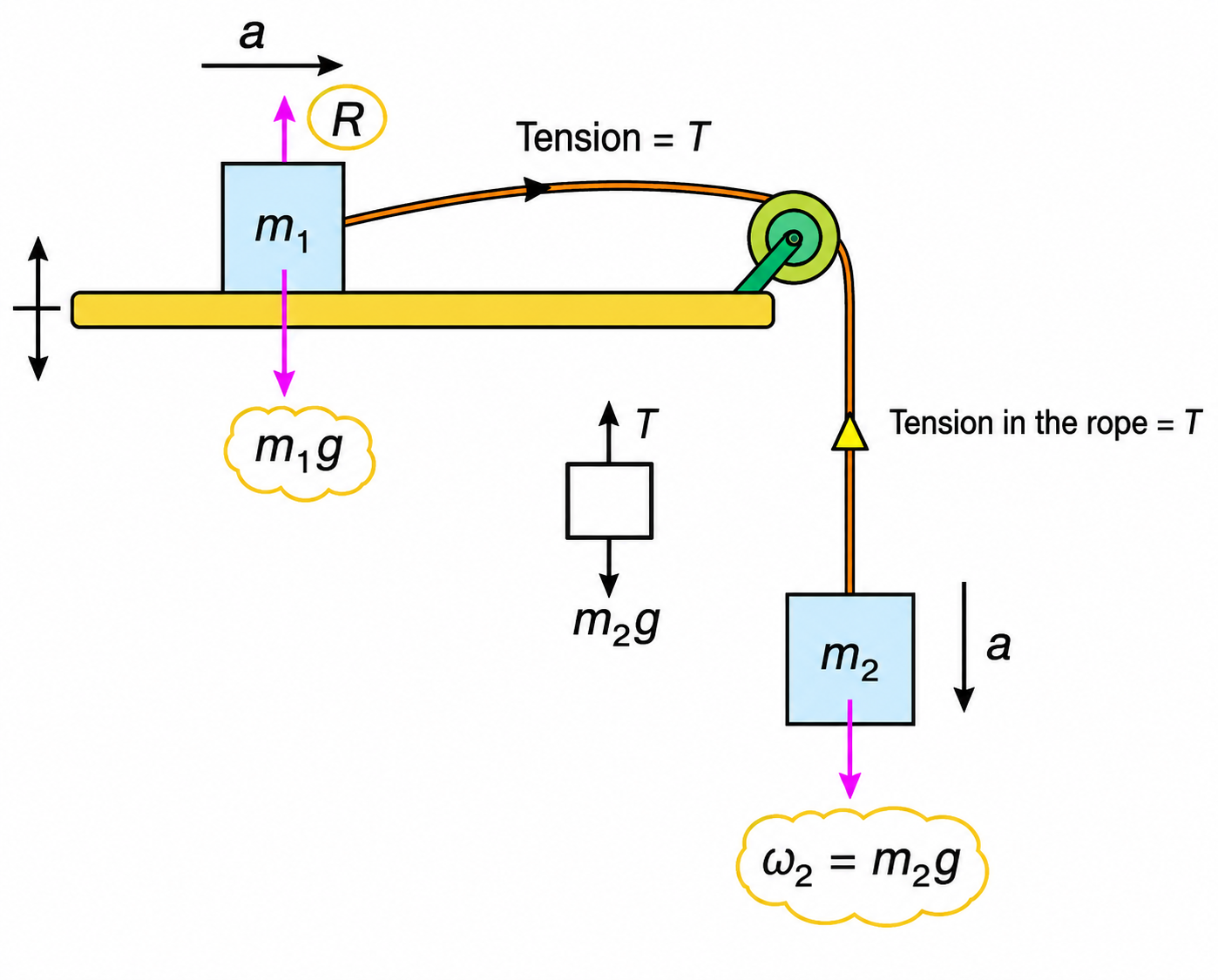
👉An object of mass is placed on a smooth table.
👉An object of mass is hanging vertically downward.
👉The two objects are connected by a light string passing over a smooth pulley.
Here, 
Therefore,
👉 will move downward.
👉 will move toward the right.
👉 The acceleration of both objects will be  .
.
👉 The tension in the string will be  .
.
Downward:
Weight,
Upward:
Tension
For the Hanging Object ( ):
):
Since the object is moving downward with acceleration, ……………………………………..(1)
For the Object on the Table ( ):
):
Since the object is moving toward the right with acceleration, ……………………………………..(2)
Substituting the value of from equation (2) into equation (1), we get,
➜ 
➜ 
➜ 
Therefore, acceleration: 
Tension in the String:
Using,
So, 
Shortcut Trick to Remember :
If,
👉One object remains on the table,
👉The other object hangs vertically,
👉There is no friction,
Then, acceleration:
Type–2 (For a Surface with Friction)
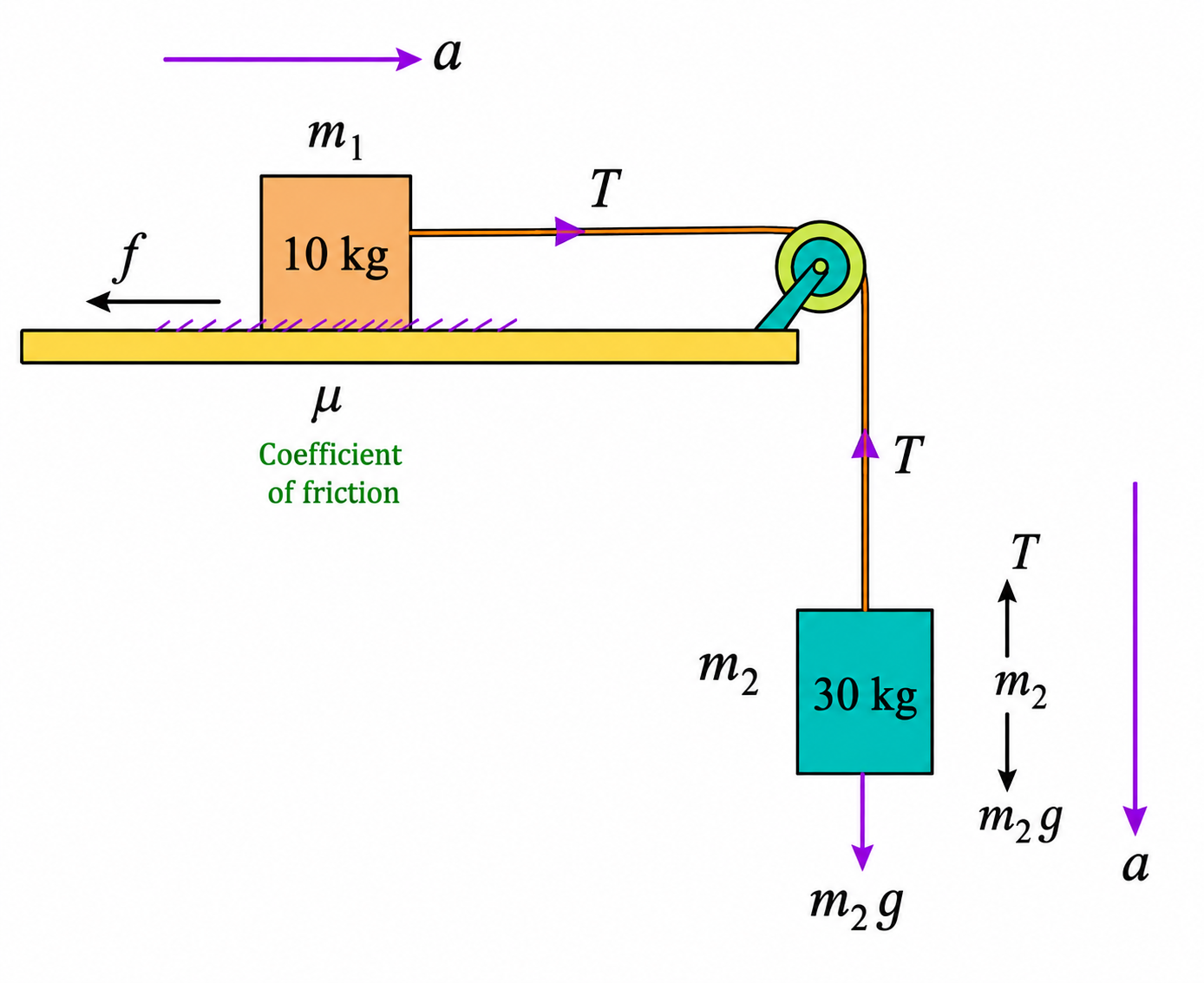
Suppose,
👉An object of mass is placed on a rough table.
👉An object of mass is hanging vertically downward.
👉The two objects are connected by a light string passing over a smooth pulley.
Here,
Therefore,
➤ will move downward.
➤ will move toward the right.
➤ The acceleration of both objects will be .
➤ The tension in the string will be .
Downward:
Weight,
Upward:
Tension,
For the Hanging Object ():
Since the object is moving downward with acceleration,……………………………………..(1)
For the Object on the Table ():
Since the object is moving toward the right with acceleration, ……………………………………..(2)
Where, frictional force, 
Adding equations (1) and (2), we get,

Substituting the value of frictional force,
Therefore, acceleration: 
Type–3 (System of Three Connected Masses)
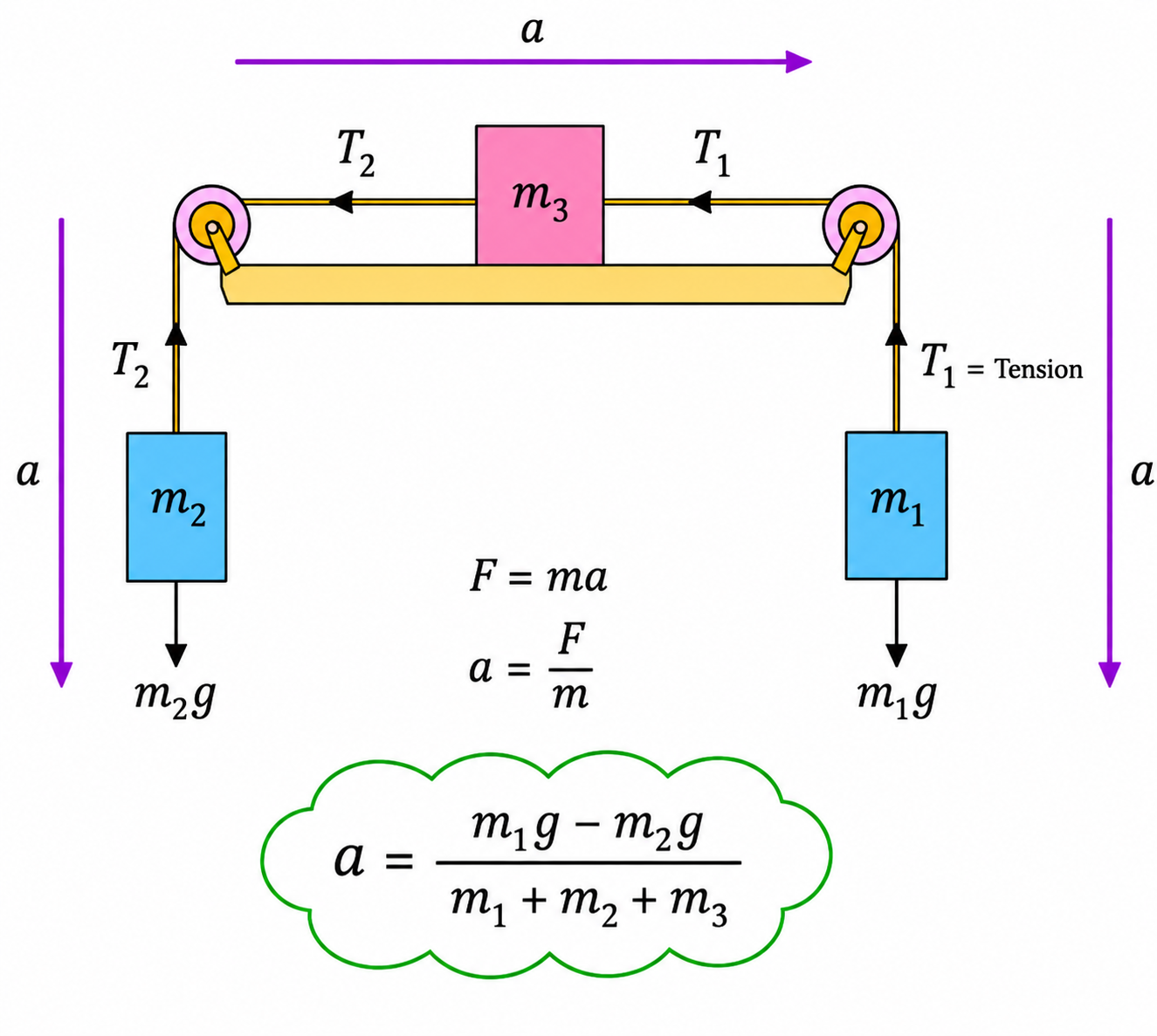
Suppose,
👉Two hanging masses are and  .
.
👉In the middle, a mass is placed on a table.
👉Due to two separate strings, two tensions are produced on the two sides:  and
and  .
.
Here,
➤ moves downward.
➤ moves upward.
➤ moves toward the right.
➤ The magnitude of acceleration of all the objects is the same  .
.
For Object
Since is moving downward, ……………………………………..(1)
For Object 
Since is moving upward, ……………………………………..(2)
For Object
Since is moving toward the right,
👉Tension acts toward the right.
👉Tension acts toward the left.
Therefore, ……………………………………..(3)
Adding equations (1), (2), and (3), we get,

Therefore, acceleration: 
👉 Shortcut Method:
If we consider the whole system together,
Total external force: 
Total mass: 
Then, 
That is,
Type–4 (Frictionless Pulley)
A pulley machine is a system where two masses and are connected by a light string, and the string passes over a frictionless pulley. If, 
then,
👉will move downward.
👉will move upward.
The acceleration of both objects will be equal; let it be .
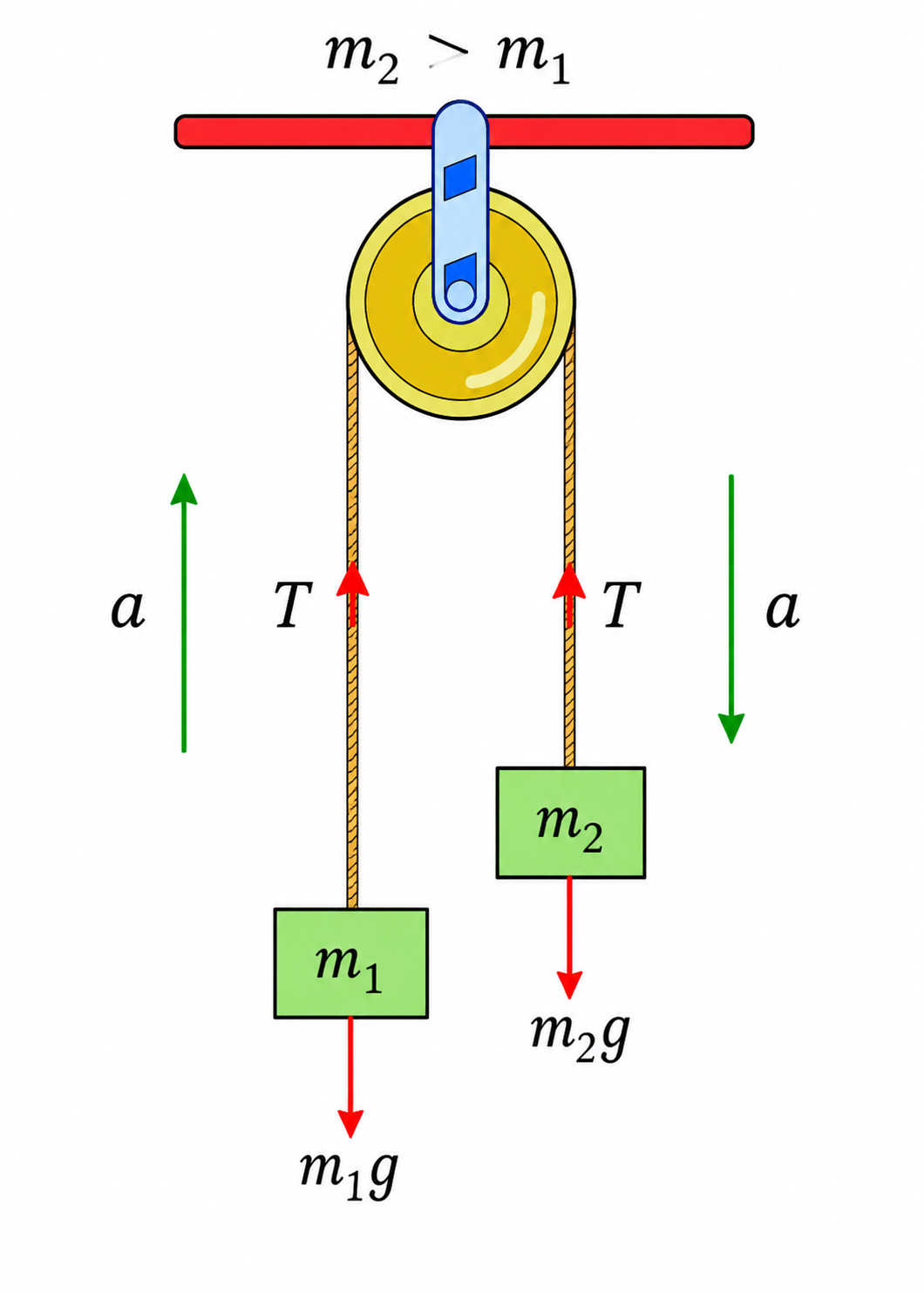
Since , the system will accelerate towards .
For object :
Downward force = 
Upward force =
Since is moving upward,
For object :
Upward force =
Downward force = 

Adding equations (1) and (2), we get,


👉 Shortcut way to remember: 

Edutrack BD
শিক্ষার আলো ছড়িয়ে দিতে আমরা প্রতিশ্রুতিবদ্ধ। নির্ভরযোগ্য নোট, সাজেশন, গাইডলাইন ও সহজ ব্যাখ্যার মাধ্যমে শিক্ষার্থীদের সফলতার পথে এগিয়ে নিতে Edutrack BD সবসময় পাশে আছে। শেখা হোক সহজ, প্রস্তুতি হোক স্মার্ট।
Categories
- Chemistry (2)
- Class 8 (4)
- General Math ( Bangla Version ) (2)
- Higher Math (2)
- HSC (10)
- HSC Physics 2nd Paper Notes ( English Version ) (1)
- ICT (2)
- ICT ( English Version ) (1)
- Math (1)
- Math ( English Version ) (1)
- Physics ( Bangla Version ) (1)
- Physics ( Englisg Version ) (1)
- Science ( Bangla Version ) (1)
- Science ( English Version ) (1)
- SSC ( Bangla Version ) (1)
- SSC ( English Version ) (9)
- Uncategorized (1)