

Chemical Bonding
Valence Electron:
The total number of electrons in the outermost principal energy level of an element is called the valence electron(s) or valency electron(s) of that element. The last orbit is called the valence shell.
✅️ From the number of valence electrons, the valency of an element can be easily determined.
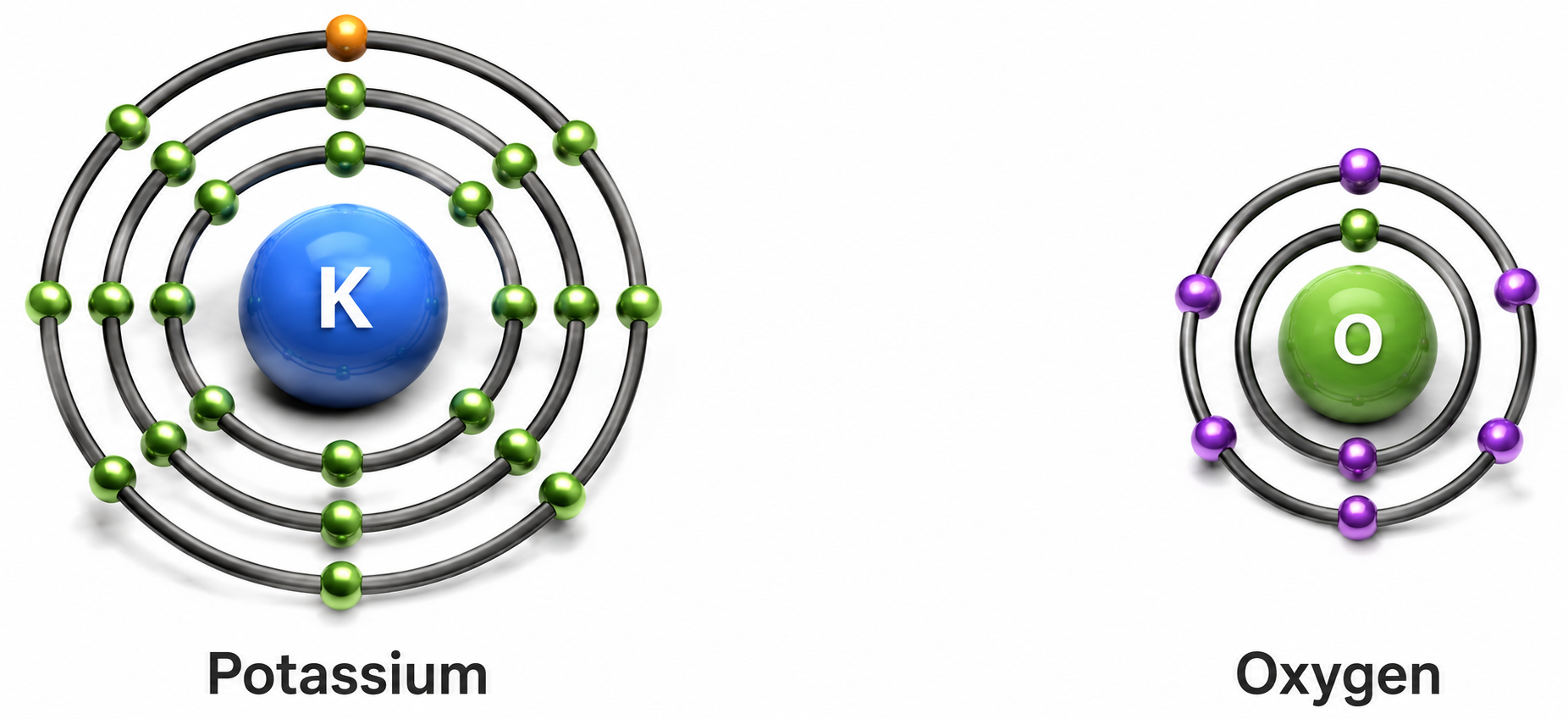
In the electron configurations of potassium and oxygen, there are 1 and 6 electrons respectively in their outermost orbit. Therefore, K has 1 valence electron and oxygen (O) has 6 valence electrons.
Example–1:
What are the numbers of valence electrons in Li, Na, O, and F?
Na(11) → 2, 8, 1 ⇒ Na has 1 valence electron
Li(3) → 2, 1 ⇒ Li has 1 valence electron
O(8) → 2, 6 ⇒ O has 6 valence electrons
F(9) → 2, 7 ⇒ F has 7 valence electrons
Therefore, the number of electrons in the outermost orbit of an element is the valence electron(s) of that element.
Valency and Valence
Valency: The number of electrons in the outermost shell of a metallic element, and the number of unpaired electrons in the outermost shell of a non-metallic element, is called valency.
Valence: The total number of electrons in the outermost shell of an element is called the valence of that element.
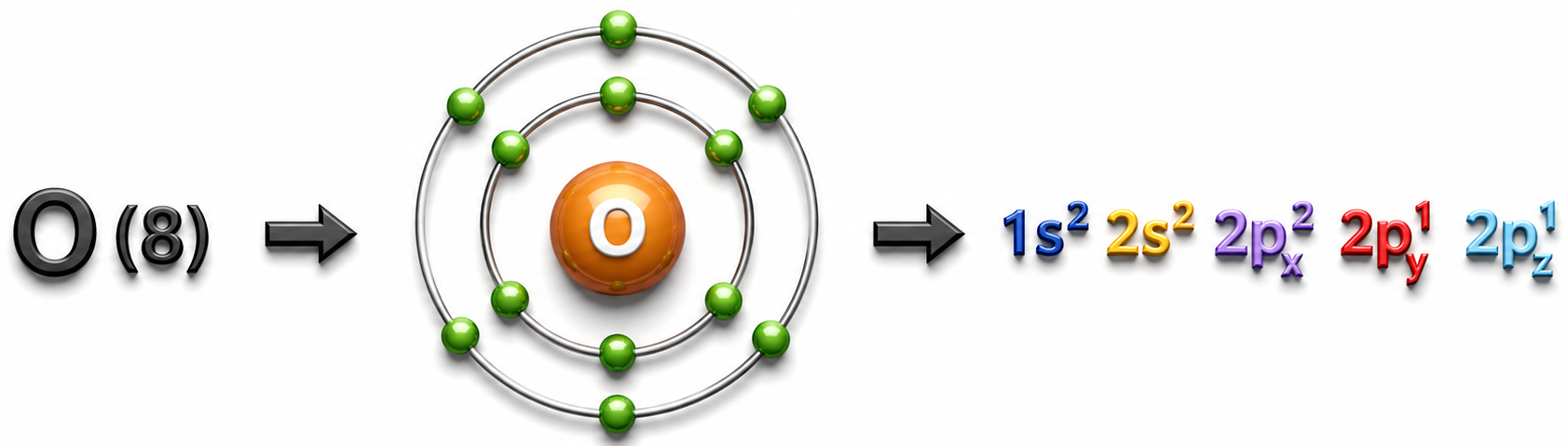
Here, the total number of electrons in the outermost shell of O is 6, so its valence is 6; and the number of unpaired electrons in the outermost shell of O is 2, so its valency is 2, and oxygen is a non-metal.
Explanation: Generally, the valency of an element is equal to its number of valence electrons. Alternatively, it is equal to the number obtained by subtracting the number of valence electrons from 4. The reason is that, during compound formation, the number of electrons that are lost, gained, or shared in order to achieve the electron configuration of a noble gas indicates the valency of that element.
✅️The number of atoms of the same element, or H atoms, or Cl atoms, with which one atom of an element can combine is called the valency or combining capacity of that element. And the valency of an H atom is always taken as 1.
✅️The valency or combining capacity of an atom is obtained by doubling the number of oxygen atoms that combine with that atom.
Note: The valency of H is always taken as 1.
Examples:
✅️In an HCl molecule, one H atom is combined with 1 Cl atom; therefore, the valency of chlorine is 1.
✅️In an H₂O molecule, one atom of O is combined with 2 atoms of H; therefore, the valency of oxygen is 2.
✅️CaO – One atom of calcium (Ca) is combined with one atom of oxygen (O), and the number of O atoms is 1. Doubling this number gives 2. Therefore, the valency of Ca is 2.
✅️NaCl – One Na atom is combined with one Cl atom. Therefore, the valency of Na is 1.
Latent Valency
If an element has more than one valency, then the valency of that element is called variable valency. For example: Fe has variable valencies of 2 and 3.
Definition: The difference between the highest valency and the active valency of an element is called the latent valency of that element.
For example, in the compound FeCl₂, the active valency of Fe is 2, but the highest valency of Fe is 3. Therefore, the latent valency of Fe in FeCl₂ is 3 − 2 = 1.
Radicals and Their Valencies
Definition: A group of atoms or ions of more than one element combine with one another to form an atomic group having a positive or negative charge, and it behaves like the ion of a single element. Such an atomic group is called a radical.
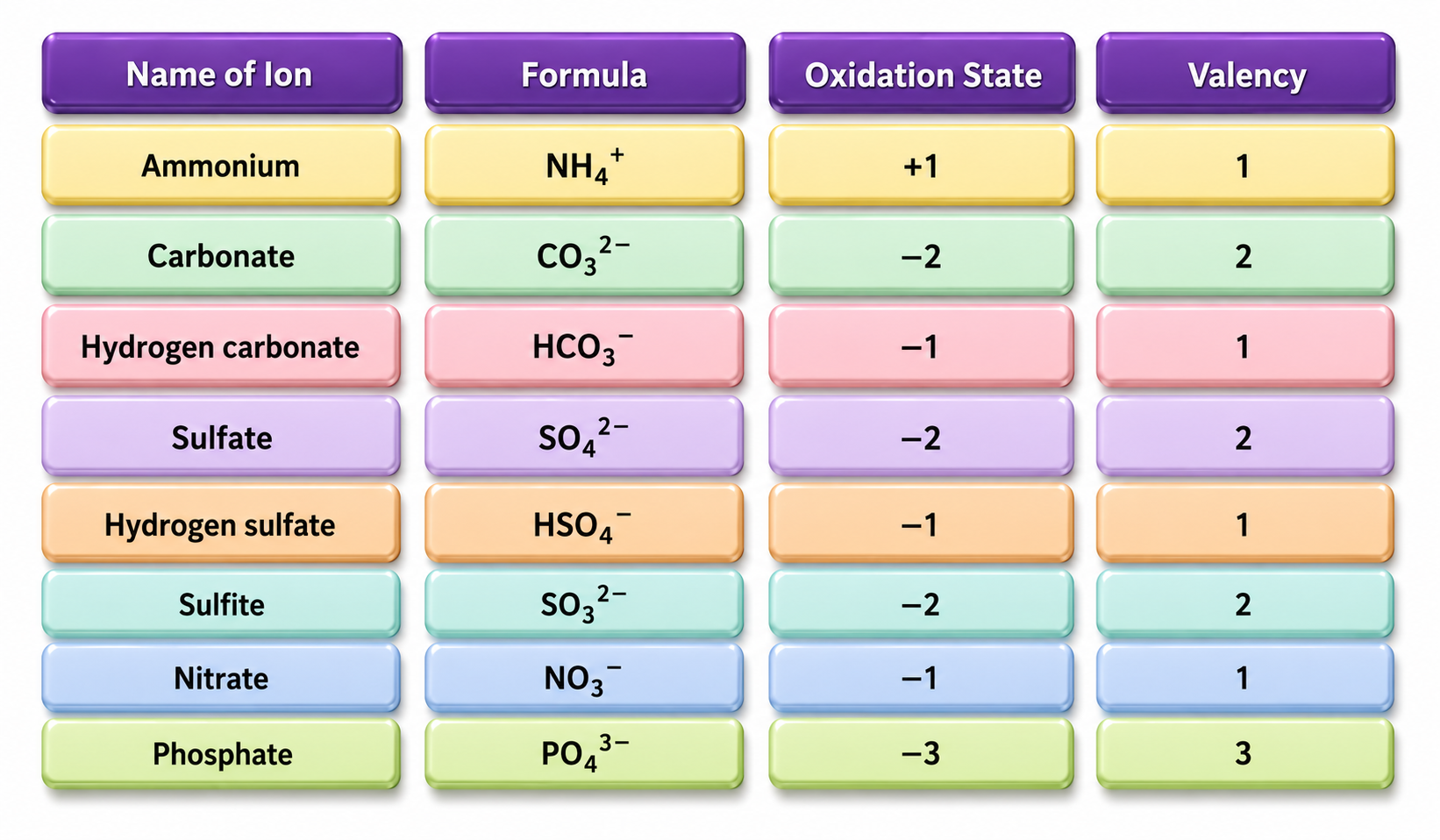
A radical may possess either a negative or a positive charge. The magnitude of its charge essentially indicates its valency.
Example:
In (NH₄⁺), one N atom combines with three H atoms and one H⁺ to form the radical called the ammonium ion (NH₄⁺). Its charge is +1. Therefore, its valency is one (1).
Names, Symbols, Charges, and Valencies of Various Radicals
Chemical Formula of a Compound
Expressing a compound molecule through the symbols or formulas of elements or radicals and their numbers is called the chemical formula of that compound.
A molecule is represented by the symbols and numbers of the atoms present in that molecule.
For example: H₂O is the chemical formula of a water molecule.
In this case, the number of elements or radicals present in the molecule is written as a small number at the lower right side of the symbol.
Rules for Writing Chemical Formulae
✅️ The number of atoms present in one molecule of an element is written in English as a small number at the lower right side of the symbol of that element.
> The formula of a nitrogen molecule is N₂. Similarly, H₂, O₂, etc.
> One molecule of ozone contains three oxygen atoms. Therefore, the formula of an ozone molecule is O₃.
>Some elements do not form molecules, so they are represented only by their symbols.
For example: all metals. To represent iron, only Fe is written. Similarly, Na, Ca, K, etc.
✅️ Sometimes a compound molecule is formed by atoms of two different elements. If their valencies are not divisible by any common number, then the symbols of the two elements are written side by side, and the valency of one element is written beside the symbol of the other. For example: Al₂O₃, CaCl₂.
> If more than one radical is present, the radical is first enclosed within brackets and then the number is written. For example: ammonium phosphate (NH₄)₃(PO₄).
✅️ If the valencies of two elements are divisible by a common number, then the valencies are divided by that common number, and the quotient is written beside the element according to the previous rule. For example: CO₂, FeSO₄.
Molecular Formula and Structural Formula
Molecular Formula: A formula expressed by the symbols of the types of elements present in a molecule of an element or compound, along with the numbers of atoms of those elements, is called a molecular formula.
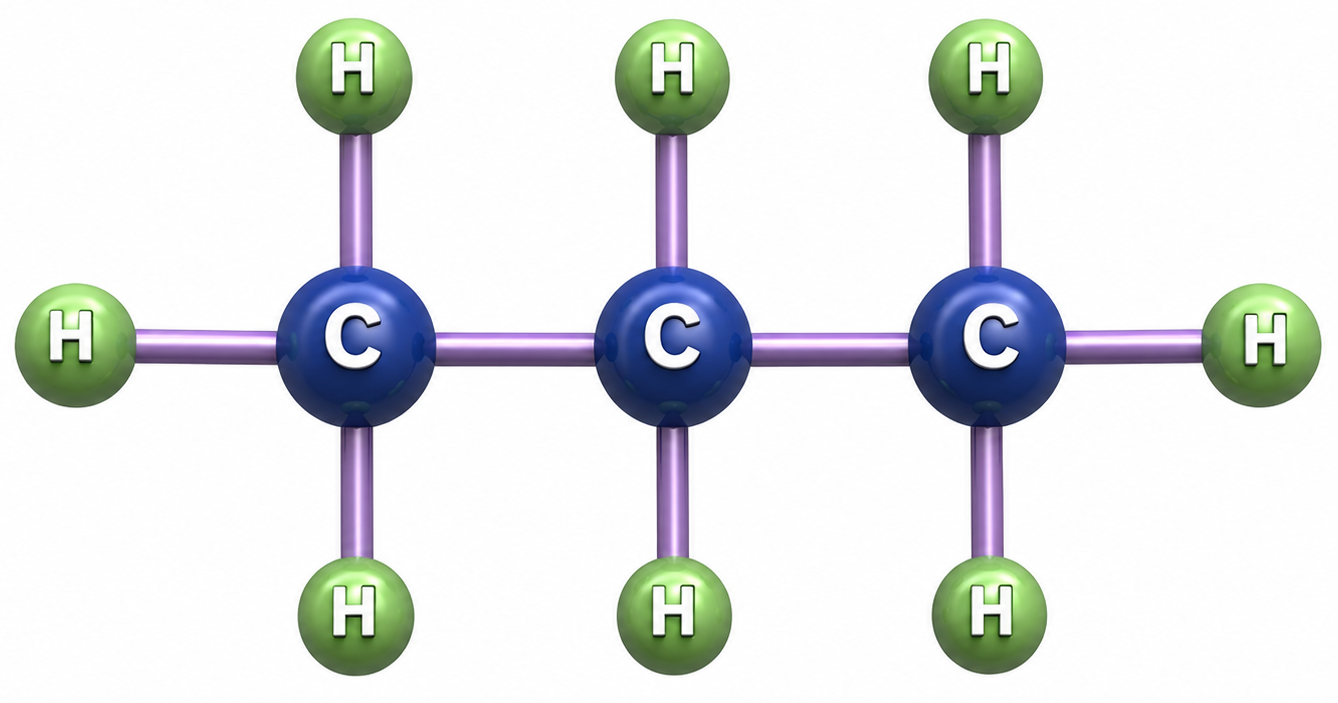
Explanation: In propane (C₃H₈), three carbon (C) atoms are combined with eight hydrogen (H) atoms, forming C₃H₈. This formula of propane (C₃H₈) is called its molecular formula.
Structural Formula: Representing the arrangement of atoms of elements in a molecule through symbols and bonds is called a structural formula.
Explanation: In the compound C₃H₈, the three carbon atoms are connected to one another in a chain-like manner, and the remaining valencies are satisfied by hydrogen atoms so that the valency of each carbon becomes 4.
Structural formula of propane:
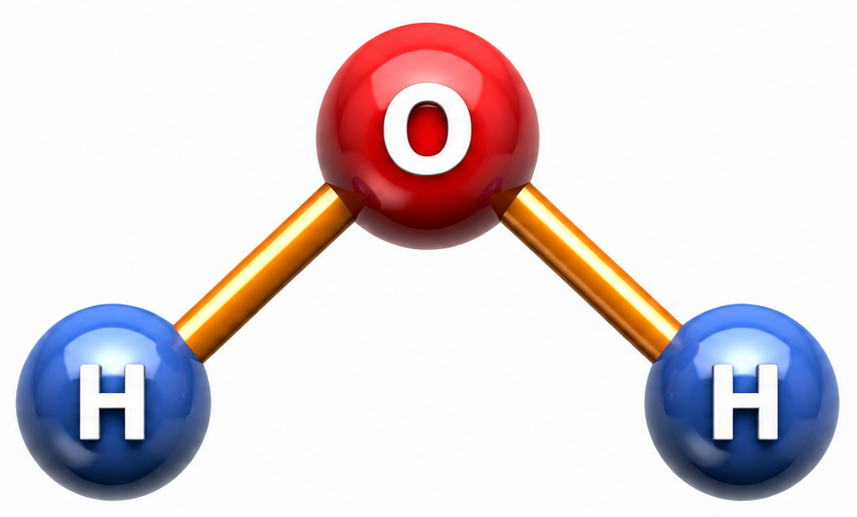
The molecular formula of water is H₂O; therefore, its structural formula is :
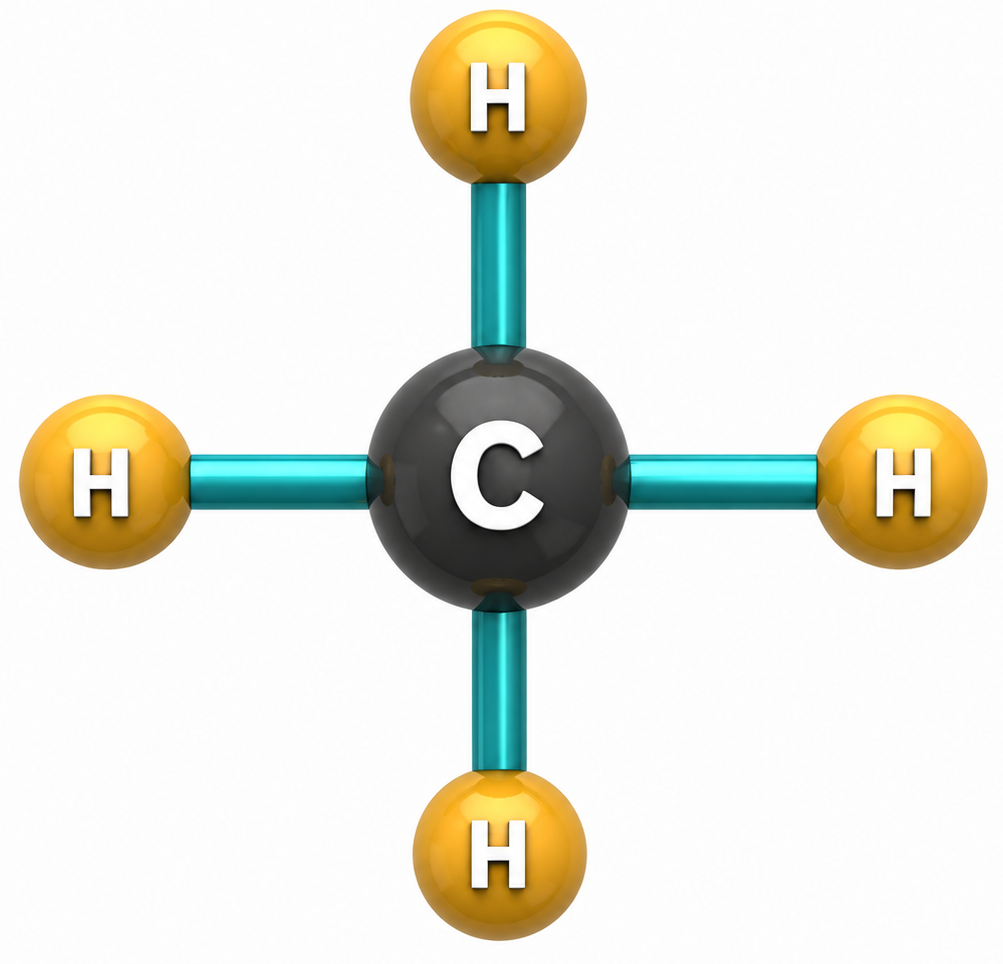
The molecular formula of methane is CH₄; therefore, its structural formula is :
Note:
Here, each line between carbon–carbon and carbon–hydrogen represents a bond. These are covalent bonds. Through a structural formula, it can be determined how many atoms of each element are present in a compound molecule and how they are connected to one another.
Octet Rule and Duplet Rule
Octet Rule: Every element tends to attain the electron configuration of a noble gas in its outermost energy level. During molecule formation, an element achieves the electron configuration of a noble gas by gaining, losing, or sharing electrons so that it has 8 electrons in its outermost energy level. This is called the octet rule.
Explanation:
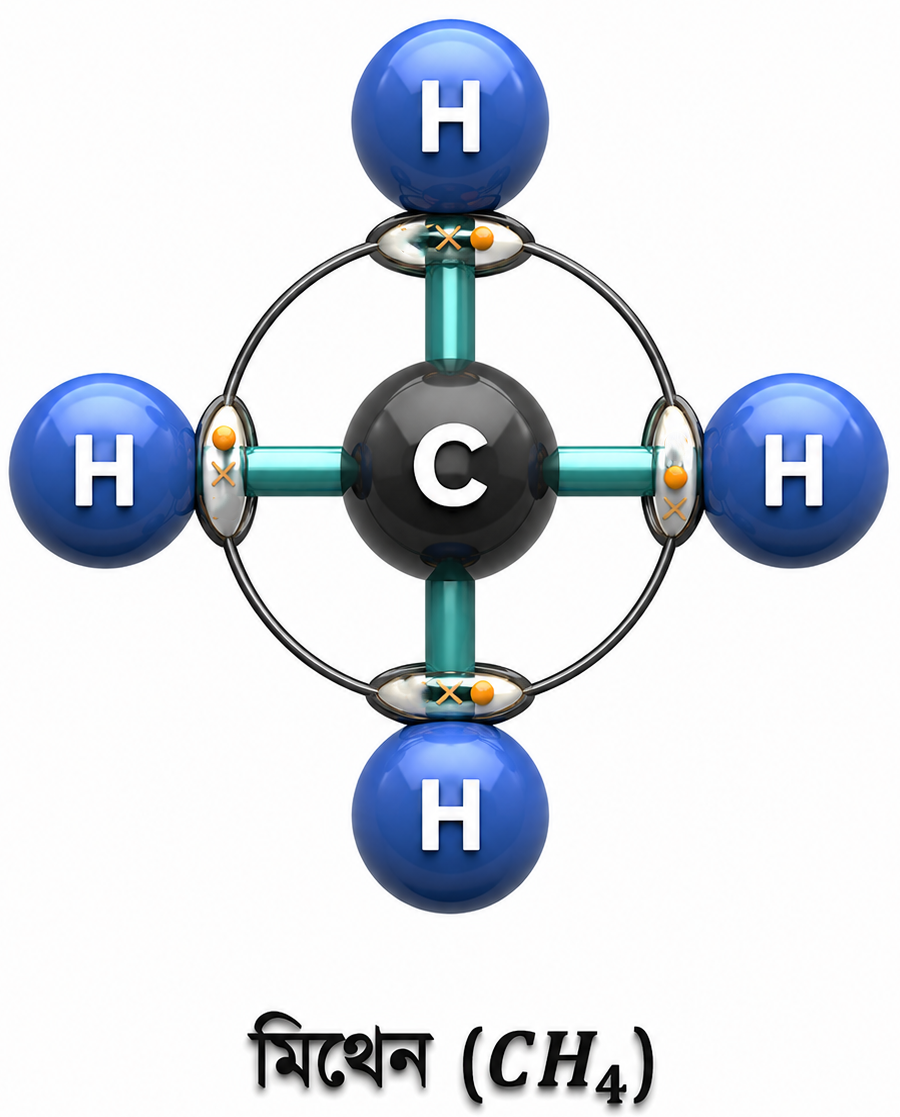
In the CH₄ molecule, the central carbon atom has 4 electrons in its outermost energy level, where 4 electrons belong to carbon itself and the remaining 4 electrons come from hydrogen atoms. In this way, atoms hold 8 electrons in their outermost energy level through the sharing, gain, or loss of electrons and attain the electron configuration of a noble gas. The process of compound formation in this manner is called the octet rule.
Note:
i. Except for helium (He), all noble gases have 8 electrons in their outermost energy level.
ii. The elements from 1–20 in the periodic table follow the octet rule quite well.
Some Exceptions to the Octet Rule
SF₄, PCl₅, BF₃, and LiF do not follow the octet rule.
Reason why SF₄ does not follow the octet rule:
⇒ S(16) = 1s²2s²2p⁶3s²3p⁴
F(9) = 1s²2s²2p⁵
Atoms of different elements attain an octet electron configuration in their outermost energy level through the transfer and sharing of electrons among themselves. This is called the octet rule.
In the SF₄ compound, one sulfur atom forms a compound with four fluorine atoms through electron sharing. As a result, for each F atom to complete its octet, a total of 10 electrons are found in the outermost energy level of S. That is, the S atom does not follow the octet rule. This is called octet expansion.
Duplet Rule
Definition: In noble gases, the outermost energy level contains either 2 electrons (in the first shell) or 8 electrons. Similarly, during molecule formation, if an atom has one or more pairs of electrons in its outermost energy level, it follows the duplet rule.

Explanation: In the BeCl₂ compound, the central Be atom has 2 pairs, that is, 4 electrons in its outermost energy level. As a result of sharing with Cl, Be obtains 4 electrons in its outermost energy level. Therefore, it does not follow the duplet rule.
That is, in a molecule, the outermost energy level of any atom will contain one or more pairs of electrons.
Note:
i. The elements from 1–20 in the periodic table follow the duplet rule quite well.
ii. Due to certain limitations of the octet rule, scientists developed the duplet rule.
Noble Gases and Electron Configuration.
He(2) → 1s²
Ne(10) → 1s²2s²2p⁶
Ar(18) → 1s²2s²2p⁶3s²3p⁶
Kr(36) → 1s²2s²2p⁶3s²3p⁶3d¹⁰4s²4p⁶
Xe(54) → 1s²2s²2p⁶3s²3p⁶3d¹⁰4s²4p⁶4d¹⁰5s²5p⁶
Rn(86) → 1s²2s²2p⁶3s²3p⁶3d¹⁰4s²4p⁶4d¹⁰4f¹⁴5s²5p⁶5d¹⁰6s²6p⁶
It is observed from the electron configurations of noble gas atoms that:
✅️Helium has 2 electrons in its outermost energy level. Since only 2 electrons are required to complete the outermost energy level of helium, its electron configuration is stable.
✅️In the case of the other noble gases, their outermost energy level contains 8 electrons (ns²np⁶). They become most stable when they attain an electron configuration similar to that of a noble gas.
✅️Other elements tend to complete a duplet or an octet in their outermost energy level in order to attain stability. Therefore, they form compounds by losing, gaining, or sharing electrons in their outermost energy level.
Chemical Bond and the Cause of Ionic Bond Formation
Definition: The force of attraction by which atoms remain connected to one another in a molecule is called a chemical bond.
Main Cause of Chemical Bond Formation: During chemical bond formation, the electrons in the outermost energy level seek to attain the stable electron configuration of a noble gas (a duplet or an octet).
For example, in the formation of an H₂ molecule, two H atoms share one electron each.
Thus, bonds are formed through the transfer or sharing of electrons.
Necessary Information for Chemical Bond Formation:
i. The electrons in the outermost energy level of an element participate in bond formation.
ii. Every atom aims to attain the electron configuration of its nearest noble gas.
iii. Elements with atomic numbers 1–17 very easily follow the duplet or octet rule during bond formation.
Cation and Anion
Cation: A positively charged atom is called a cation.
Explanation: If one or more electrons are removed from the outermost energy level of a neutral atom, the atom will no longer remain neutral. It will generally be converted into a positively charged ion.
The elements that have a small number of electrons in their outermost energy level have those electrons located farther from the nucleus compared to other elements in the same period. As a result, they are weakly attracted to the nucleus and tend to lose electrons in order to complete a duplet or an octet.
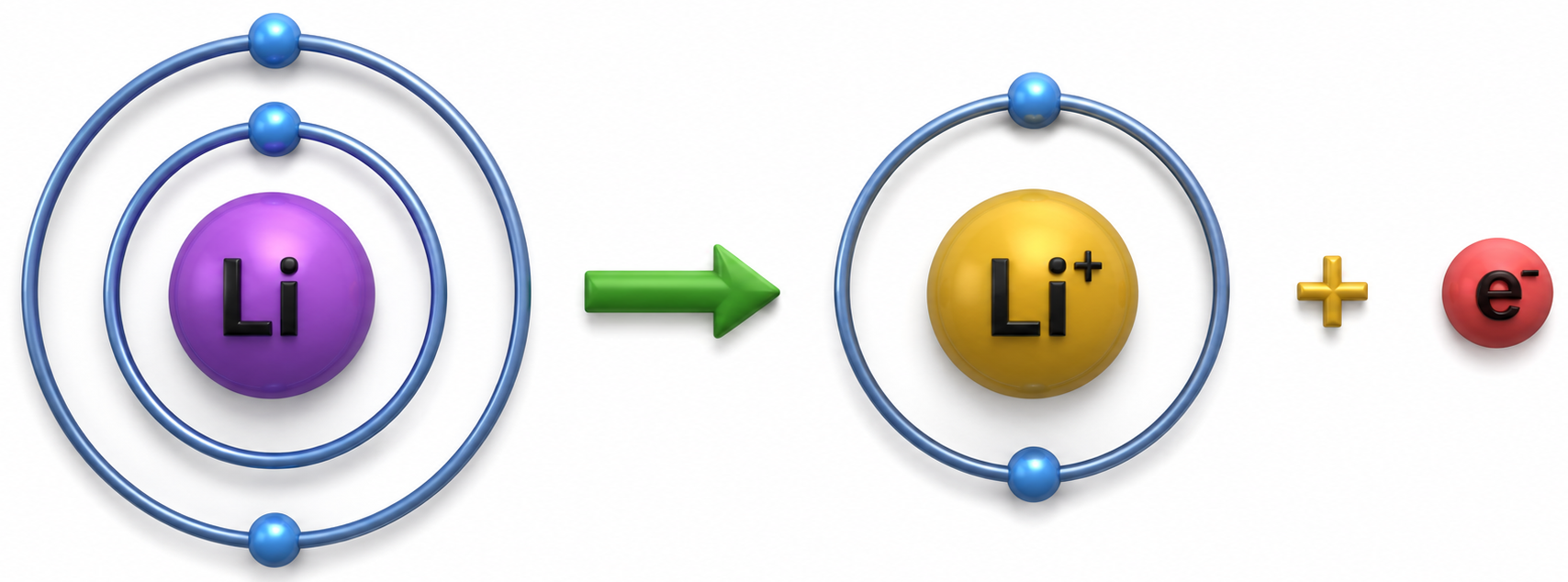
Figure: Lithium Cation (Li⁺)
Li atom forms the Li⁺ cation (Li⁺) by losing one electron from its outermost energy level and thereby attaining the electron configuration of the noble gas helium (He).
Anion: A negatively charged atom is called an anion.
Explanation: The elements whose outermost energy level has an incomplete octet generally lack 1, 2, or 3 electrons. By gaining that number of electrons, they can easily attain the stable electron configuration of a noble gas. In other words, they have a greater tendency to gain electrons rather than lose them.
In these atoms, the number of electrons becomes greater relative to the number of protons in the nucleus, and their negative charge increases. Therefore, such atoms generally become negatively charged ions. A negatively charged ion formed in this way is called an anion.
For example:
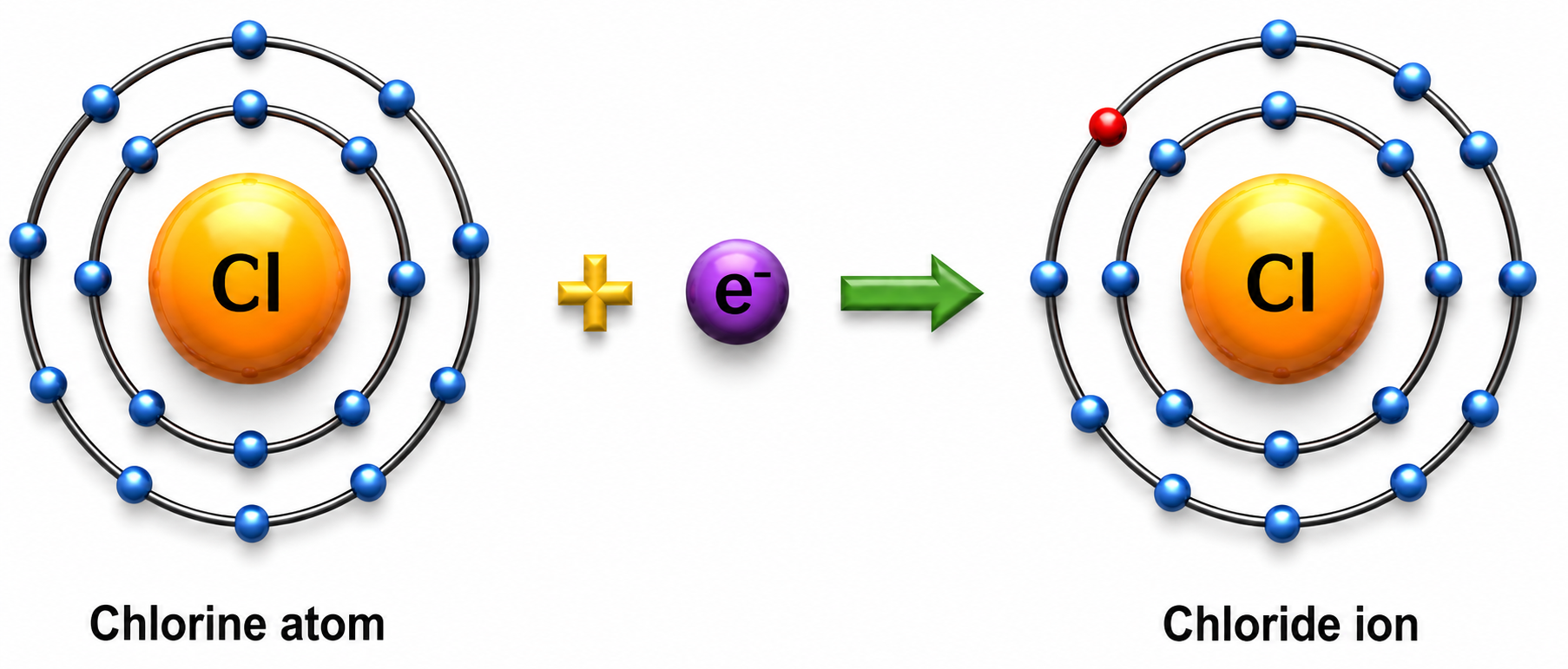
A chlorine (Cl) atom gains one electron and attains the electron configuration of the noble gas argon (Ar), thereby forming the chloride ion (Cl⁻).
Ionic Bond or Electrovalent Bond
Definition: The electrostatic force of attraction by which cations and anions formed through the transfer of electrons are held together is called an ionic bond.
Explanation: Because metals have low ionization energy, they can very easily lose one or more electrons from their outermost energy level and form positive ions or cations. On the other hand, non-metals have a greater tendency to gain electrons, so they accept electrons and form negative ions or anions.
In this way, the oppositely charged cations and anions that are formed remain bound together by the force of electrostatic attraction. Through this force, they stay connected to one another. This is called an ionic bond.
For example: Ionic bonding in the MgO compound –
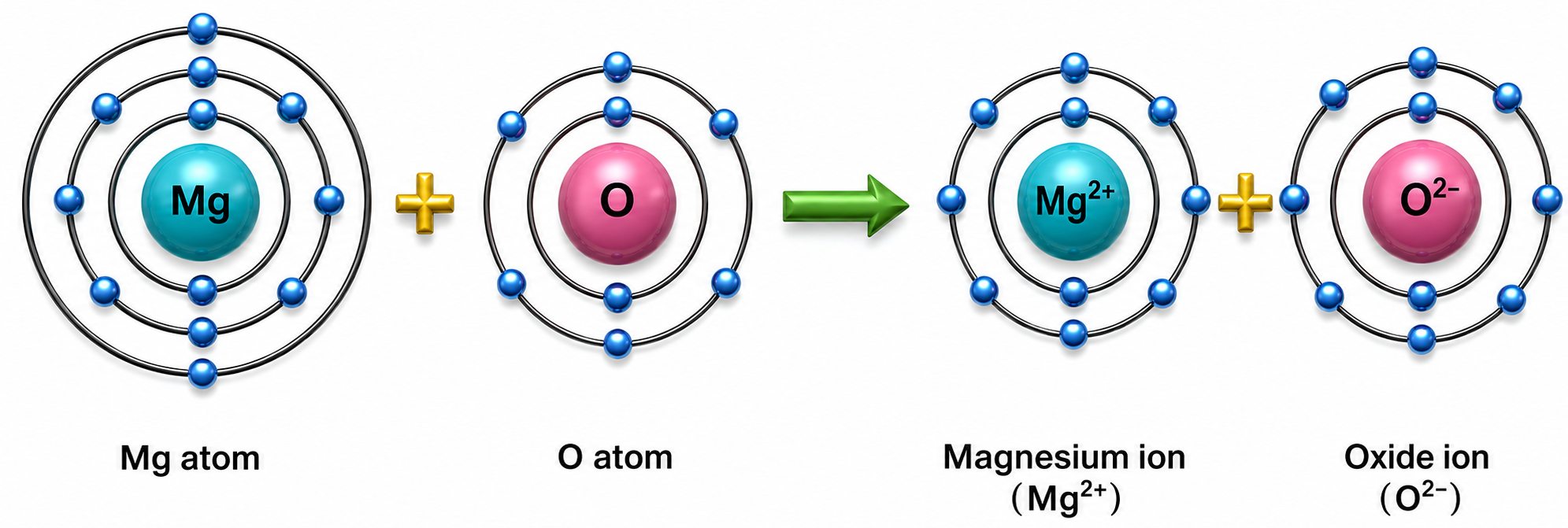
In the MgO molecule, Mg loses 2 electrons and attains an electron configuration similar to that of the noble gas Ne. That is, by losing 2 electrons from its outermost energy level, it is converted into Mg²⁺.

Again, the O atom gains those 2 electrons and attains an electron configuration similar to that of the noble gas Ne. That is, by gaining 2 electrons in its outermost energy level, it is converted into O²⁻.

Then Mg²⁺ and O²⁻ come close to each other and form an ionic bond.
Exception: (i) The element Al of Group 13 forms ionic bonds even though it does not belong to Group 1 or Group 2 elements.
Covalent Bond
Definition: A bond formed through the sharing of electrons in order for atoms to attain a stable electron configuration in their outermost energy level is called a covalent bond.
Explanation: In a covalent bond, atoms share electrons and thereby attain an electron arrangement close to a stable configuration in their outermost shell. The atoms achieve the electron configuration of a noble gas through electron sharing and attain stability. As a result, atoms form covalent bonds by sharing electrons in their outermost energy level.
For example:
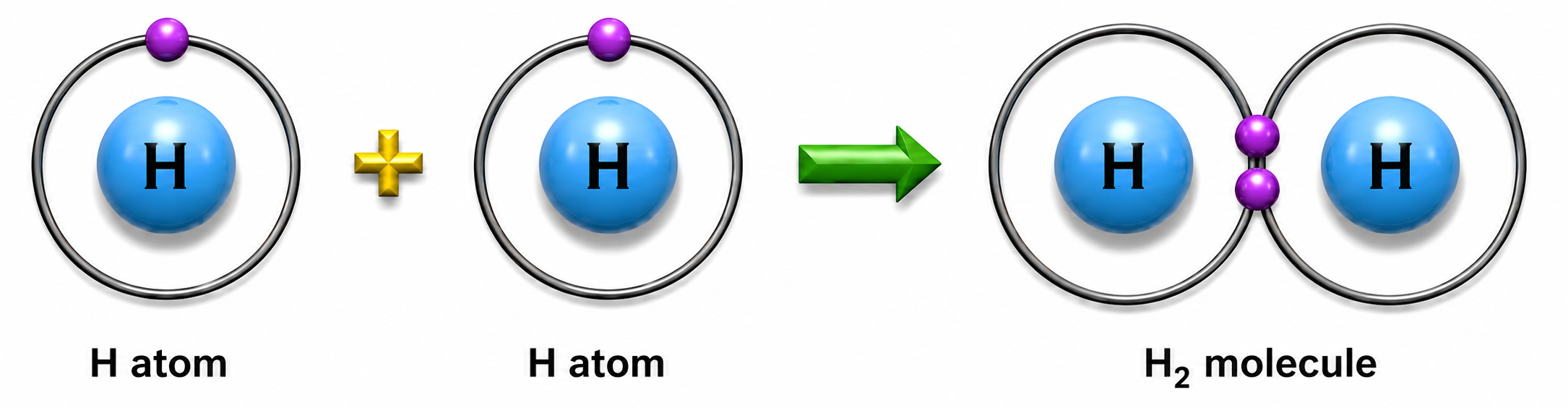
Figure: Formation of a Covalent Bond in an H₂ Molecule
The electron configuration of the H atom is:
H(1) → 1s¹
When two H atoms come close to each other, the two atoms share one electron each and attain an electron configuration similar to that of a noble gas. That is, each atom attains 2 electrons in its outermost energy level and remains bonded through a covalent bond.
Characteristics of Ionic and Covalent Bonds
Melting Point and Boiling Point :
➤ Ionic compounds contain positive and negative ions. These ions are held together with one another.
➤ In ionic compounds, numerous positive and negative ions remain close to one another and are arranged in a three-dimensional manner to form a complex structure.
➤ As a result, the interionic force of attraction becomes very strong.
➤ Therefore, a large amount of heat is required to separate them from one another. Consequently, their melting points and boiling points are high.
On the other hand,
➤ In covalent molecules, intermolecular attraction mainly arises due to weak van der Waals forces. Therefore, the intermolecular force of attraction is much lower.
➤ As a result, only a small amount of heat is needed for the molecules to move away from one another. That is, their melting points and boiling points are low.
Solubility :
➤ When an ionic compound is added to water, the positive end of the water molecule attracts the negative end or anion of the ionic compound.
➤ With a few exceptions, almost all ionic compounds are soluble in water.
➤ Although AgCl is an ionic compound, it remains insoluble in water.
On the other hand,
➤ In covalent compounds, positive and negative ends like those in ionic compounds are not formed, so attraction and repulsion do not occur in the same way.
➤ A covalent compound does not break into ions in water; therefore, the covalent compound is not soluble in water.
➤ However, some covalent compounds develop partial positive and negative ends; that is, they exhibit polarity.
For example: ethanol (C₂H₅OH), HCl, etc.
Electrical Conductivity
Ionic Compounds :
➤ Ionic compounds conduct electricity in aqueous solution.
➤ In an aqueous solution of common salt (NaCl), Na⁺ acts as the positive ion and Cl⁻ acts as the negative ion to conduct electricity.
➤ Since ionic compounds exist as separate positive and negative ions in aqueous solution, all ionic compounds conduct electricity in aqueous solution.
➤ For example, in a CaCl₂ solution, Ca²⁺ and Cl⁻ ions are present, and they conduct electricity.
Covalent Compounds :
➤ Covalent compounds do not conduct electricity.
➤ These compounds do not contain the ions necessary for electrical conduction.
➤ Covalent compounds do not form separate ions; and if there are no ions in a solution, it can never conduct electricity.
Note: Ionic compounds do not conduct electricity in the solid state; they conduct electricity only in aqueous solution.
Metallic Bond
Definition: The force of attraction by which metal atoms remain bonded to one another is called a metallic bond.
Explanation: In other words, the attraction through which atoms remain connected within a piece of metal is called a metallic bond.
➤ In copper wires, iron-made knives and forks, aluminum-made windows, and gold ornaments, countless atoms of the same metal are connected to one another through metallic bonds.
➤ In metals, atoms lose one or more electrons from their outermost energy level and become positive ions; these positive ions are called atomic cores.
➤ The electrons released by metal atoms move around in the spaces between the cores, and these are called delocalized electrons.
Electrical Conductivity and Thermal Conductivity of Metals
➤ If one end of a piece of metal is heated by placing it over a flame, it will be observed that the other end starts to become hot quite quickly. This means that metals exhibit thermal conductivity.
➤ Delocalized electrons absorb energy, causing their speed to increase. These electrons absorb more thermal energy and move rapidly toward the cooler end. As a result, heat is transferred from one end of the metal to the other.

Edutrack BD
শিক্ষার আলো ছড়িয়ে দিতে আমরা প্রতিশ্রুতিবদ্ধ। নির্ভরযোগ্য নোট, সাজেশন, গাইডলাইন ও সহজ ব্যাখ্যার মাধ্যমে শিক্ষার্থীদের সফলতার পথে এগিয়ে নিতে Edutrack BD সবসময় পাশে আছে। শেখা হোক সহজ, প্রস্তুতি হোক স্মার্ট।
Categories
- Chemistry (2)
- Class 8 (4)
- General Math ( Bangla Version ) (2)
- Higher Math (2)
- HSC (10)
- HSC Physics 2nd Paper Notes ( English Version ) (1)
- ICT (2)
- ICT ( English Version ) (1)
- Math (1)
- Math ( English Version ) (1)
- Physics ( Bangla Version ) (1)
- Physics ( Englisg Version ) (1)
- Science ( Bangla Version ) (1)
- Science ( English Version ) (1)
- SSC ( Bangla Version ) (1)
- SSC ( English Version ) (9)
- Uncategorized (1)