

- SSC Chemistry Chapter 8 Notes PDF – Chemistry and Energy
- Classification of chemical reactions:
- Calculation of the change in heat of a chemical reaction:
- Uses related to chemical energy
- Adverse effects of the use of chemical energy:
- Chemical reactions with the help of electricity
- i. Electrolytic cell:
- ii. Galvanic cell:
- Conductors are generally of two types:-
- Electrolyte:
- i. Strong electrolytes:
- ii. Weak electrolytes:
- Solutions related to electrolysis techniques
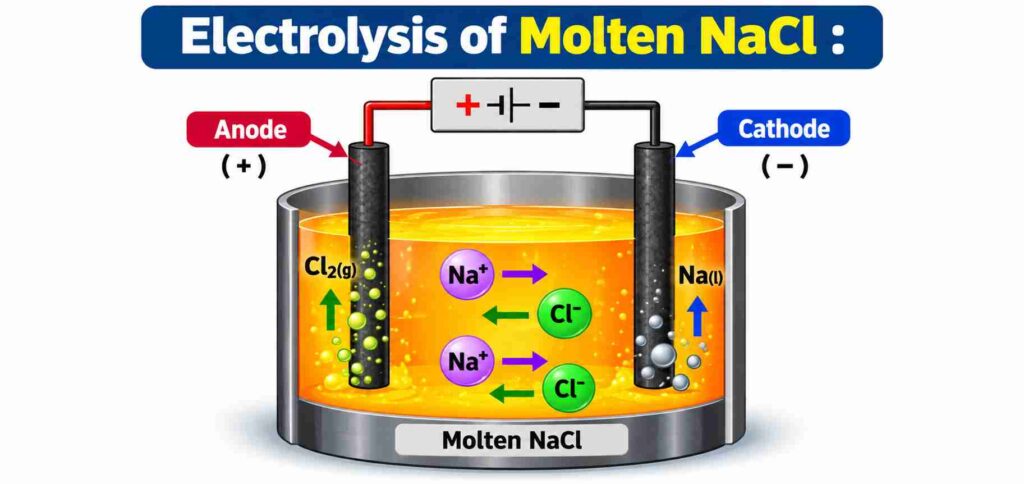
- i. Electrolysis of molten NaCl:
- ii. Electrolysis of concentrated NaCl solution:
- iv. H2O electrolysis of pure water:
- v. MgCl2 electrolysis of Magnesium chloride:
- vi. PbCl2 electrolysis of Lead chloride:
- Describe nickel plating on an iron-made spoon
- Production of electricity through chemical reactions
- i. Construction of the galvanic cell or the technique of electricity production
- Salt bridge and its uses:
- ii. Construction of the dry cell and the technique of electricity production:
ii. Electrolysis of concentrated NaCl solution:
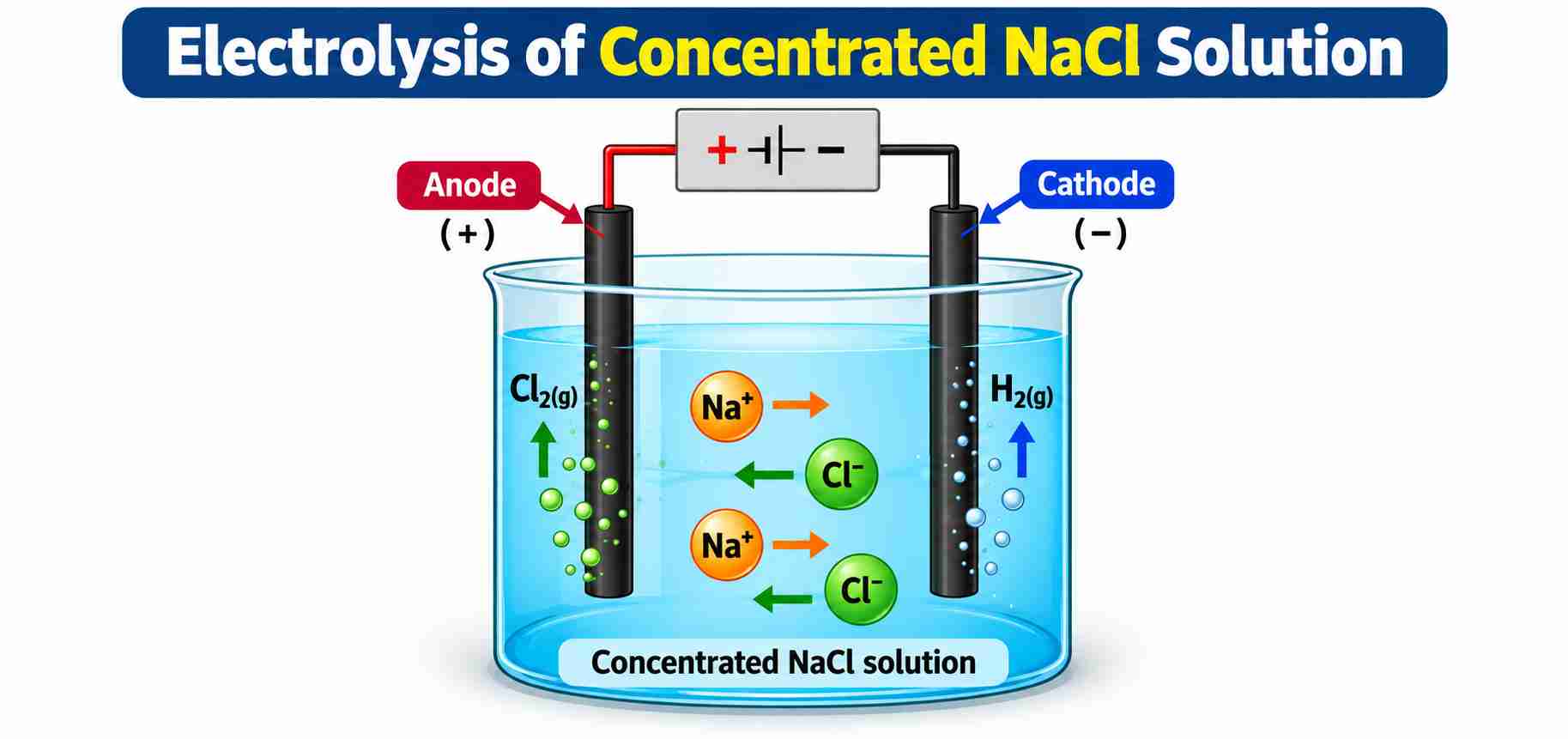
In concentrated sodium chloride solution, NaCl ionizes and produces Na+ and Cl− ions. NaCl → Na+ + Cl−. Like molten sodium chloride, only these two ions are not present. Here, a small amount of the water molecules ionize and produce H+ and OH−. H2O → H+ + OH−. During the electrolysis of NaCl in the electrolytic cell, when electric current flows, Na+ and H+ rush toward the cathode at the same time. We know that, compared to the Na+ ion, H+ accepts one e− and is converted into that atom; two hydrogen atoms combine and produce H2
Cathode reaction:
H+ + e− → H
H + H → H2
At the anode, Cl− and OH− go at the same time. Here the Cl− ion gives up one electron at the anode electrode and is converted to a Cl atom; two chlorine Cl atoms combine together and produce a Cl2 molecule—
Anode reaction:
Cl → Cl− + e− (oxidation)
Cl + Cl → Cl2 In the solution, Na+ and OH− ions combine and form NaOH.
iv. H2O electrolysis of pure water:
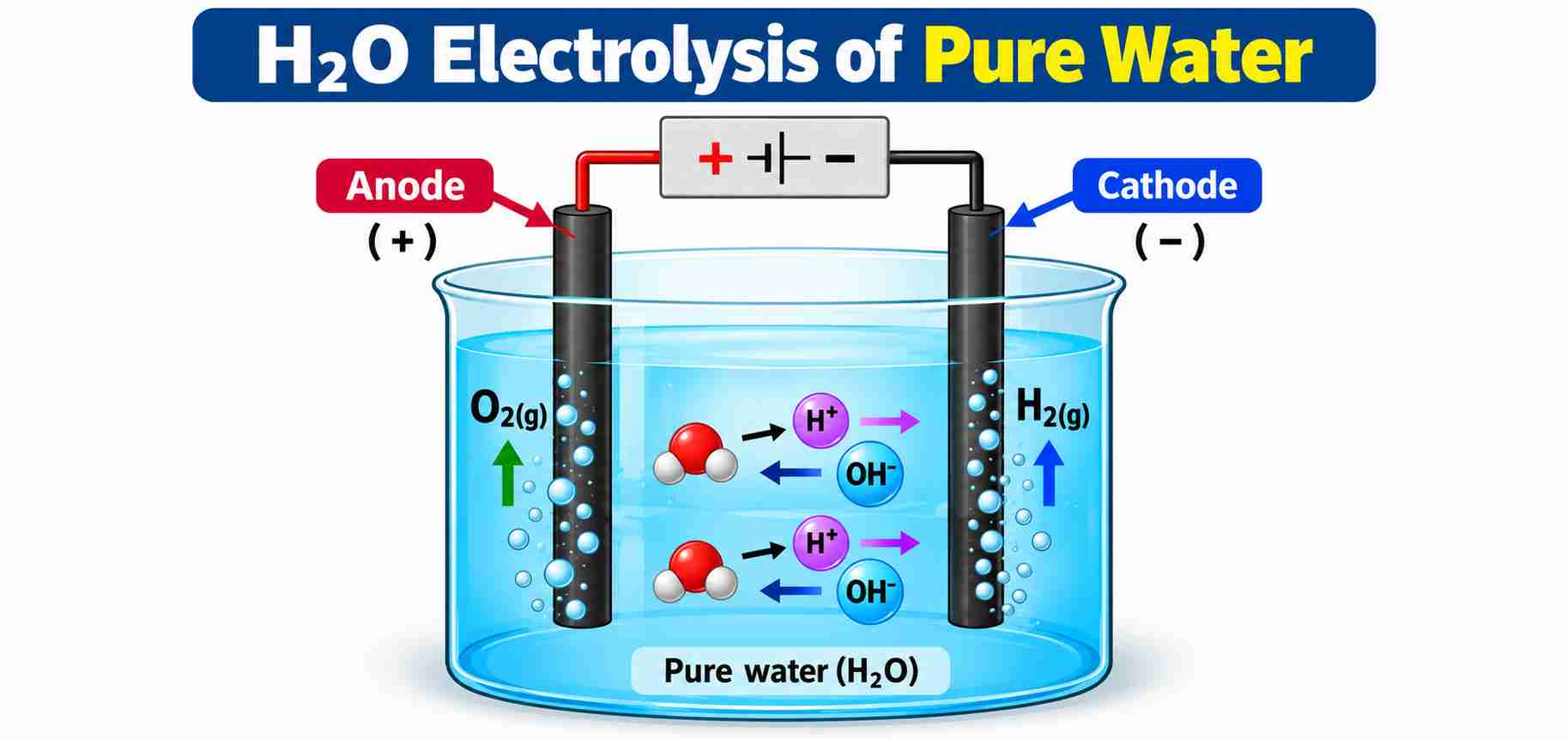
Pure water is ionized (dissociated) to a very small extent. To increase the amount of ionization of water, an equal amount of H2SO4 acid is added to it, as a result of which the water dissociates.
H2O ⇌ H+ + H−
Here, when electric current is passed with the help of a battery, OH− ions are produced at the anode and H+ ions at the cathode.
Cathode reaction = 2H+ + 2e− → H2
Anode reaction = 4OH− − 4e− → O2 + 2H2O
v. MgCl2 electrolysis of Magnesium chloride:
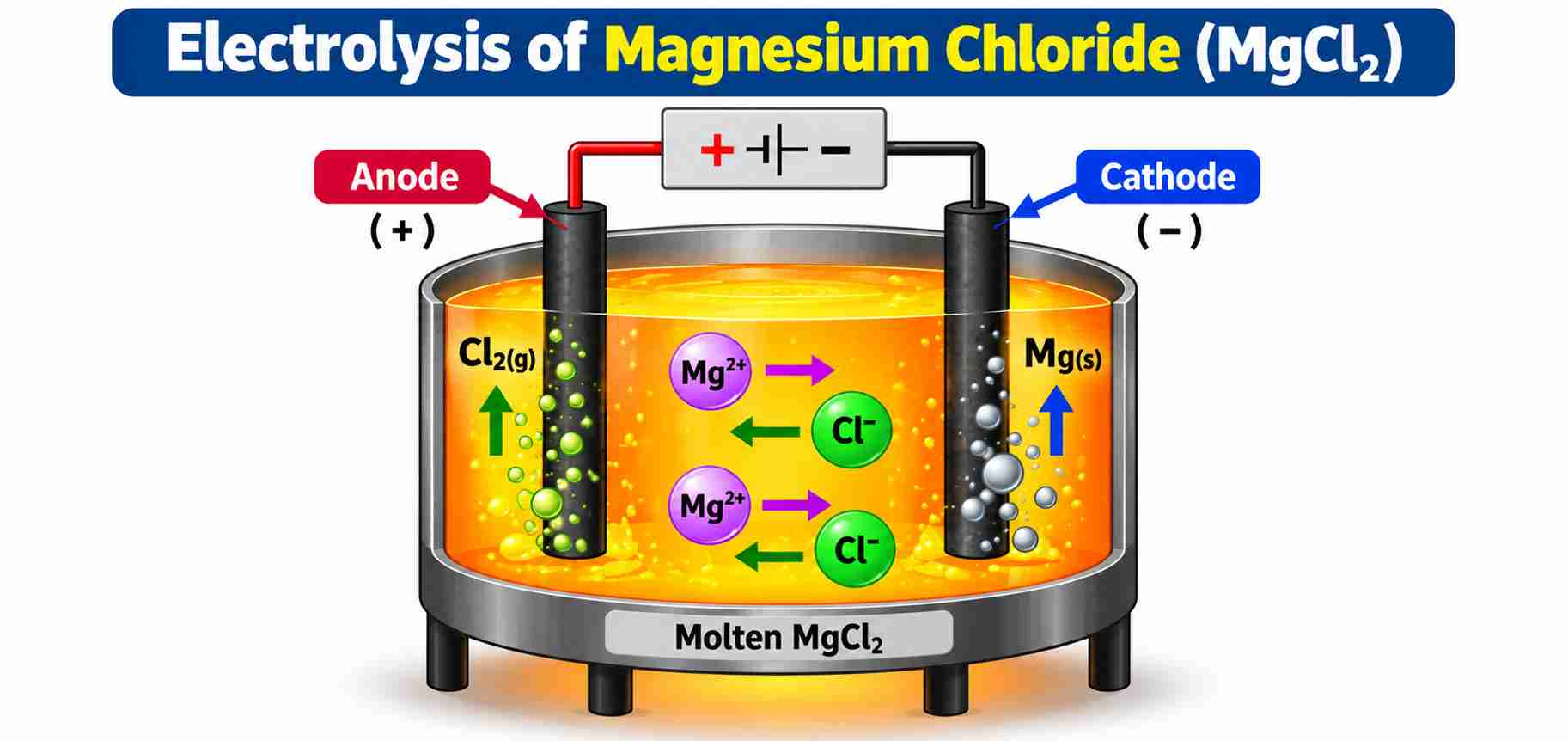
Electrolysis ionizes in the aqueous solution.
MgCl2 = Mg2+ + 2Cl−
Since water H2O itself is also an electrolyte, it also ionizes by itself.
H2O = H+ + OH−
When electric current is passed through the solution, Mg2+ and H+ will go toward the cathode together. But since H+ ions have a greater tendency than Mg2+ ions to accept electrons, the H+ ion accepts 1 electron from the cathode and is converted into that [atom]; two such atoms combine together and produce an H2 molecule.
Cathode reaction: H+ + e− → H (reduction)
H + H → H2
At the anode, Cl− and OH− go at the same time. Although the tendency of OH− to donate electrons is greater than that of the Cl− ion, the concentration of Cl− ions in the solution is much greater than the concentration of OH ions. So the Cl− ion first donates an electron at the anode and is converted into a Cl atom. Later, two Cl atoms combine together and produce a Cl2 molecule.
Anode reaction: Cl− → Cl + e− (oxidation reaction)
Cl + Cl → Cl2
Therefore, in the electrolysis, in MgCl2 aqueous solution, Cl2 gas is produced at the anode and H2 gas at the cathode, and Mg2+ + OH− → Mg(OH)2 is produced.
vi. PbCl2 electrolysis of Lead chloride:
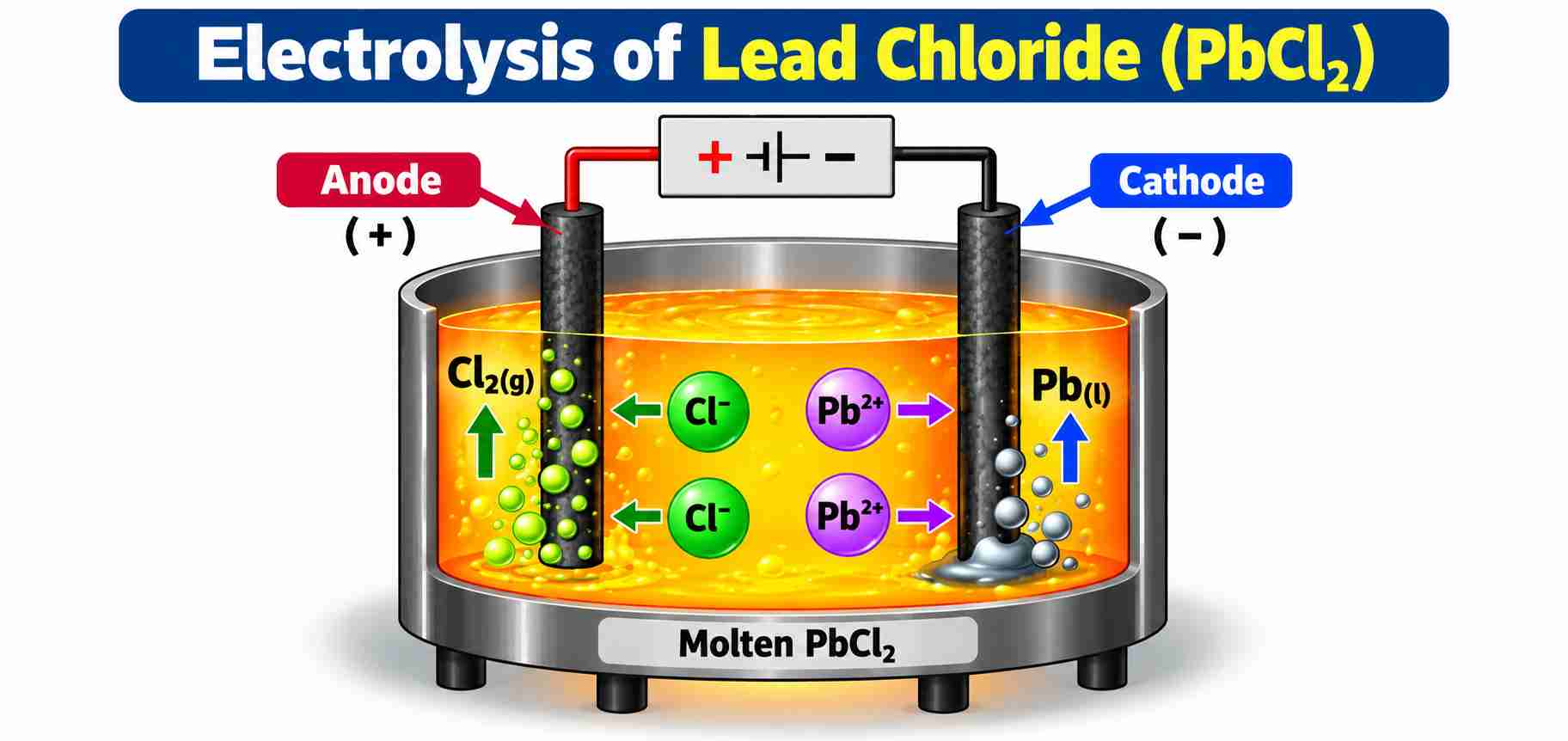
Here,
PbCl2 = Pb2+ + 2Cl−
and H2O = H+ + OH−
Cathode reaction:
H+ + e− → H
H + H → H2
Anode reaction:
Cl− → Cl + e−
Cl + Cl → Cl2
Therefore, in aqueous solution Cl2 gas and H2 gas are produced and Pb2+ + OH− → Pb(OH)2 is produced.
For nickel plating on an iron spoon, a nickel rod is used as the anode in the electrolytic cell. An iron spoon is used as the cathode, and a salt of nickel such as NiSO4 is used as the electrolyte. Now when electric current is passed through the NiSO4 solution by a battery, from the nickel rod used as the anode, the metallic nickel atoms give up two electrons, are converted to Ni2+ ions and go into the solution. And in the solution the Ni2+ ions accept electrons from the cathode electrode and are converted to metallic nickel and stick to the cathode (spoon). Thus a plating of nickel is deposited on the iron spoon.
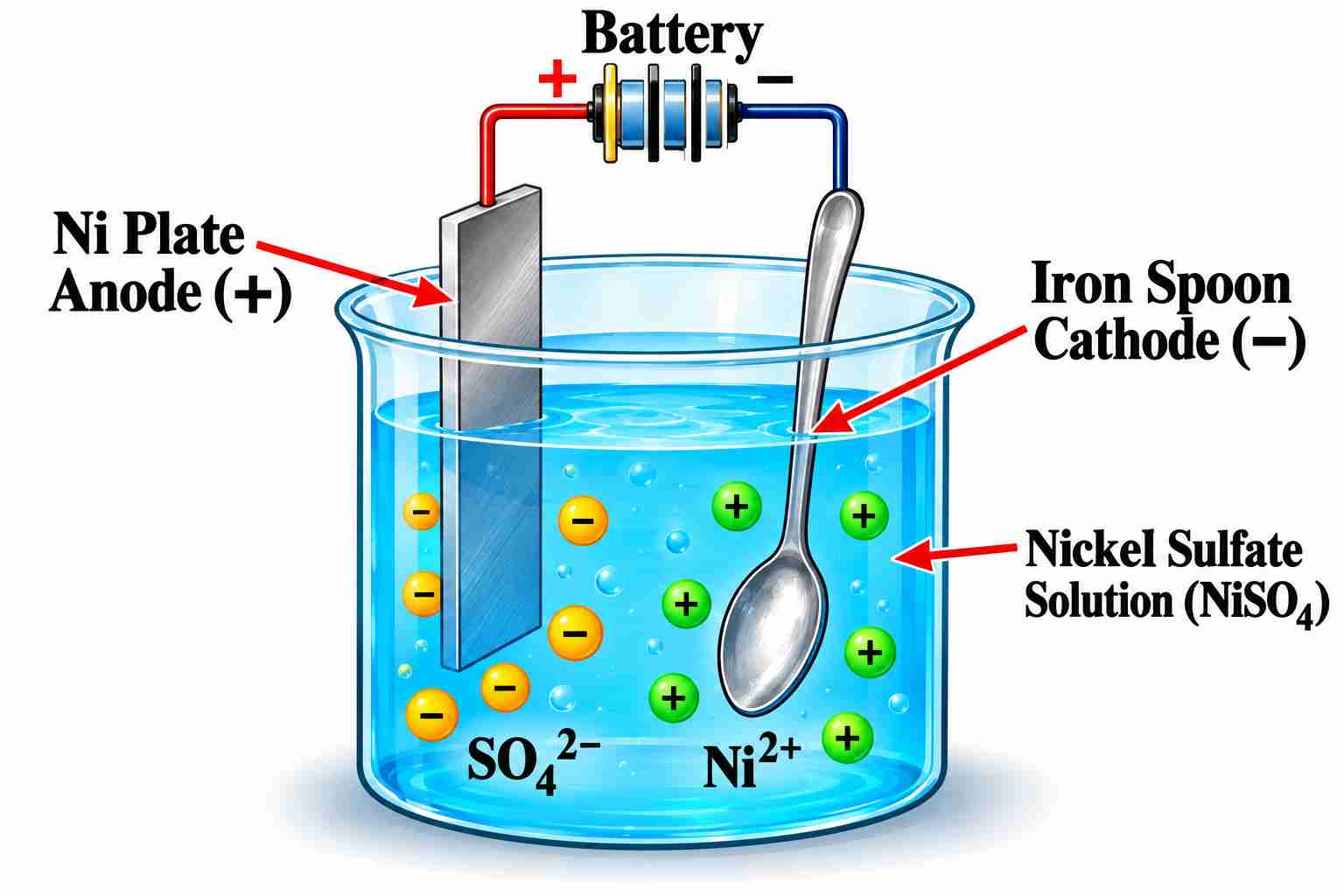
NiSO4 ⇌ Ni2+ + SO42−
Anode reaction:
Ni → Ni2+ + 2e−
Cathode reaction:
Ni2+ + 2e− → Ni
i. Construction of the galvanic cell or the technique of electricity production
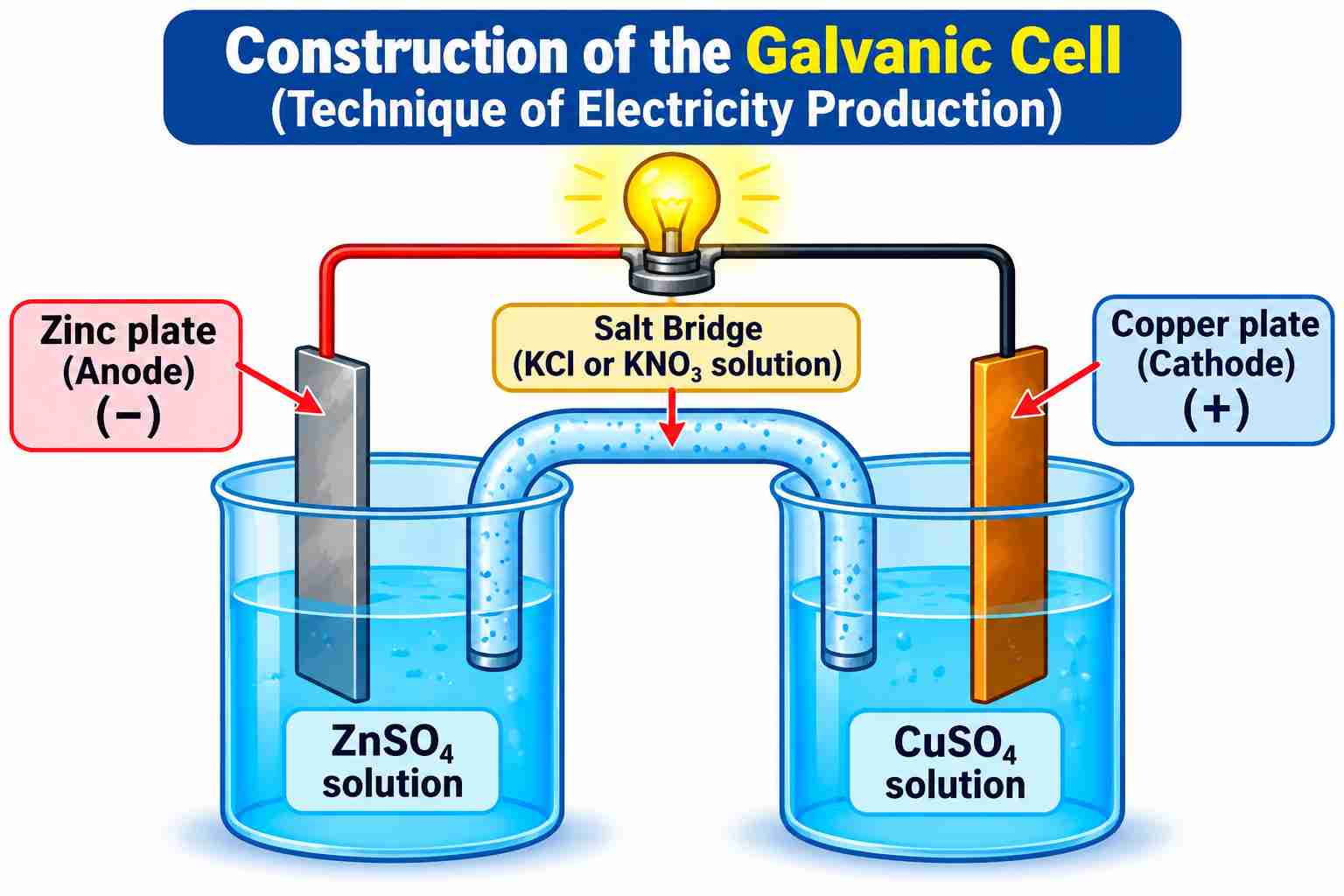
This is a galvanic cell or Daniell cell. In clay (earthen) pots, one has zinc sulfate solution and the other copper sulfate solution. The copper rod is kept immersed in the aqueous solution of copper sulfate, and the zinc rod is kept immersed in the zinc sulfate solution.
To establish a connection between the two vessels, a U-shaped tube filled with an inactive electrolyte (KCl) solution is immersed in both vessels. Now connect the two electrodes with a wire. Then the following oxidation-reduction reactions will take place spontaneously.
Anode reaction: Zn → Zn2+ + 2e−
Cathode reaction: Cu2+ + 2e− → Cu
Over all Reaction : Zn + Cu2+ → Zn2+ + Cu
That is, the zinc Zn as anode releases electrons by itself and dissolves in the ionized solution as Zn2+ ions. On the other hand, the Cu2+ ions of the solution accept electrons from the cathode and are deposited as metal Cu at the cathode. In fact, the electrons produced at the anode reach the cathode through the wire and maintain the balance of electrons. Then, as soon as the two electrodes are connected by a wire, a flow of electrons from the anode to the cathode is created, that is, electron flow means electric current.
Salt bridge and its uses:
i. The salt bridge maintains the ionic balance between the two attractions.
ii. Maintains electrical neutrality.
iii. Establishes a connection between the two half-cells.
ii. Construction of the dry cell and the technique of electricity production:
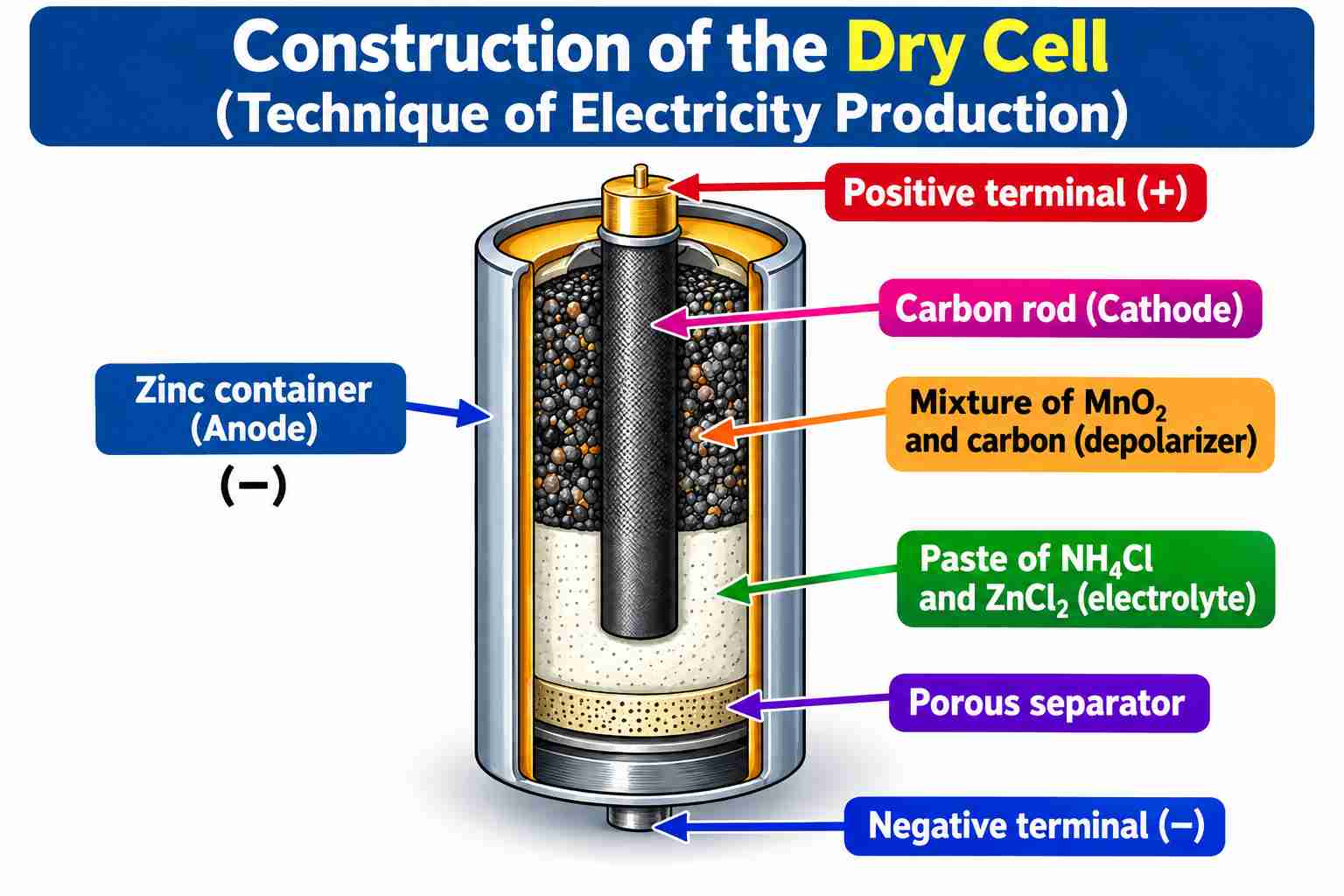
In the dry cell, we take a small jar-like can made of ordinary metallic zinc as the anode; we fill this can with an electrolyte solution of MnO2 manganese dioxide. In this electrolyte solution we make a mixture of NH4Cl and ZnCl2. With this mixture we make a paste or slurry with water. To thicken this paste or slurry, a small amount of starch is added. With this paste we fill the zinc can; exactly in the middle of it a cathode rod is inserted: a carbon rod coated with a heavy coating of manganese dioxide as the cathode is inserted. Then one end of the battery works as the cathode. The other end works as the anode. The cathode toward the anode, and the anode toward the cathode, moves or attracts. As a result, electrons are exchanged between them; this exchange of e− is electric current, that is, this is how electricity is produced.
Zn ⟶ Zn2+ + 2e−
Cathode reaction:
2NH4+ + 2MnO2 + 2e− ⟶ 2NH3 + Mn2O3 + H2O
Overall cell reaction:
Zn + 2NH4+ + 2MnO2 ⟶ Zn2+ + 2NH3 + Mn2O3 + H2O